Why Is Pluto Not a Planet? The 2006 Decision Explained
Pluto lost its planet status in 2006. The three rules astronomers set for a planet, why Pluto fails one, and what New Horizons revealed about this icy world.
Short answer
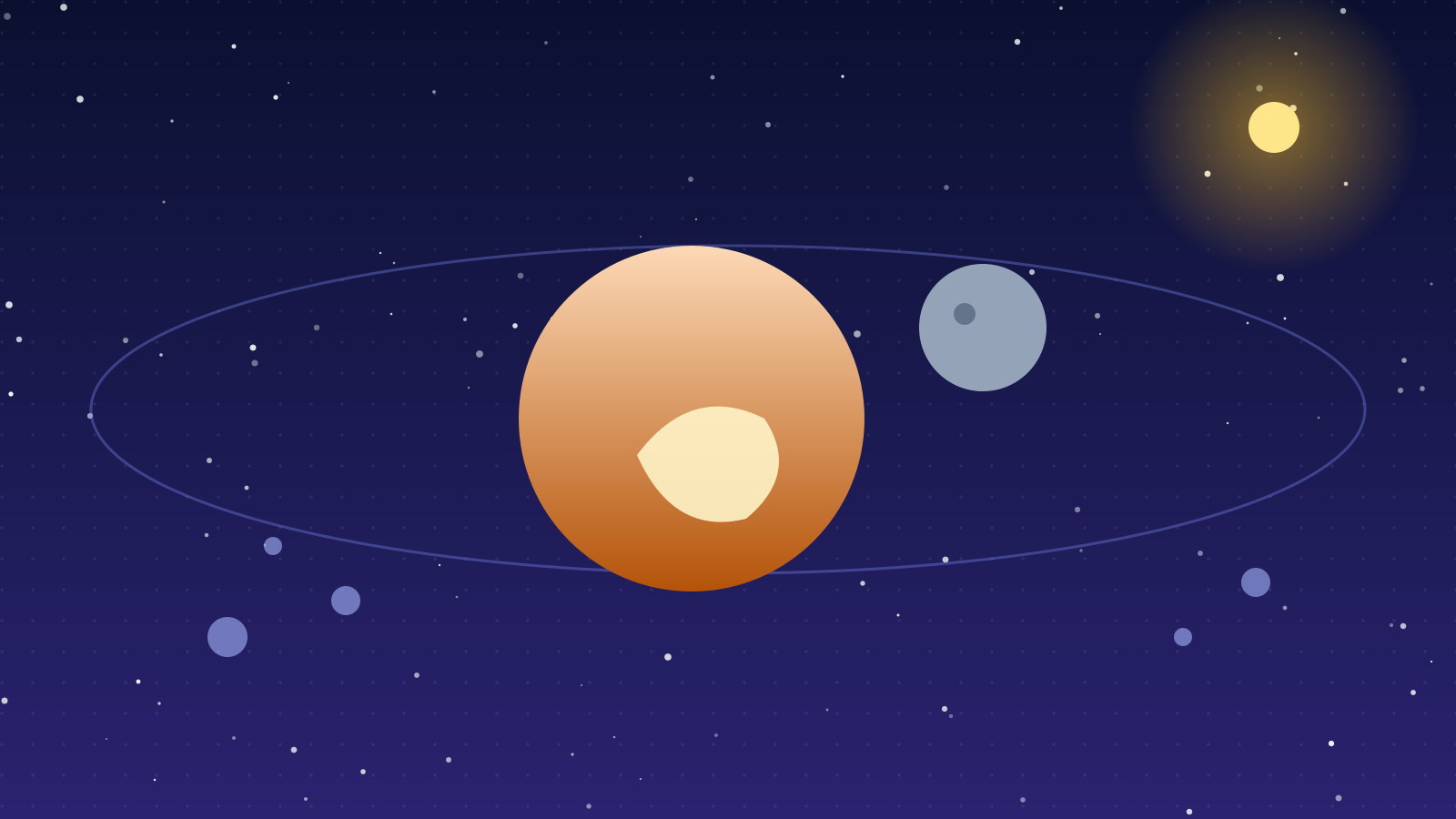
Pluto is no longer called a planet because in 2006 the International Astronomical Union (IAU) set three rules for a planet: it must orbit the Sun, be massive enough for its gravity to make it round, and have cleared the neighbourhood around its orbit of other objects. Pluto meets the first two but not the third, because it shares its region of space, the Kuiper Belt, with thousands of other icy bodies. It was therefore classed as a dwarf planet. The decision was prompted by the discovery of Eris in 2005, a distant world almost the same size as Pluto.
In this article (7)
For 76 years, every schoolchild learned that the solar system had nine planets, with little Pluto at the edge. Then, in August 2006, astronomers voted, and Pluto was out. Many people were upset. But the decision was not about Pluto changing; it was about astronomers finally deciding what a planet is.
Before 2006, there was no definition
Surprisingly, until 2006 there was no official scientific definition of the word “planet”. The ancient Greek word simply meant “wanderer”: a light that moves across the sky against the fixed stars. When Clyde Tombaugh discovered Pluto in 1930, it was called the ninth planet more or less automatically.
Over time, Pluto began to look odd. It is tiny, smaller than our Moon. Its orbit is tilted and so stretched that it sometimes comes closer to the Sun than Neptune. And from 1992 onwards, astronomers found more and more icy objects beyond Neptune, in a region called the Kuiper Belt. Pluto turned out to be one of the largest members of this crowd, not a lone world.
The trigger: Eris
In 2005, a team led by Mike Brown discovered Eris, a distant icy world roughly the same size as Pluto and slightly more massive. If Pluto was a planet, Eris had to be one too, and possibly dozens more would follow. Astronomers needed a rule.
The three tests
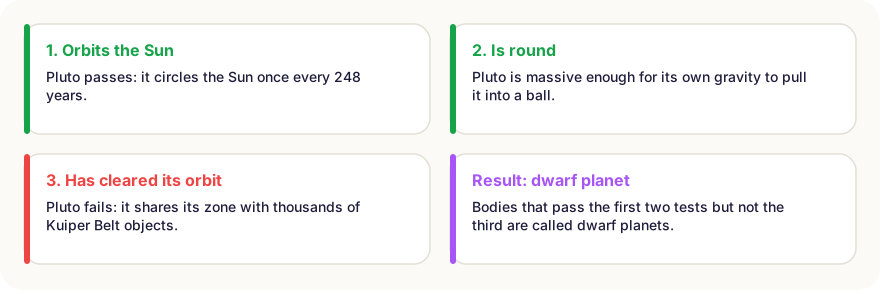
In 2006 the International Astronomical Union (IAU) decided that a planet is a body that:
- orbits the Sun;
- has enough mass for its own gravity to pull it into a nearly round shape;
- has cleared the neighbourhood around its orbit, meaning it is by far the dominant object in its zone.
Pluto passes the first two. But it fails the third: it shares its orbital zone with countless Kuiper Belt objects and its mass is tiny compared with the total of everything around it. Objects that pass the first two tests but not the third are called dwarf planets. Today the IAU recognises five: Ceres, Pluto, Eris, Haumea and Makemake.
How small is Pluto?
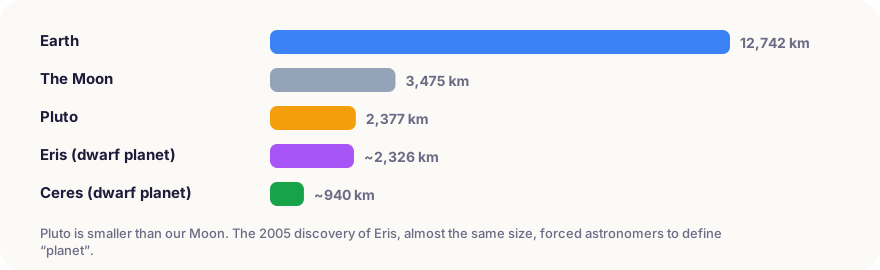
Pluto is about 2,377 kilometres across, smaller than our Moon and only about a fifth the width of Earth. It has five known moons; the largest, Charon, is half Pluto’s size, so large that the two orbit a point in the space between them.
A surprisingly lively world
In July 2015, NASA’s New Horizons spacecraft flew past Pluto after a nine-year journey and sent back the first close-up pictures. They showed a world far more active than expected: a huge, smooth, heart-shaped plain of nitrogen ice, mountains of water ice several kilometres high, and a thin, hazy blue atmosphere. Being a dwarf planet clearly does not mean being boring.
Still debated
Not everyone is happy with the definition. Some planetary scientists argue that any body round enough to be shaped by its own gravity should count as a planet, which would make Pluto, Eris and even some large moons planets. For now, the IAU’s 2006 definition is the official one, and Pluto remains the most famous dwarf planet.
In short
- In 2006 the IAU defined a planet for the first time.
- A planet must orbit the Sun, be round and have cleared its orbit.
- Pluto fails the third test because it shares space with the Kuiper Belt.
- It is now a dwarf planet, alongside Ceres, Eris, Haumea and Makemake.
- Pluto is about 2,377 km wide, smaller than our Moon.
- New Horizons revealed ice mountains and a heart-shaped nitrogen plain in 2015.
Frequently asked questions
How many planets are there now?
Eight: Mercury, Venus, Earth, Mars, Jupiter, Saturn, Uranus and Neptune. The IAU also recognises five dwarf planets: Ceres, Pluto, Eris, Haumea and Makemake.
Is Pluto bigger than the Moon?
No. Pluto is about 2,377 kilometres across, roughly two-thirds the width of our Moon and smaller than seven of the solar system’s moons.
Could Pluto become a planet again?
Only if astronomers changed the definition. Some planetary scientists argue for a broader definition based on whether a body is round, but the IAU definition from 2006 is still in use.
How long is a year on Pluto?
Pluto takes about 248 Earth years to orbit the Sun. Since its discovery in 1930 it has not yet completed even half an orbit.
Sources
This article is based on peer-reviewed research and publications from trusted institutions, and it is reviewed regularly. How we work →
You might also wonder
All in Space →
What Are Shooting Stars? Meteors, Meteor Showers and Where to See Them
Shooting stars are not stars at all. What makes those streaks of light, why do meteor showers happen on the same dates every year, and how can you see the most?
Why Does Saturn Have Rings? What They Are Made Of and How Old They Are
Saturn’s rings are made of billions of ice chunks, yet they are only metres thick. Where did they come from, why aren’t they a moon, and will they vanish?
Why Does the Moon Look Bigger on the Horizon? The Moon Illusion Explained
A rising full Moon looks huge, yet it is no bigger than when it is high in the sky. Why does our brain inflate it, and how can you prove the illusion yourself?
How Do Solar Eclipses Work? Why the Moon Fits the Sun Perfectly
A total solar eclipse happens when the Moon exactly covers the Sun. Why the fit is so perfect, the types of eclipse, and how to watch one safely.
Why Do We Only See One Side of the Moon? Tidal Locking Explained
The Moon spins once for every trip around Earth, so the same face always points at us. How tidal locking works, and why the far side is not really dark.
Why Is the Night Sky Dark? Olbers’ Paradox and the Age of the Universe
With billions of stars out there, why isn’t the night sky ablaze with light? Olbers’ paradox, the finite age of the universe and cosmic expansion, explained.