What Are Shooting Stars? Meteors, Meteor Showers and Where to See Them
Shooting stars are not stars at all. What makes those streaks of light, why do meteor showers happen on the same dates every year, and how can you see the most?
Short answer
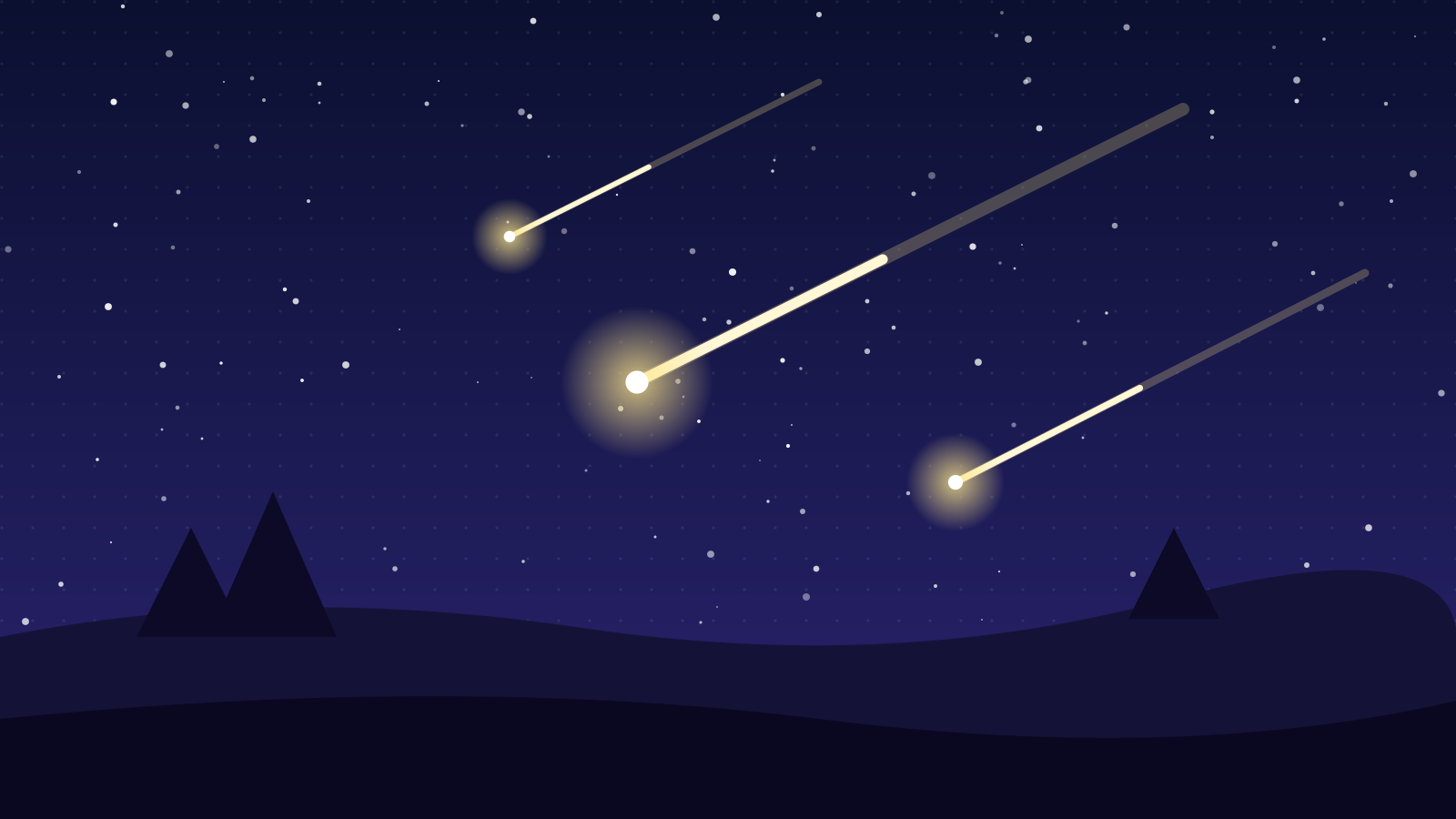
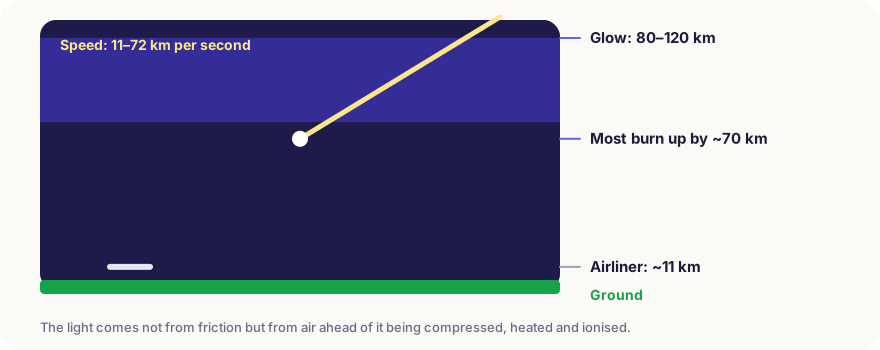
A shooting star is a meteor: a small piece of space rock or dust, usually smaller than a grain of sand, hitting Earth’s atmosphere at 11 to 72 kilometres per second. At about 80 to 120 km altitude it rams into the air so fast that the air in front of it is compressed and heated to thousands of degrees, and the particle and surrounding gas glow briefly before it vaporises. Meteor showers happen when Earth passes through a trail of debris left by a comet, which it does on roughly the same dates each year.
In this article (7)
You are lying on the grass on a summer night when a thin streak of light flashes across the sky and vanishes in a second. In many cultures people make a wish. But what you just saw was not a star. It was a speck of dust, older than the Earth itself, dying in a flash high above your head.
Meteoroid, meteor, meteorite
The names can be confusing, so it helps to sort them out first:
- Meteoroid: a small piece of rock, metal or dust travelling through space.
- Meteor: the streak of light we see when a meteoroid enters the atmosphere. This is the “shooting star”.
- Meteorite: a piece that survives the fiery trip and lands on the ground.
Most meteors come from meteoroids that are astonishingly small, often no bigger than a grain of sand. They shine so brightly because of their speed, not their size.
Why does a speck of dust glow so brightly?
Meteoroids hit the atmosphere at between 11 and 72 kilometres per second, up to 200 times faster than a bullet. At the high end they would cross a big city in under a second.
At an altitude of about 80 to 120 kilometres, the air is thin, but not thin enough. The meteoroid slams into air molecules so hard that the air in front of it is squeezed and heated to thousands of degrees. Its surface melts and vaporises, a process called ablation, and the vaporised atoms and surrounding air are ionised and glow. Contrary to popular belief, this is not simple friction like rubbing your hands together; it is closer to the heating of air ahead of a re-entering spacecraft.
The colour of a meteor can hint at its chemistry. Sodium gives an orange-yellow glow, magnesium blue-green and calcium violet, while the heated nitrogen and oxygen in the air can add red.
Where do meteoroids come from?
Most meteoroids are crumbs from comets and asteroids. When a comet approaches the Sun, its ice turns to gas and releases dust and grit that spread along its orbit. Collisions between asteroids also chip off fragments.
On any clear night you can see a few random meteors per hour; astronomers call these sporadic meteors. But a few times a year, the numbers jump.
Why do meteor showers return every year?
A comet’s orbit is littered with a long, thin river of debris. Earth crosses some of these rivers at the same point in its own orbit each year, and so on the same dates. When it does, it sweeps up thousands of particles, and we get a meteor shower.
All the meteors in a shower travel in parallel. Like railway tracks seeming to meet in the distance, their paths appear to start from one point in the sky called the radiant. Showers are named after the constellation that contains it: the Perseids seem to come from Perseus, the Geminids from Gemini.
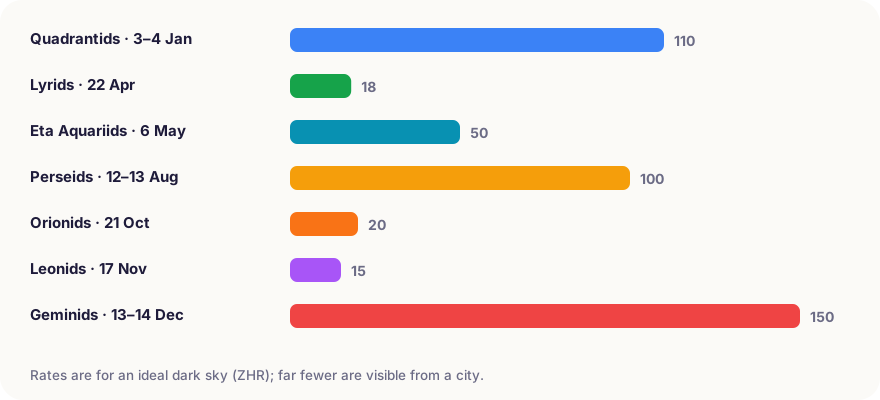
Some showers have famous parents. The Perseids come from Comet Swift–Tuttle, a mountain of ice about 26 km across. The Geminids are unusual because their parent, 3200 Phaethon, looks more like an asteroid than a comet.
Earth is gaining weight
All this dust adds up. Scientists who collected tiny micrometeorites from the clean snow of Dome C in Antarctica estimated that about 5,200 tonnes of extraterrestrial dust reach Earth’s surface each year. Most of it is too small to notice. Some of the dust on your windowsill may literally have come from space.
How to see more shooting stars
- Get away from lights. A dark sky can show ten times more meteors than a city.
- Wait until after midnight. In the early morning your side of Earth faces forward in its orbit, so it runs into more meteoroids, like a car windscreen in rain.
- Give your eyes time. It takes 20 to 30 minutes for your eyes to adapt fully to the dark. Avoid looking at your phone.
- Look at a wide patch of sky, not directly at the radiant. Meteors can appear anywhere.
- Check the Moon. A bright full Moon can hide most meteors.
In short
- A shooting star is a meteor: a tiny meteoroid burning up in the atmosphere, not a star.
- It glows at 80–120 km because it hits the air at 11–72 km per second, heating and ionising the air in front of it.
- Meteor showers happen when Earth crosses a comet’s debris trail on the same dates each year.
- The Perseids (August) and Geminids (December) are the strongest regular showers.
- Earth collects thousands of tonnes of space dust every year.
Frequently asked questions
What is the difference between a meteoroid, a meteor and a meteorite?
A meteoroid is the rock or dust in space. A meteor is the streak of light when it burns up in the atmosphere. A meteorite is a piece that survives and lands on the ground.
Are shooting stars dangerous?
Almost never. Nearly all meteors are tiny and vaporise high in the atmosphere. Only rare, much larger objects reach the ground as meteorites, and injuries are extremely rare.
What is a fireball?
A fireball is an unusually bright meteor, brighter than the planet Venus. It is usually caused by a meteoroid the size of a pebble or larger. Very bright ones that explode are called bolides.
When is the best time to see shooting stars?
After midnight and before dawn, from a dark place away from city lights, ideally during a major shower such as the Perseids in August or the Geminids in December.
Sources
- NASA Science – Meteors and Meteorites
- American Meteor Society – Meteor FAQs
- Rojas, J. et al. (2021). The micrometeorite flux at Dome C (Antarctica), monitoring the accretion of extraterrestrial dust on Earth. Earth and Planetary Science Letters
This article is based on peer-reviewed research and publications from trusted institutions, and it is reviewed regularly. How we work →
You might also wonder
All in Space →
Why Does Saturn Have Rings? What They Are Made Of and How Old They Are
Saturn’s rings are made of billions of ice chunks, yet they are only metres thick. Where did they come from, why aren’t they a moon, and will they vanish?
Why Does the Moon Look Bigger on the Horizon? The Moon Illusion Explained
A rising full Moon looks huge, yet it is no bigger than when it is high in the sky. Why does our brain inflate it, and how can you prove the illusion yourself?
Why Is the Night Sky Dark? Olbers’ Paradox and the Age of the Universe
With billions of stars out there, why isn’t the night sky ablaze with light? Olbers’ paradox, the finite age of the universe and cosmic expansion, explained.
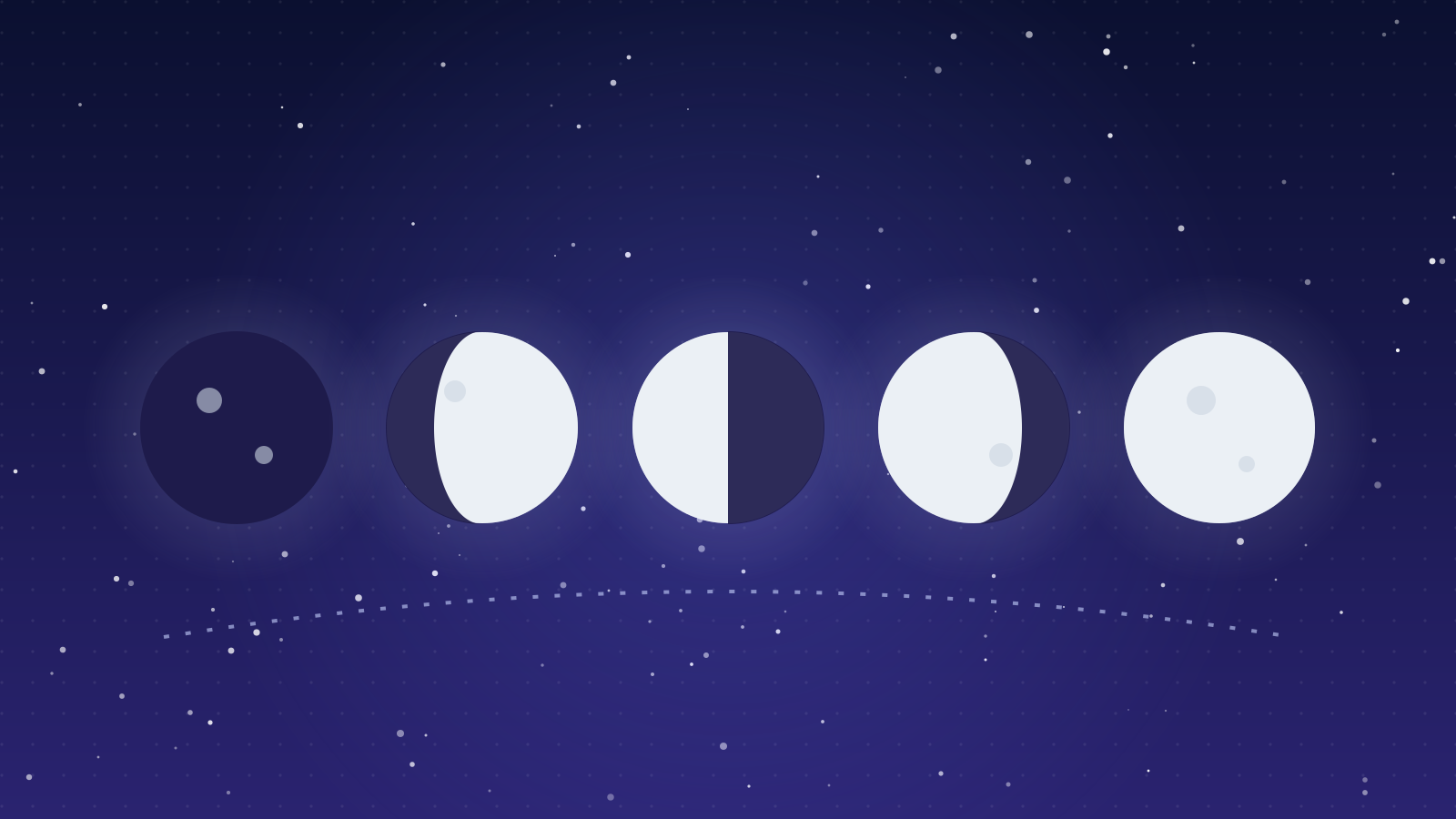
Why Does the Moon Change Shape? Moon Phases Explained Simply
Why does the Moon go from crescent to full? Why lunar phases have nothing to do with Earth’s shadow, and how to tell a waxing Moon from a waning one.
What Is a Black Hole? How They Form and What Happens Inside
What is a black hole, how does it form and what is the event horizon? A clear guide to the objects not even light can escape — and their first images.
What Is a Light-Year? Making Sense of Space’s Enormous Distances
Is a light-year a unit of time or distance? How big a light-year really is, why looking at stars means looking into the past, and the scale of the universe.