Why Does the Moon Change Shape? Moon Phases Explained Simply
Why does the Moon go from crescent to full? Why lunar phases have nothing to do with Earth’s shadow, and how to tell a waxing Moon from a waning one.
Short answer
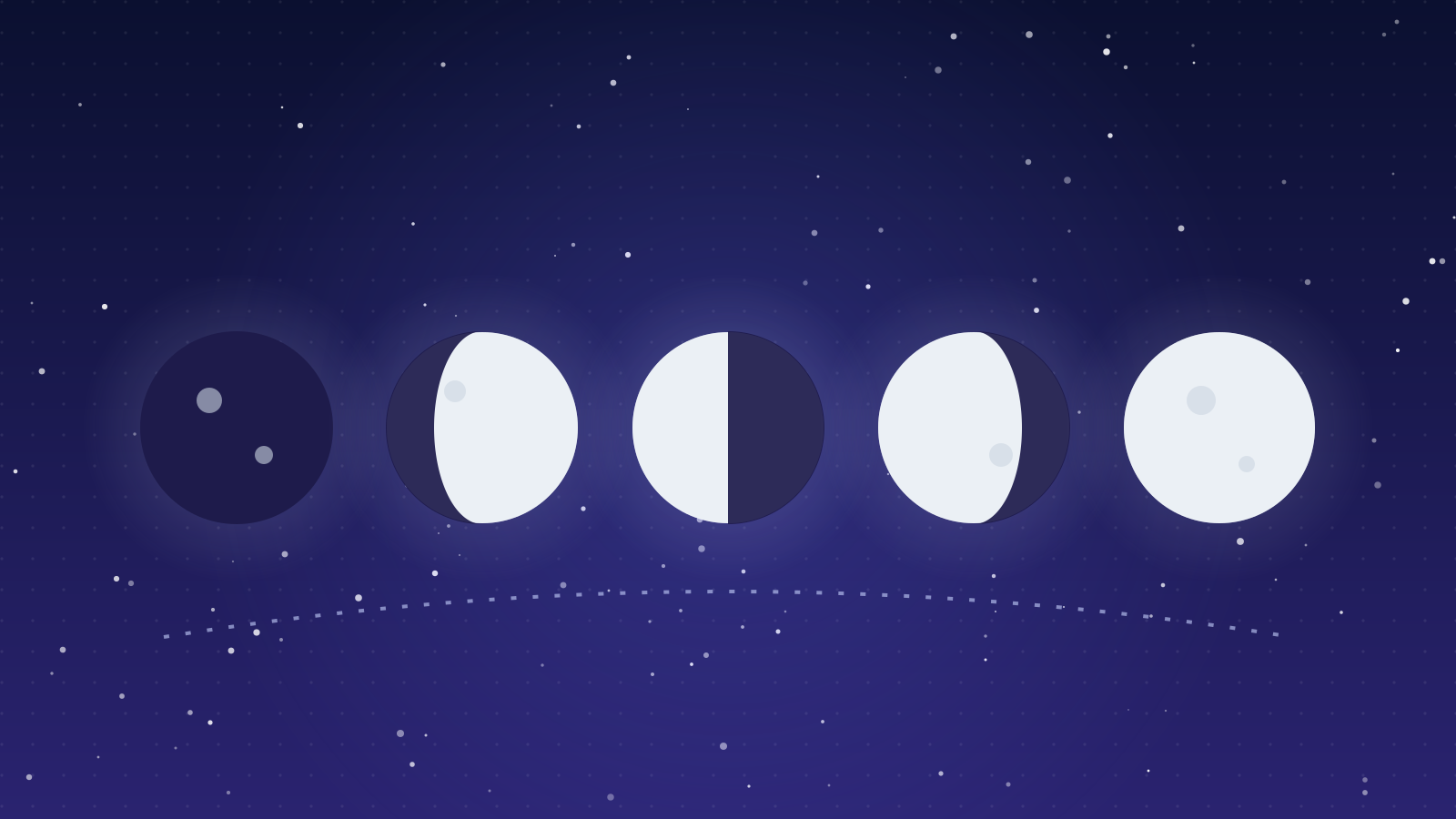
The Moon makes no light of its own; half of it is always lit by the Sun. As the Moon orbits Earth over about 29.5 days, the portion of that sunlit half facing us keeps changing. That is why we see a crescent, then a half Moon, then a full Moon, and then the same phases in reverse. Earth’s shadow has nothing to do with it.
In this article (8)
A thin crescent, a half circle, then a full Moon lighting up the night: the Moon looks a little different every evening. Many people assume Earth’s shadow causes the change, but the truth is simpler and more elegant.
Moonlight is really sunlight
The Moon is not a star and produces no light of its own. It shines in the night sky only because it reflects sunlight. So at any moment half of the Moon is lit and the other half is dark — just as one side of Earth always has day while the other has night.
What decides the Moon’s phase is how much of that sunlit half we can see from Earth.
Recreate the phases at home
The easiest way to understand this is a simple experiment:
- In a dark room, switch on a single lamp. That is the Sun.
- Hold a ball at arm’s length. The ball is the Moon; you are Earth.
- Slowly turn on the spot and watch the ball.
With the ball directly between you and the lamp, you see its dark side: a new Moon. As you turn, a thin bright sliver appears along its edge — a crescent. A quarter turn later it looks half lit. When the lamp is behind you, the ball is fully lit: a full Moon.
The eight phases of the Moon
Relative to the Sun, the Moon completes its circuit around Earth in about 29.5 days, the synodic month. During that time the phases follow in order:
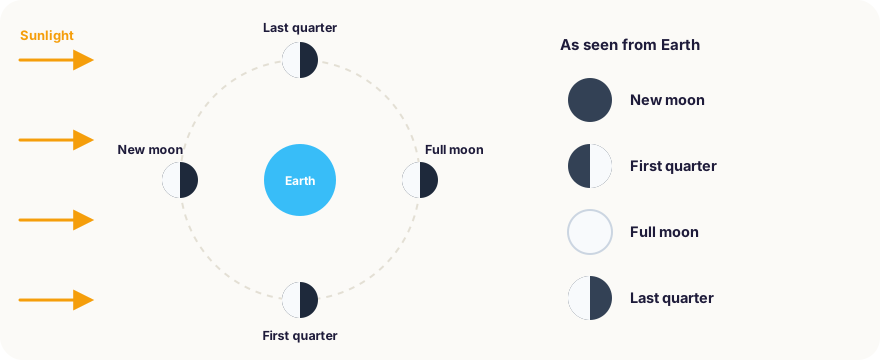
| Phase | Appearance | When to see it |
|---|---|---|
| New Moon | Invisible | Rises and sets with the Sun |
| Waxing crescent | Thin arc | Western sky after sunset |
| First quarter | Half disc | Afternoon and first half of the night |
| Waxing gibbous | More than half | Evening to after midnight |
| Full Moon | Full disc | Rises at sunset, visible all night |
| Waning gibbous | More than half | Midnight to morning |
| Last quarter | Half disc | Second half of the night and morning |
| Waning crescent | Thin arc | Eastern sky before dawn |
In the “waxing” phases the lit portion grows each night; in the “waning” phases it shrinks.
How to tell a waxing Moon from a waning one
In the Northern Hemisphere you can use this rule:
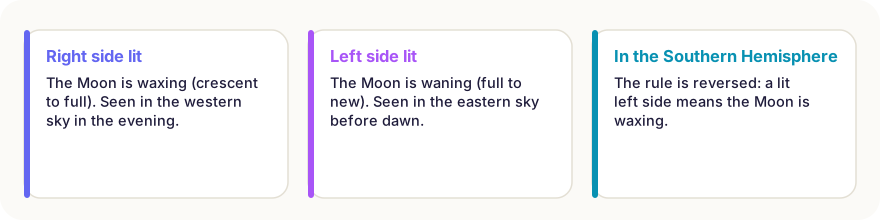
- Lit on the right: the Moon is waxing, heading towards full.
- Lit on the left: the Moon is waning, heading towards new.
A popular memory aid is “DOC”: a Moon shaped like a D is growing, O is full, and a C is shrinking. Time of day helps too: a crescent in the west in the early evening is waxing, while one in the east before dawn is waning.
The most common misconception: Earth’s shadow
The phases are not caused by Earth’s shadow. The easiest way to see this is the full Moon. A full Moon happens when the Sun and Moon are on opposite sides of Earth. By shadow logic the Moon should be dark at exactly that moment — instead it is at its brightest.
Earth’s shadow falls on the Moon only during a lunar eclipse. Because the Moon’s orbit is tilted by about 5 degrees, that happens only a few times a year, not every full Moon. Even then the Moon rarely disappears; it turns a coppery red, because Earth’s atmosphere bends sunset-coloured light into the shadow.
Why can you faintly see the dark part of a crescent?
Look closely at a thin crescent and you may notice that the rest of the Moon glows faintly. This is earthshine: sunlight reflected off Earth’s clouds and oceans lights up the Moon’s dark side and bounces back to us. The first person to explain it correctly was Leonardo da Vinci, in the early 1500s.
We always see the same face
Although the phases change, the pattern of dark “seas” and craters always looks the same. The Moon spins once on its axis in exactly the time it takes to orbit Earth, a state called tidal locking. Over billions of years, Earth’s gravity slowed the Moon’s spin until it settled into this balance.
The Moon’s “far side” is not permanently dark — it just cannot be seen from Earth. At new Moon, it is fully bathed in sunlight.
In short
The Moon’s changing shape is not a shadow play but a matter of viewing angle. Half the Moon is always lit; as it travels around Earth, the share of that lit half we see changes. The cycle from crescent to full and back takes about 29.5 days — and has shaped calendars for thousands of years.
Frequently asked questions
Are the Moon’s phases caused by Earth’s shadow?
No — this is a very common misconception. Earth’s shadow only falls on the Moon during a lunar eclipse. Phases happen because we see the Moon’s sunlit half from different angles.
Why isn’t there a lunar eclipse every full Moon?
The Moon’s orbit is tilted about 5 degrees relative to Earth’s orbit around the Sun, so at most full Moons it passes just above or below Earth’s shadow.
Why can you see the Moon during the day?
Except around full Moon, the Moon spends part of the day above the horizon. At first quarter, for example, it is easy to spot in the eastern sky in the afternoon.
Does the Moon look different in the Southern Hemisphere?
Yes, it appears flipped. A waxing Moon that is lit on the right in the north appears lit on the left in the south.
Sources
This article is based on peer-reviewed research and publications from trusted institutions, and it is reviewed regularly. How we work →
You might also wonder
All in Space →
Why Is the Night Sky Dark? Olbers’ Paradox and the Age of the Universe
With billions of stars out there, why isn’t the night sky ablaze with light? Olbers’ paradox, the finite age of the universe and cosmic expansion, explained.
What Is a Black Hole? How They Form and What Happens Inside
What is a black hole, how does it form and what is the event horizon? A clear guide to the objects not even light can escape — and their first images.
What Is a Light-Year? Making Sense of Space’s Enormous Distances
Is a light-year a unit of time or distance? How big a light-year really is, why looking at stars means looking into the past, and the scale of the universe.
How Does the Sun Shine? The Story of Nuclear Fusion in Its Core
How does the Sun produce light and heat, how does its energy reach us and when will it burn out? Nuclear fusion in the core and the Sun’s layers, explained.
Why Do Stars Twinkle? The Atmosphere Behind the Flicker
Why do stars twinkle while planets shine steadily? How starlight bends in Earth’s atmosphere, and how astronomers fight the twinkle to get sharp images.
Why Is Mars Red? The Rusty Secret of the Red Planet
What gives Mars its red colour? The iron-oxide dust covering its surface, the 2025 discovery of traces of water, and why Martian sunsets are blue.