How Does the Sun Shine? The Story of Nuclear Fusion in Its Core
How does the Sun produce light and heat, how does its energy reach us and when will it burn out? Nuclear fusion in the core and the Sun’s layers, explained.
Short answer
In its core, the Sun fuses the nuclei of hydrogen atoms into helium — a process called nuclear fusion. The helium produced is slightly lighter than the hydrogen that formed it, and that missing mass becomes an enormous amount of energy according to Einstein’s E = mc². Every second the Sun converts about 4 million tonnes of mass into energy, which streams into space as light and heat.
In this article (8)
The Sun that rises every morning is the energy source for almost all life on Earth. Photosynthesis in plants, the water cycle that feeds the rain, the winds and even the energy stored in fossil fuels are all, ultimately, forms of sunlight. So how does this giant light source work — and how has it kept shining for billions of years?
How big is the Sun?
The Sun is an ordinary but enormous star:
| Property | Value |
|---|---|
| Diameter | About 1.39 million km (109 times Earth’s) |
| Volume | About 1.3 million Earths would fit inside |
| Mass | 99.8% of all the mass in the Solar System |
| Age | About 4.6 billion years |
| Distance from Earth | About 150 million km on average |
The Sun is mostly hydrogen (about 73%) and helium (about 25%). These gases are so hot that their atoms have lost their electrons, forming an electrically charged state called plasma.
The layers of the Sun
Inside, the Sun is layered like an onion, and each layer has a different job:
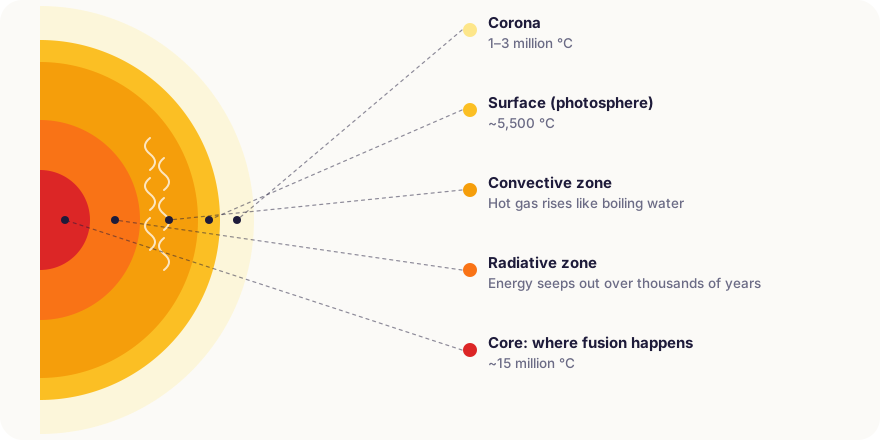
- Core: the centre, at about 15 million °C, where all the energy is produced.
- Radiative zone: energy travels outwards as particles of light — photons. But the material is so dense that each photon is constantly absorbed and re-emitted in random directions, so crossing this zone can take tens of thousands of years.
- Convective zone: here energy is carried by vast currents of hot gas that rise and sink like water boiling in a pan.
- Photosphere (surface): the layer at about 5,500 °C from which the light we see is emitted.
- Corona: the Sun’s outer atmosphere, visible as a white halo during a total solar eclipse. Surprisingly, it is 1–3 million °C — far hotter than the surface.
The Sun’s engine: nuclear fusion
In the Sun’s core, temperature and pressure are so extreme that the nuclei of hydrogen atoms can collide and fuse. This is called nuclear fusion.
Normally, atomic nuclei repel each other because they are positively charged. To fuse them, that repulsion must be overcome. The core’s 15-million-degree heat gives particles speeds of hundreds of kilometres a second, while the immense pressure from the Sun’s own weight squeezes them together. Even so, fusion is not easy: without a quantum effect called “tunnelling”, even the Sun’s heat would not be enough.
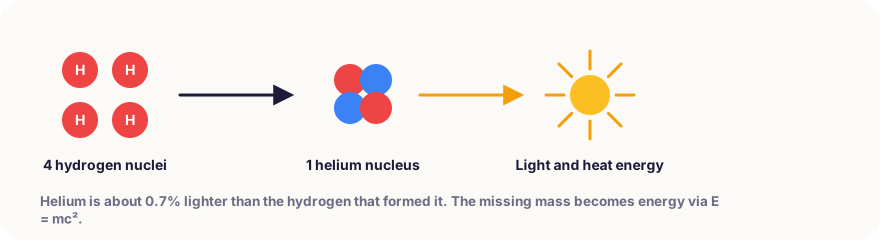
The process takes several steps, but in summary:
- Four hydrogen nuclei (protons) combine to form one helium nucleus.
- The resulting helium nucleus is about 0.7% lighter than the four protons that made it.
- That lost mass becomes energy according to Einstein’s famous E = mc². Because c — the speed of light — is such a huge number, even a tiny mass means an enormous amount of energy.
Every second the Sun turns about 600 million tonnes of hydrogen into helium, and about 4 million tonnes of mass are converted entirely into energy. That sounds a lot, but the Sun is so vast that it can keep going at this rate for billions of years.
Why doesn’t the Sun explode or collapse?
The Sun is in a constant balance:
- the gravity of its enormous mass tries to squeeze it inwards;
- the heat and pressure from the energy produced in the core push outwards.
The two forces balance each other. If fusion speeds up slightly, the Sun expands a little, its core cools and fusion slows. If fusion slows, the Sun contracts slightly, its core heats up and fusion speeds up again. This self-regulating system lets the Sun shine steadily for billions of years.
Light’s long journey
Once sunlight leaves the surface, it reaches Earth in about 8 minutes and 20 seconds. So when you look at the Sun, you see it as it was 8 minutes ago.
But that light’s real journey began much earlier. Energy produced in the core wanders through the radiative zone as photons are absorbed and re-emitted again and again, as if lost in a maze. Scientists estimate it takes tens of thousands, perhaps hundreds of thousands, of years to reach the surface. The energy in the sunlight warming your face today may have been produced in the Sun’s core before humans painted the first cave walls.
The Sun’s future
The Sun is about 4.6 billion years old and has used about half the hydrogen in its core. Scientists predict its future like this:
- Over the next billion years: the Sun will slowly brighten, which in the distant future could boil away Earth’s oceans.
- In about 5 billion years: as hydrogen in the core runs low, the Sun will swell into a red giant, swallowing Mercury and Venus and perhaps reaching Earth’s orbit.
- The final stage: it will shed its outer layers into space as a planetary nebula, leaving behind an Earth-sized, extremely dense and slowly cooling white dwarf.
The Sun is not heavy enough to explode as a supernova or form a black hole — it would need to be at least several times more massive. We explain how black holes form in What is a black hole?.
Is fusion energy possible on Earth?
For decades scientists have tried to recreate the Sun’s working principle on Earth. Fusion energy promises a power source with no carbon emissions, no long-lived radioactive waste and fuel that can be extracted from seawater.
But Earth lacks the Sun’s immense pressure, so fusion reactors must reach temperatures above 100 million °C — hotter even than the Sun’s core. The international ITER project under construction in France and experimental reactors in several countries are working towards that goal. In 2022 a US laboratory achieved, for the first time, more energy from a fusion experiment than the laser energy delivered to its fuel. Commercial fusion power stations, though, are still some way off.
In short
The Sun is a giant nuclear fusion reactor that fuses hydrogen nuclei into helium in its core. The small amount of mass lost becomes enormous energy according to E = mc². That energy takes tens of thousands of years to travel from the core to the surface, then just 8 minutes to reach Earth. Thanks to the balance between gravity and internal pressure, the Sun will keep shining steadily for another 5 billion years or so.
Frequently asked questions
Is the Sun a ball of fire? Is something burning?
No. Burning is a chemical reaction that needs oxygen. In the Sun, atomic nuclei fuse — a nuclear process that releases millions of times more energy than burning the same mass.
When will the Sun burn out?
The Sun is about 4.6 billion years old and has used about half its fuel. In about 5 billion years, as hydrogen in its core runs low, it will swell into a red giant, then shed its outer layers and leave behind a slowly fading white dwarf.
Could the Sun explode or become a black hole?
No. The Sun is not massive enough to explode as a supernova or form a black hole — it would need to be at least several times heavier.
Why is the Sun’s surface cooler than its corona?
It is one of the great puzzles of solar physics. The surface is about 5,500 °C, while the outer atmosphere, the corona, reaches millions of degrees. Magnetic fields are thought to carry energy into the corona, and NASA’s Parker Solar Probe is investigating.
Sources
- NASA Science – Sun: Facts
- NASA Space Place – How Does the Sun Produce Energy?
- NASA Space Place – How Big Is the Sun?
This article is based on peer-reviewed research and publications from trusted institutions, and it is reviewed regularly. How we work →
You might also wonder
All in Space →
Why Is the Night Sky Dark? Olbers’ Paradox and the Age of the Universe
With billions of stars out there, why isn’t the night sky ablaze with light? Olbers’ paradox, the finite age of the universe and cosmic expansion, explained.

Why Does the Moon Change Shape? Moon Phases Explained Simply
Why does the Moon go from crescent to full? Why lunar phases have nothing to do with Earth’s shadow, and how to tell a waxing Moon from a waning one.

What Is a Black Hole? How They Form and What Happens Inside
What is a black hole, how does it form and what is the event horizon? A clear guide to the objects not even light can escape — and their first images.
What Is a Light-Year? Making Sense of Space’s Enormous Distances
Is a light-year a unit of time or distance? How big a light-year really is, why looking at stars means looking into the past, and the scale of the universe.

Why Do Stars Twinkle? The Atmosphere Behind the Flicker
Why do stars twinkle while planets shine steadily? How starlight bends in Earth’s atmosphere, and how astronomers fight the twinkle to get sharp images.
Why Is Mars Red? The Rusty Secret of the Red Planet
What gives Mars its red colour? The iron-oxide dust covering its surface, the 2025 discovery of traces of water, and why Martian sunsets are blue.