Why Is the Night Sky Dark? Olbers’ Paradox and the Age of the Universe
With billions of stars out there, why isn’t the night sky ablaze with light? Olbers’ paradox, the finite age of the universe and cosmic expansion, explained.
Short answer
If the universe were infinite, unchanging and eternal, every line of sight would eventually end on the surface of a star and the whole night sky would glow as brightly as the Sun. It is dark because the universe has a finite age of about 13.8 billion years: light from very distant stars has not had time to reach us, stars themselves do not shine forever, and the expansion of space stretches distant light into wavelengths our eyes cannot see.
In this article (8)
Step outside on a clear night far from city lights and you will see thousands of stars. Through a telescope there are billions more, and beyond them hundreds of billions of galaxies. With so many suns out there, a simple question turns out to be surprisingly deep: why is the sky between the stars dark at all?
Astronomers call this puzzle Olbers’ paradox, and its answer tells us something fundamental about the universe: it has not existed forever.
The paradox in one picture
Imagine standing in the middle of a huge forest. Near you, you can see gaps between the trunks. But if the forest goes on forever in every direction, every line of sight will eventually hit a tree. The view would become a solid wall of wood.
Now replace the trees with stars. If the universe were infinite in size, infinitely old and unchanging, every direction you looked would end on the surface of a star. Distant stars look dimmer, but there are more of them at greater distances, and the two effects cancel out exactly. The result would be a sky as bright as the surface of the Sun, day and night.
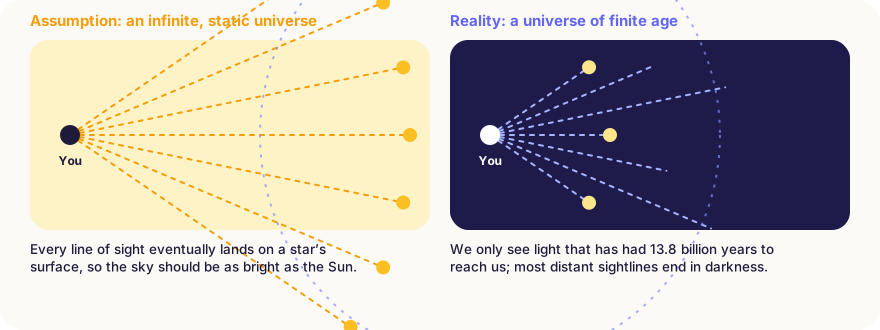
The fact that we sleep in darkness means at least one of those assumptions is wrong.
An old question with a famous name
The puzzle is much older than its name. Johannes Kepler used the dark sky in 1610 to argue that the universe of stars could not be infinite. In the 18th century, the Swiss astronomer Jean-Philippe Loys de Chéseaux worked out how bright an infinite sky should be. In 1823 the German physician and astronomer Heinrich Wilhelm Olbers described it again, and his name stuck.
For a long time, the favourite explanation was dust: perhaps clouds of gas and dust between the stars absorb the light. It sounds reasonable, but it fails. In an eternal universe the dust would keep absorbing energy until it became as hot as the stars, and then it would shine just as brightly.
The real answer: the universe has an age
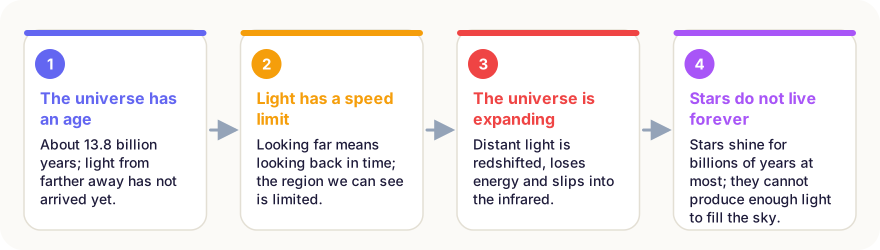
The key insight came from modern cosmology. The universe began about 13.8 billion years ago in the hot, dense state we call the Big Bang. Light travels fast, but not infinitely fast. That means we can only see objects whose light has had time to reach us.
Looking out into space is therefore also looking back in time. Beyond a certain distance there is simply no starlight that has arrived yet. Most lines of sight do not end on a star; they end in the dark, early universe before the first stars formed.
Curiously, one of the first people to suggest something like this was not an astronomer but the writer Edgar Allan Poe. In his 1848 prose poem Eureka, he suggested that the dark gaps might be regions so distant that their light has not yet had time to reach us. It was a lucky guess, but a remarkably good one.
Stars do not shine forever
There is a second limit. Even in a very old universe, stars are not eternal lamps. A star like the Sun lives for roughly 10 billion years; massive stars burn out in a few million. There is simply not enough matter, or enough time, for stars to fill the whole sky with light.
Physicist Edward Harrison showed in the 1980s that the total energy stars can produce is far too small to light up the sky like the Sun’s surface. Even if all the matter in the universe were turned into starlight, the night would still be dark.
Expansion stretches the light
The universe is not only finite in age; it is also expanding. As light travels through expanding space, its wavelength is stretched. Astronomers call this redshift.
Stretched light carries less energy. Light from the most distant galaxies has been shifted out of the visible range into the infrared. So even the light that does reach us from far away is largely invisible to our eyes. Calculations, such as those by Paul Wesson in 1991, show that expansion makes the sky darker, but the finite age of the universe is the bigger factor.
The sky is not perfectly dark
If you could see in microwaves, the night sky would glow everywhere. This is the cosmic microwave background: light released about 380,000 years after the Big Bang, when the universe first became transparent. At that time it was the glow of a hot gas at around 3,000 kelvin. Expansion has since stretched it into microwaves, corresponding to a temperature of only about 2.7 degrees above absolute zero.
In a way, this is the ghost of Olbers’ bright sky. The early universe really was bright in every direction. We just see that brightness redshifted into darkness.
There is also a faint extragalactic background light from all the galaxies that have ever shone, but it is far too dim for the human eye to notice.
Why this matters
The dark night sky is one of the simplest pieces of evidence that the universe had a beginning. Every time you look up and see black between the stars, you are seeing the edge of time, not the edge of space.
In short
- In an infinite, eternal, unchanging universe every line of sight would end on a star and the night would be as bright as the Sun.
- The sky is dark mainly because the universe has a finite age of about 13.8 billion years, so light from beyond a certain distance has not reached us yet.
- Stars have limited lifetimes and could never produce enough light to fill the sky.
- The expansion of the universe redshifts distant light out of the visible range.
- The darkness is filled with the faint cosmic microwave background, the stretched-out glow of the early universe.
Frequently asked questions
Who was Olbers?
Heinrich Wilhelm Olbers was a German physician and amateur astronomer who popularised the puzzle in 1823. Johannes Kepler and others had raised similar questions much earlier, so the paradox is named after him more by tradition than by priority.
Doesn’t the dust between stars block their light?
Dust cannot be the full answer. In an eternal universe the dust would absorb starlight until it heated up and glowed just as brightly as the stars themselves.
Would the sky be dark if the universe were not expanding?
Mostly, yes. The finite age of the universe is the main reason. Expansion adds to the darkness by redshifting distant light and lowering its energy.
Is the night sky completely black from space?
Away from the Sun and Earth’s atmosphere it looks very dark, but sensitive instruments detect a faint extragalactic background light from all the galaxies, plus the much stronger microwave background.
Sources
- Edward L. Wright, UCLA – Cosmology FAQ: Why is the sky dark at night?
- NASA WMAP – How old is the universe?
- Wesson, P. S. (1991). Olbers’s paradox and the spectral intensity of the extragalactic background light. The Astrophysical Journal
This article is based on peer-reviewed research and publications from trusted institutions, and it is reviewed regularly. How we work →
You might also wonder
All in Space →
What Are Shooting Stars? Meteors, Meteor Showers and Where to See Them
Shooting stars are not stars at all. What makes those streaks of light, why do meteor showers happen on the same dates every year, and how can you see the most?
Why Does Saturn Have Rings? What They Are Made Of and How Old They Are
Saturn’s rings are made of billions of ice chunks, yet they are only metres thick. Where did they come from, why aren’t they a moon, and will they vanish?

Why Does the Moon Look Bigger on the Horizon? The Moon Illusion Explained
A rising full Moon looks huge, yet it is no bigger than when it is high in the sky. Why does our brain inflate it, and how can you prove the illusion yourself?
How Do Solar Eclipses Work? Why the Moon Fits the Sun Perfectly
A total solar eclipse happens when the Moon exactly covers the Sun. Why the fit is so perfect, the types of eclipse, and how to watch one safely.
Why Do We Only See One Side of the Moon? Tidal Locking Explained
The Moon spins once for every trip around Earth, so the same face always points at us. How tidal locking works, and why the far side is not really dark.
Why Is Pluto Not a Planet? The 2006 Decision Explained
Pluto lost its planet status in 2006. The three rules astronomers set for a planet, why Pluto fails one, and what New Horizons revealed about this icy world.