How Do Solar Eclipses Work? Why the Moon Fits the Sun Perfectly
A total solar eclipse happens when the Moon exactly covers the Sun. Why the fit is so perfect, the types of eclipse, and how to watch one safely.
Short answer
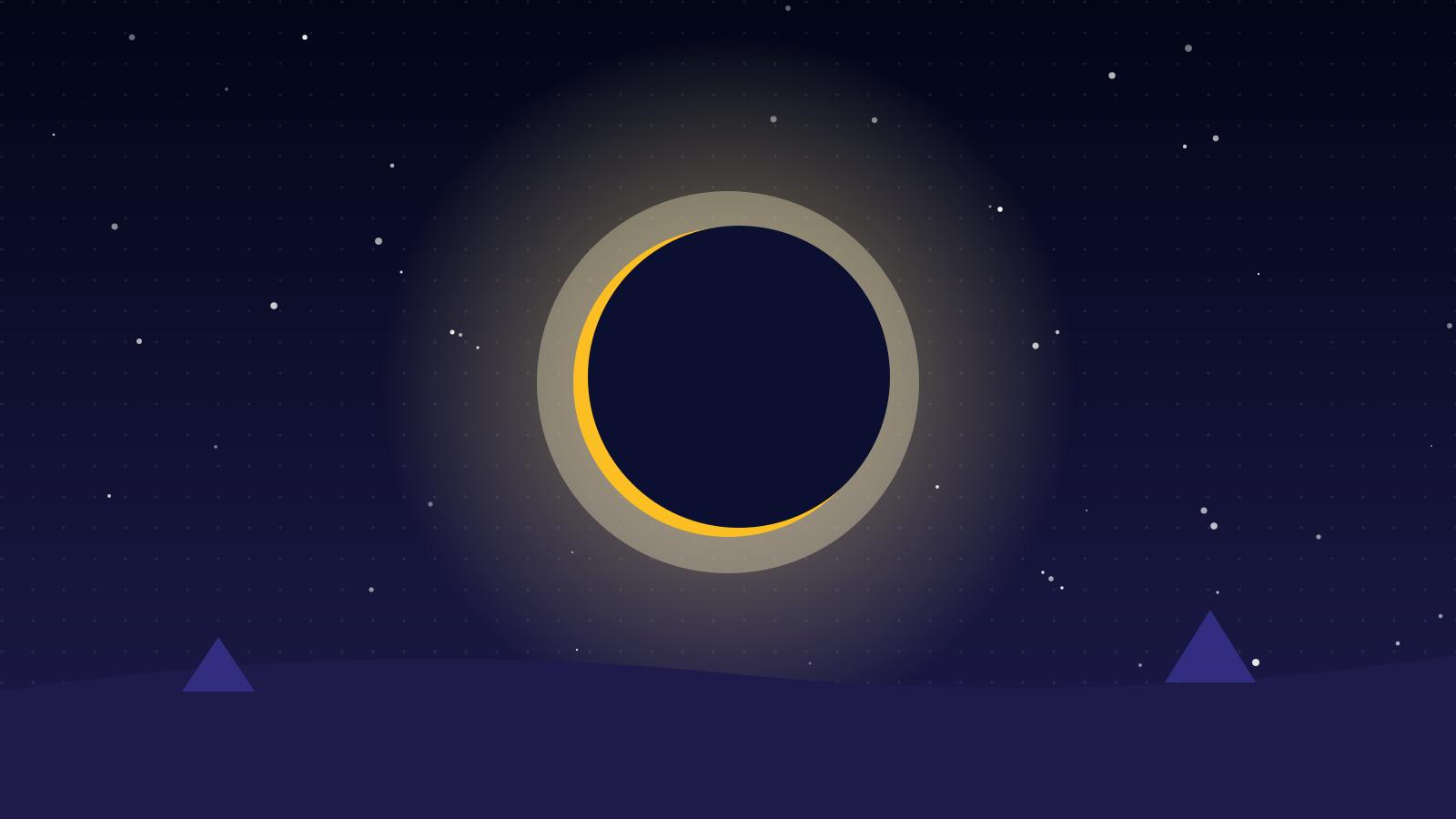
A solar eclipse happens when the Moon passes directly between the Sun and Earth and casts its shadow on our planet. It can only occur at new moon, but not every month, because the Moon’s orbit is tilted by about 5 degrees to Earth’s. A total eclipse is possible thanks to a cosmic coincidence: the Sun is about 400 times wider than the Moon but also about 400 times farther away, so both look almost the same size in our sky. Inside the Moon’s narrow central shadow, day turns to twilight for a few minutes and the Sun’s glowing outer atmosphere, the corona, becomes visible.
In this article (7)
Few sights move people like a total solar eclipse. In the middle of the day the light turns strange and silvery, the temperature drops, birds fall silent and, suddenly, the Sun disappears, leaving a black disc surrounded by a shimmering crown of light. How does this happen, and why can we see it at all?
The Moon gets in the way
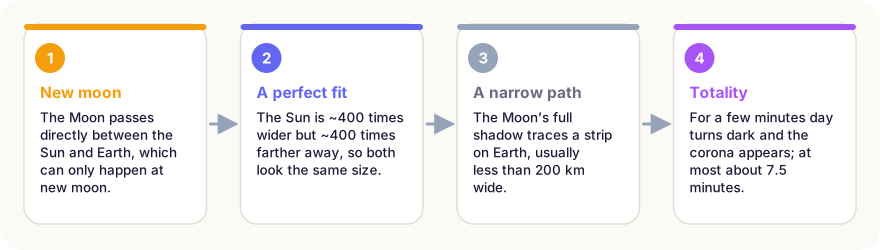
A solar eclipse happens when the Moon passes directly between the Sun and Earth. The Moon’s shadow then falls on part of our planet. That can only happen at new moon, when the Moon lies on the Sun’s side of Earth.
So why isn’t there an eclipse every month? Because the Moon’s orbit is tilted by about 5 degrees relative to Earth’s orbit around the Sun. Most months, the new moon passes a little above or below the Sun in our sky. Only when a new moon happens close to the points where the two orbits cross, about twice a year, do we get an eclipse season.
A perfect fit by coincidence
The Sun is about 400 times wider than the Moon. By pure chance, it is also about 400 times farther away. So in our sky the two discs look almost exactly the same size, and the Moon can cover the bright face of the Sun precisely, while leaving its faint outer atmosphere visible.
This is not permanent. The Moon is slowly moving away from Earth, by about 3.8 centimetres a year. In several hundred million years it will look too small to cover the Sun completely, and total eclipses will end.
Types of solar eclipse
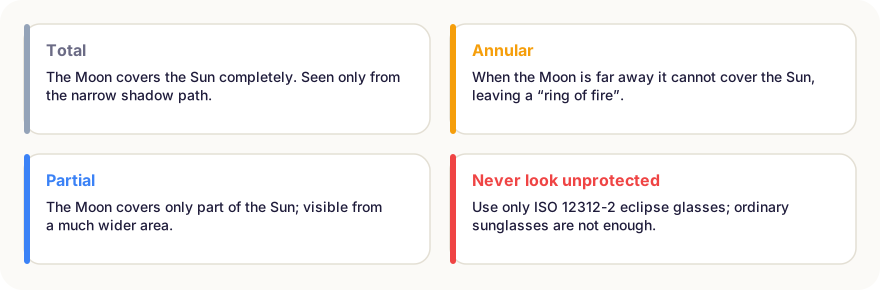
- Total: the Moon covers the Sun completely. This is only seen from inside the path of totality, the strip where the Moon’s darkest shadow, the umbra, sweeps across Earth. It is usually less than 200 kilometres wide.
- Annular: the Moon’s orbit is slightly oval. When it is at its farthest from Earth, it looks a little too small and leaves a bright “ring of fire” around it.
- Partial: outside the central path, observers see the Moon take only a bite out of the Sun. A partial eclipse is visible over a much wider area.
What happens during totality
As totality approaches, shadows sharpen and the light fades. Just before the Sun disappears, beads of sunlight shine through valleys on the Moon’s edge, called Baily’s beads, and a final flash creates the diamond ring. Then the corona, the Sun’s outer atmosphere, millions of degrees hot but normally hidden by glare, spreads out in pearly streamers. Bright planets and stars appear. Totality lasts from a few seconds to at most about 7.5 minutes.
Eclipses have made scientific history. During the total eclipse of 1919, astronomers measured how starlight was bent by the Sun’s gravity, confirming Einstein’s general theory of relativity.
How to watch safely
Never look directly at the Sun, even when most of it is covered. Use eclipse glasses that meet the ISO 12312-2 standard, or project the Sun’s image through a pinhole onto paper. Ordinary sunglasses are not enough. Only during the few minutes of totality, when the Sun is completely covered, is it safe to look with the naked eye.
Upcoming eclipses
A total eclipse crossed Greenland, Iceland and Spain on 12 August 2026. The next big one, on 2 August 2027, will cross southern Spain and North Africa; near Luxor in Egypt totality will last about 6 minutes 23 seconds. Turkey last saw a total eclipse on 29 March 2006, along the Antalya coast.
In short
- A solar eclipse happens when the Moon passes between the Sun and Earth.
- It needs a new moon, but the Moon’s orbit is tilted about 5°, so not every month.
- The Sun is 400 times bigger but 400 times farther than the Moon, so they look the same size.
- Eclipses can be total, annular or partial.
- Totality reveals the corona and lasts at most about 7.5 minutes.
- Always use ISO 12312-2 eclipse glasses; never look at the Sun unprotected.
Frequently asked questions
Is it safe to look at a solar eclipse?
Only with proper eclipse glasses meeting the ISO 12312-2 standard, or by projecting the image. Even a thin crescent of Sun can damage your retina. Only during the brief moments of totality is it safe to look without protection.
How often do total solar eclipses happen?
Somewhere on Earth, roughly every 18 months. But any one place sees a total eclipse only about once every 375 years on average, because the path of totality is so narrow.
What is the difference between a solar and a lunar eclipse?
In a solar eclipse the Moon blocks the Sun, and it happens at new moon. In a lunar eclipse Earth’s shadow falls on the Moon, which happens at full moon and can be seen safely by anyone on the night side of Earth.
When was the last total solar eclipse in Turkey?
On 29 March 2006, when the path of totality crossed southern Turkey, including the Antalya coast. Partial eclipses are seen in Turkey much more often.
Sources
This article is based on peer-reviewed research and publications from trusted institutions, and it is reviewed regularly. How we work →
You might also wonder
All in Space →
What Are Shooting Stars? Meteors, Meteor Showers and Where to See Them
Shooting stars are not stars at all. What makes those streaks of light, why do meteor showers happen on the same dates every year, and how can you see the most?
Why Does Saturn Have Rings? What They Are Made Of and How Old They Are
Saturn’s rings are made of billions of ice chunks, yet they are only metres thick. Where did they come from, why aren’t they a moon, and will they vanish?
Why Does the Moon Look Bigger on the Horizon? The Moon Illusion Explained
A rising full Moon looks huge, yet it is no bigger than when it is high in the sky. Why does our brain inflate it, and how can you prove the illusion yourself?
Why Do We Only See One Side of the Moon? Tidal Locking Explained
The Moon spins once for every trip around Earth, so the same face always points at us. How tidal locking works, and why the far side is not really dark.
Why Is Pluto Not a Planet? The 2006 Decision Explained
Pluto lost its planet status in 2006. The three rules astronomers set for a planet, why Pluto fails one, and what New Horizons revealed about this icy world.
Why Is the Night Sky Dark? Olbers’ Paradox and the Age of the Universe
With billions of stars out there, why isn’t the night sky ablaze with light? Olbers’ paradox, the finite age of the universe and cosmic expansion, explained.