Why Does Saturn Have Rings? What They Are Made Of and How Old They Are
Saturn’s rings are made of billions of ice chunks, yet they are only metres thick. Where did they come from, why aren’t they a moon, and will they vanish?
Short answer
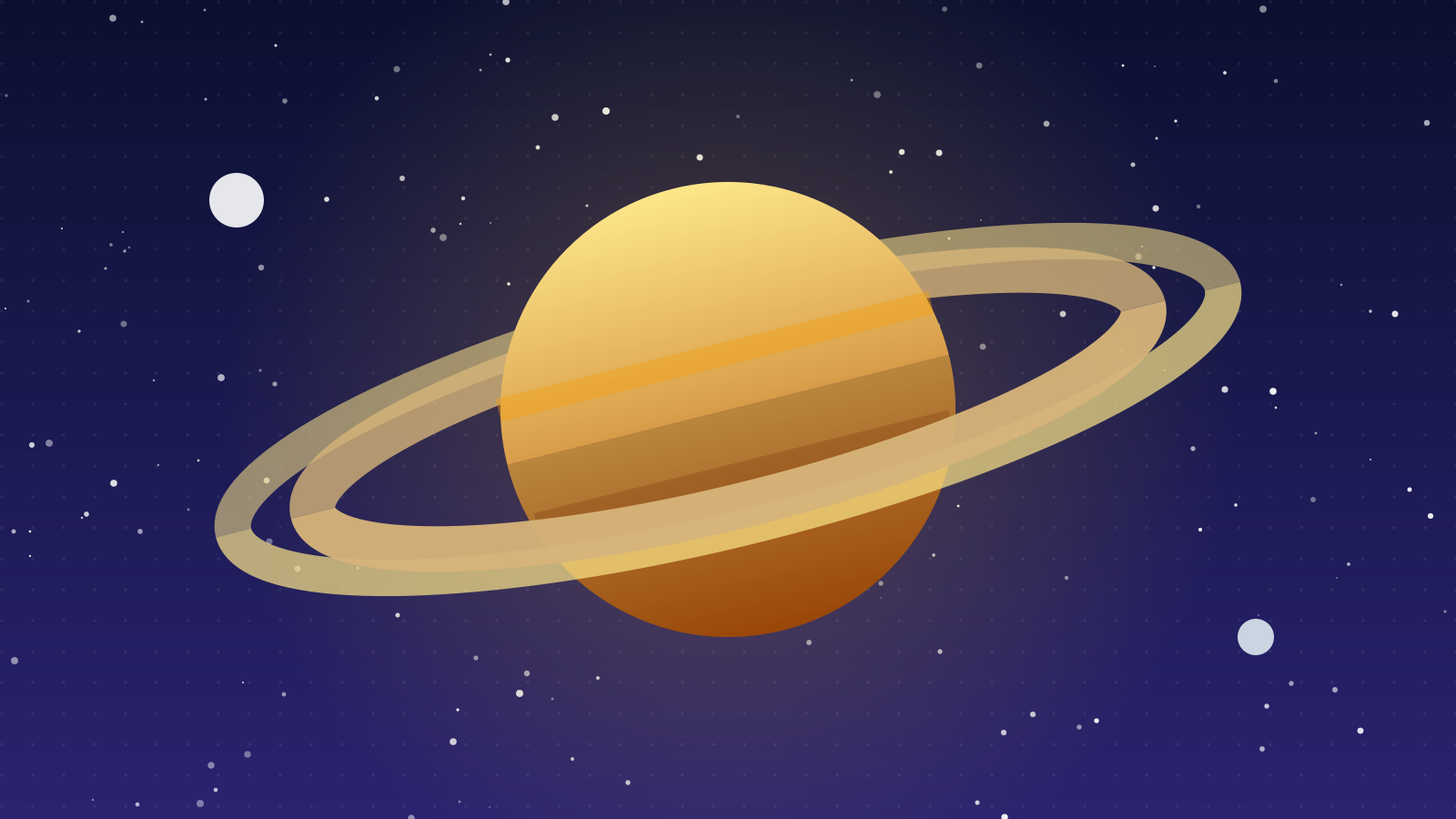
Saturn’s rings are a vast, flat disc of countless pieces of water ice, from dust grains to chunks the size of a house, orbiting the planet. They most likely formed when a moon or comet strayed too close and was torn apart by Saturn’s gravity. Inside a zone called the Roche limit, tidal forces stop the debris from clumping back into a moon, so it spreads into rings. How old they are is still debated: some evidence suggests a few hundred million years, other studies argue they could be billions of years old.
In this article (7)
Of all the sights in a small telescope, few match the first glimpse of Saturn. A golden ball floats inside a perfect, delicate ring, almost too neat to be real. Galileo saw it in 1610 but could not make sense of it; he thought Saturn had “ears”. Today we know the rings in remarkable detail, and they are stranger than he could have imagined.
What are the rings made of?
Saturn’s rings are not solid hoops. They are made of billions of separate particles, each orbiting the planet like a tiny moon. More than 95% of the material is water ice, which is why the rings shine so brightly in sunlight.
The particles range from fine dust to chunks several metres across. Some larger “moonlets” of a kilometre or so are embedded in the rings and carve small waves and gaps around them.
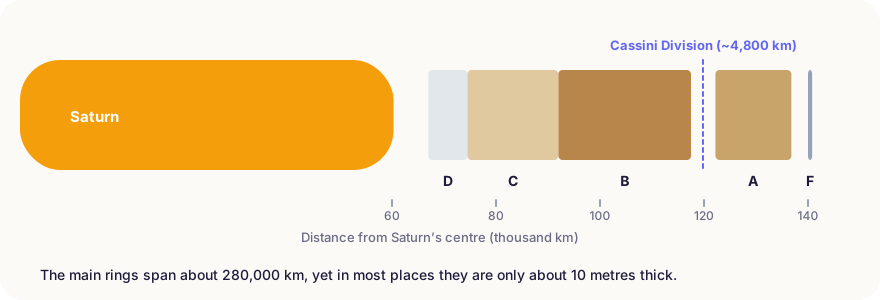
The main rings are about 280,000 kilometres across, roughly three-quarters of the distance from Earth to the Moon. Yet in most places they are only about 10 metres thick. If you shrank the rings to the width of a football pitch, they would be thinner than a sheet of paper.
The rings have names and gaps
Astronomers named the main rings with letters in the order they were discovered, so their order out from the planet is D, C, B, A, F, G and E. The bright B ring is the most massive. Between the B and A rings lies a dark gap about 4,800 km wide, the Cassini Division, discovered by Giovanni Cassini in 1675.
The gaps are not random. Saturn’s moons pull on ring particles with regular tugs. Where a particle’s orbit would line up with a moon’s orbit in a simple ratio, for example circling twice for every one orbit of the moon Mimas, those repeated tugs push it out. Small “shepherd moons” such as Prometheus and Pandora keep the narrow F ring in place.
Why do the rings not form a moon?
Close to a planet, its gravity pulls harder on the near side of an object than on the far side. This difference, the tidal force, tries to stretch the object apart. Inside a distance called the Roche limit, tidal forces are stronger than the weak gravity holding loose ice and rock together.
That is why Saturn’s main rings lie close to the planet. Pieces of ice there can collide and stick briefly, but they cannot grow into a moon. Farther out, beyond the Roche limit, debris can clump together; Saturn’s moons orbit there.
Where did the rings come from?
The leading idea is that the rings are the remains of something that came too close. Possible culprits include:
- a moon that spiralled inward and was torn apart by tides;
- a large comet or icy body that passed near Saturn and broke up;
- material left over from the disc of gas and dust that formed Saturn itself.
The almost pure ice of the rings favours an icy moon or the icy outer layers of one.
How old are the rings? A lively debate
For decades scientists assumed the rings were as old as Saturn, about 4.5 billion years. NASA’s Cassini spacecraft, which orbited Saturn from 2004 to 2017, challenged that idea.
In its final months Cassini dived between the planet and the rings. By measuring tiny changes in its path, scientists weighed the rings for the first time. In 2019 Luciano Iess and colleagues reported that they hold only about 40% of the mass of the small moon Mimas, less than expected for ancient rings.
Cassini also measured how much dust from space falls onto the rings. Space dust is dark and rocky, so old rings should look dirty. In 2023 Sascha Kempf and colleagues concluded that the rings are so clean they can be no more than a few hundred million years old. If so, they formed when dinosaurs walked on Earth.
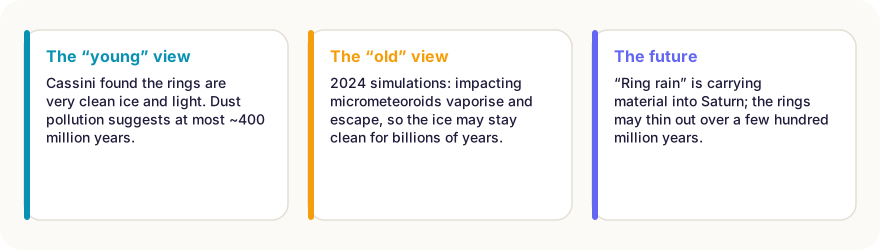
The debate is not settled. In 2024 a team led by Ryuki Hyodo used computer simulations to argue that fast micrometeoroids hitting the rings vaporise on impact, and much of the vapour escapes instead of coating the ice. In that case the rings could stay bright for billions of years and only look young.
The rings are slowly raining away
Whatever their age, the rings are not permanent. Cassini and earlier observations showed ice particles being pulled by Saturn’s magnetic field and gravity into the planet’s upper atmosphere, a process nicknamed “ring rain”. Some estimates suggest the main rings could mostly disappear within a few hundred million years. We may be lucky to live at a time when Saturn wears its finest jewellery.
In short
- Saturn’s rings are made of billions of separate pieces of water ice, from dust to house-sized chunks.
- They are about 280,000 km wide but usually only about 10 metres thick.
- Inside the Roche limit, tidal forces stop ring material from forming a moon.
- They probably formed from a moon or comet that was torn apart.
- Their age is debated: Cassini data suggest a few hundred million years, while newer simulations allow billions.
- “Ring rain” is slowly draining the rings into Saturn.
Frequently asked questions
Are Saturn’s rings solid?
No. They are made of billions of separate particles, each orbiting Saturn on its own path like a tiny moon. Spacecraft have flown through gaps in them.
Do other planets have rings?
Yes. Jupiter, Uranus and Neptune all have rings, but they are much fainter and darker, made more of dust and rock than bright ice.
Can you see Saturn’s rings with binoculars?
Strong, steady binoculars may show Saturn as slightly oval. A small telescope with about 25x magnification is enough to see the rings clearly.
Will Saturn lose its rings?
Slowly, yes. Ring material is falling into Saturn as “ring rain”. Estimates suggest the main rings could largely disappear within a few hundred million years.
Sources
- NASA – Cassini mission overview
- Iess, L. et al. (2019). Measurement and implications of Saturn’s gravity field and ring mass. Science
- Kempf, S. et al. (2023). Micrometeoroid infall onto Saturn’s rings constrains their age to no more than a few hundred million years. Science Advances
- Hyodo, R. et al. (2024). Pollution resistance of Saturn’s ring particles during micrometeoroid impact. Nature Geoscience
This article is based on peer-reviewed research and publications from trusted institutions, and it is reviewed regularly. How we work →
You might also wonder
All in Space →
What Are Shooting Stars? Meteors, Meteor Showers and Where to See Them
Shooting stars are not stars at all. What makes those streaks of light, why do meteor showers happen on the same dates every year, and how can you see the most?

Why Does the Moon Look Bigger on the Horizon? The Moon Illusion Explained
A rising full Moon looks huge, yet it is no bigger than when it is high in the sky. Why does our brain inflate it, and how can you prove the illusion yourself?
Why Is the Night Sky Dark? Olbers’ Paradox and the Age of the Universe
With billions of stars out there, why isn’t the night sky ablaze with light? Olbers’ paradox, the finite age of the universe and cosmic expansion, explained.

Why Does the Moon Change Shape? Moon Phases Explained Simply
Why does the Moon go from crescent to full? Why lunar phases have nothing to do with Earth’s shadow, and how to tell a waxing Moon from a waning one.
What Is a Black Hole? How They Form and What Happens Inside
What is a black hole, how does it form and what is the event horizon? A clear guide to the objects not even light can escape — and their first images.
What Is a Light-Year? Making Sense of Space’s Enormous Distances
Is a light-year a unit of time or distance? How big a light-year really is, why looking at stars means looking into the past, and the scale of the universe.