What Is a Light-Year? Making Sense of Space’s Enormous Distances
Is a light-year a unit of time or distance? How big a light-year really is, why looking at stars means looking into the past, and the scale of the universe.
Short answer
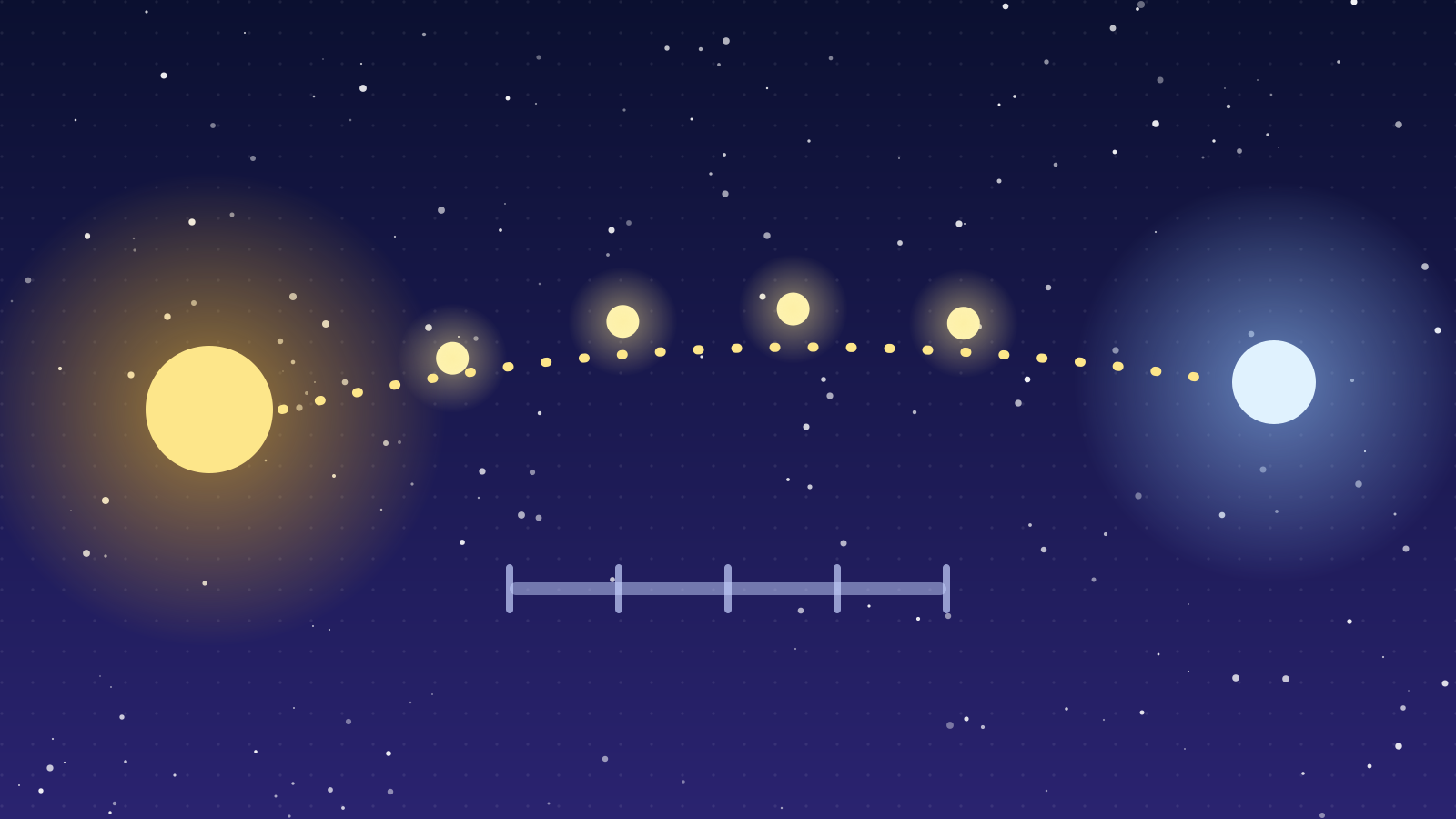
Despite its name, a light-year is a unit of distance, not time: it is how far light travels through a vacuum in one year. Because light moves at about 300,000 kilometres per second, one light-year is roughly 9.46 trillion kilometres. Astronomers use it to describe distances between stars and galaxies that are far too large to express sensibly in kilometres.
In this article (8)
Some of the stars you see in the night sky are a few light-years away; others are thousands of light-years away. The phrase sounds familiar, but most people do not really know how vast a light-year is or why we need such a unit. Many even assume it is a unit of time.
A light-year is a distance
Light is the fastest thing in the universe. In a vacuum it travels about 299,792 kilometres per second. At that speed, light:
- could circle Earth 7.5 times in one second;
- reaches the Moon in 1.3 seconds;
- travels from the Sun to Earth in 8 minutes and 20 seconds.
A light-year is the distance light covers at that dizzying speed in one year. Let’s work it out:
299,792 km/s × 60 seconds × 60 minutes × 24 hours × 365.25 days ≈ 9.46 trillion kilometres
That is about 9,460,000,000,000 kilometres — a number so huge that kilometres stop being practical, rather like measuring the distance between London and Edinburgh in millimetres.
How big is a light-year?
It is very hard to grasp. Here is a comparison:
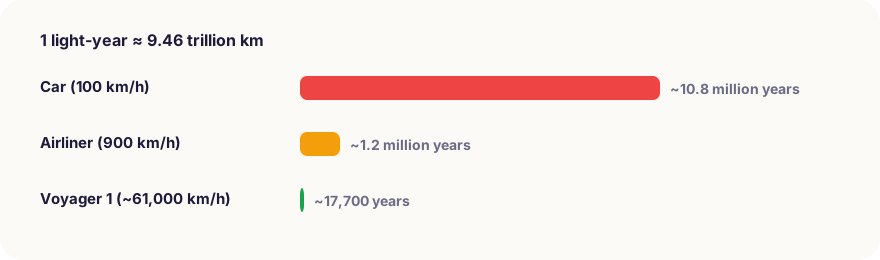
- A car driving non-stop at 100 kilometres per hour would take about 10.8 million years to cover one light-year.
- An airliner flying at 900 kilometres per hour would need about 1.2 million years.
- Voyager 1, humanity’s most distant spacecraft, travelling at roughly 61,000 kilometres per hour, would still need about 17,700 years.
After almost 50 years of travel since its launch in 1977, Voyager 1 is only reaching one light-day from Earth in autumn 2026 — just 1/365th of a light-year.
The scale of the universe
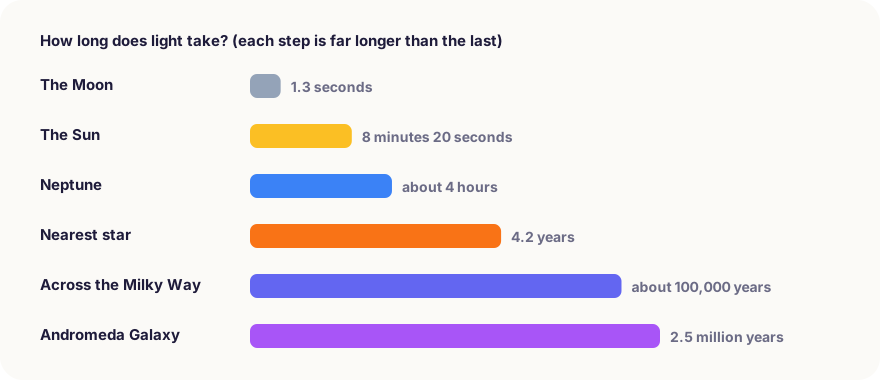
Light-years make distances in space understandable. Here is how long light takes to reach various objects:
| Object | Distance |
|---|---|
| The Moon | 1.3 light-seconds |
| The Sun | 8.3 light-minutes |
| Neptune | About 4 light-hours |
| Proxima Centauri (nearest star) | 4.24 light-years |
| Polaris (the North Star) | About 430 light-years |
| Centre of the Milky Way | About 26,000 light-years |
| Diameter of the Milky Way | About 100,000 light-years |
| Andromeda Galaxy | About 2.5 million light-years |
Even if the Solar System were the size of a football pitch, the nearest star would be in another country.
Looking at stars is looking into the past
The most fascinating consequence of the light-year is this: when we look into space, we look into the past.
Light takes time to reach us, so we see objects not as they are now but as they were when their light set off:
- Looking at the Sun, you see it as it was 8 minutes ago.
- Seeing Proxima Centauri through a telescope, you see it as it was about 4 years ago.
- Looking at the Andromeda Galaxy, you see it as it was 2.5 million years ago — when its light set off, modern humans had not yet appeared on Earth.
That also means some stars may no longer exist. Even if a distant star has exploded, its light keeps arriving, so we continue to see it in the sky.
Astronomers use this like a time machine. By observing very distant galaxies, they can study the universe as it was billions of years ago. The James Webb Space Telescope has imaged galaxies whose light set off more than 13 billion years ago, from the early days of the universe.
How big is the universe?
The universe is about 13.8 billion years old. You might think, then, that we can see at most 13.8 billion light-years away. The truth is even stranger.
The universe is expanding. While light travelled towards us, the galaxies that emitted it kept moving away because of that expansion. So the observable universe — the part we can see today — is calculated to be about 93 billion light-years across. How much universe lies beyond it is unknown; it might even be infinite.
Astronomers’ other units
The light-year is the best known, but astronomers use other units too:
- Astronomical unit (AU): the average distance between Earth and the Sun, about 150 million kilometres — used within the Solar System.
- Parsec (pc): about 3.26 light-years, from the parallax method, which measures how much a star’s position shifts in the sky as Earth orbits the Sun.
- Megaparsec (Mpc): a million parsecs, used for distances between galaxies.
Why can’t we go faster than light?
The light-year also shows why space travel is so hard. According to Einstein’s special theory of relativity, no object with mass can reach the speed of light in a vacuum. As an object approaches it, the energy needed to accelerate it further heads towards infinity.
That is why reaching even the nearest star would take tens of thousands of years with today’s technology. Scientists are working on new ideas such as tiny laser-pushed light sails, which might let very small probes reach the nearest star within a few decades.
In short
Despite its name, a light-year is not a time but a distance: about 9.46 trillion kilometres, the distance light travels in a year. It makes the mind-boggling distances between stars and galaxies understandable. Because light’s journey takes time, looking into space means looking into the past — we see the Sun as it was 8 minutes ago and Andromeda as it was 2.5 million years ago. The scale of the universe stretches the limits of human imagination.
Frequently asked questions
Why isn’t a light-year a unit of time?
The word “year” is misleading. A light-year tells you how far light travels in a year, so it is a length — just as “an hour’s drive” actually describes a distance.
How many light-years away is the nearest star?
After the Sun, the nearest star is Proxima Centauri, about 4.24 light-years away. The light we see from it today set off about four years and three months ago.
What is a parsec?
A parsec is another unit astronomers often use, equal to about 3.26 light-years. Its name comes from the parallax method used to measure the distances of stars.
Is it possible to travel faster than light?
According to Einstein’s theory of relativity, no object with mass can reach or exceed the speed of light in a vacuum. That is why the speed of light is considered the universe’s speed limit.
Sources
This article is based on peer-reviewed research and publications from trusted institutions, and it is reviewed regularly. How we work →
You might also wonder
All in Space →
What Are Shooting Stars? Meteors, Meteor Showers and Where to See Them
Shooting stars are not stars at all. What makes those streaks of light, why do meteor showers happen on the same dates every year, and how can you see the most?
Why Does Saturn Have Rings? What They Are Made Of and How Old They Are
Saturn’s rings are made of billions of ice chunks, yet they are only metres thick. Where did they come from, why aren’t they a moon, and will they vanish?

Why Does the Moon Look Bigger on the Horizon? The Moon Illusion Explained
A rising full Moon looks huge, yet it is no bigger than when it is high in the sky. Why does our brain inflate it, and how can you prove the illusion yourself?
How Do Solar Eclipses Work? Why the Moon Fits the Sun Perfectly
A total solar eclipse happens when the Moon exactly covers the Sun. Why the fit is so perfect, the types of eclipse, and how to watch one safely.
Why Do We Only See One Side of the Moon? Tidal Locking Explained
The Moon spins once for every trip around Earth, so the same face always points at us. How tidal locking works, and why the far side is not really dark.
Why Is Pluto Not a Planet? The 2006 Decision Explained
Pluto lost its planet status in 2006. The three rules astronomers set for a planet, why Pluto fails one, and what New Horizons revealed about this icy world.