Why Do We Only See One Side of the Moon? Tidal Locking Explained
The Moon spins once for every trip around Earth, so the same face always points at us. How tidal locking works, and why the far side is not really dark.
Short answer
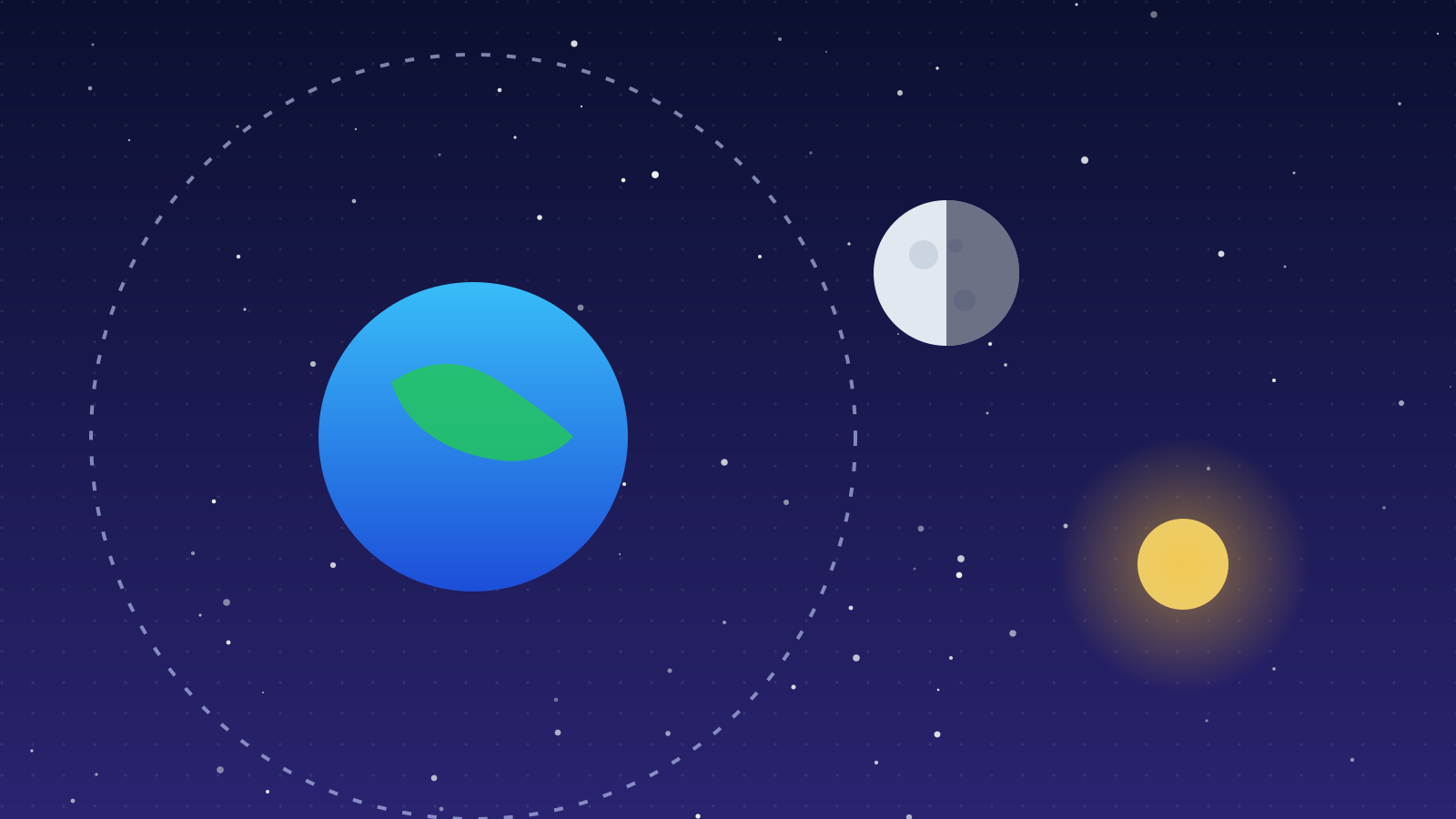
We always see the same side of the Moon because it is tidally locked to Earth: it takes exactly as long to spin once on its axis as it does to orbit Earth, about 27.3 days. Billions of years ago the young Moon spun faster, but Earth’s gravity stretched it into a slightly elongated shape. Those bulges kept being pulled back towards Earth, acting like a brake, until the Moon’s spin matched its orbit. Thanks to small wobbles called librations, we can actually see about 59% of the lunar surface from Earth. The far side is not dark; it gets just as much sunlight as the near side.
In this article (6)
Look at the full Moon tonight and you will see the same dark patches people have described for thousands of years: a face, a rabbit, a woman reading. Every generation in history has seen exactly the same view. The Moon never turns around to show us its other side. Why not?
It does spin, just slowly
A common idea is that the Moon does not rotate. In fact it does, but at a very particular speed. The Moon turns once on its axis in about 27.3 days, exactly the time it takes to complete one orbit around Earth. Because spin and orbit stay in step, the same hemisphere always faces us.
You can try this yourself. Walk in a circle around a chair while always facing it. By the time you have gone round once, you have also turned through a full circle, yet the chair only ever saw your face.
How it got locked
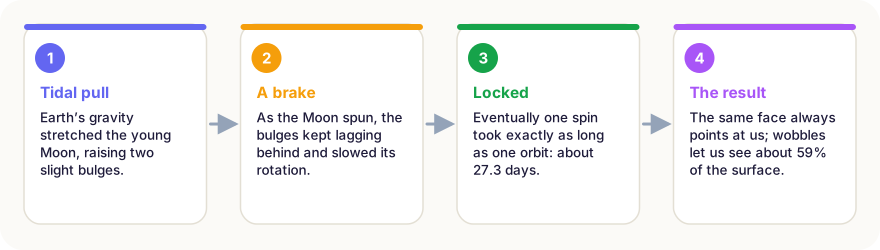
The young Moon, more than four billion years ago, spun much faster. But Earth’s gravity pulls harder on the near side of the Moon than on the far side. This difference, the tidal force, stretched the Moon very slightly, raising a bulge on each side, much as the Moon raises tides in our oceans.
As the Moon spun, the bulges were carried slightly ahead of the line pointing at Earth. Earth’s gravity kept tugging them back, creating a twisting force that acted like a brake. Over millions of years the spin slowed until it matched the orbit exactly. At that point the bulges stayed lined up with Earth and the braking stopped. This state is called tidal locking, or synchronous rotation.
It is the normal outcome for moons close to their planets. Most of the large moons in the solar system are tidally locked, and Pluto and its moon Charon are locked to each other, each always showing the other the same face.
We see more than half
Even so, we can see about 59% of the Moon’s surface over time, not just 50%. The Moon’s orbit is slightly elliptical, so its orbital speed changes while its spin stays steady, and its axis is slightly tilted. These effects make the Moon appear to rock and nod a little, a motion called libration, which lets us peek around its edges.
The “dark side” isn’t dark
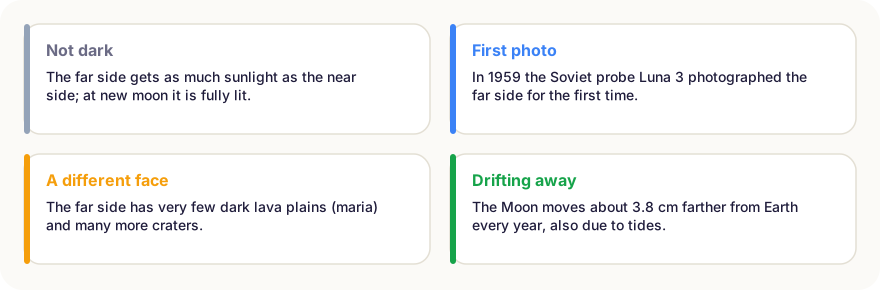
The side we never see is often called the “dark side”, but it gets just as much sunlight as the side facing us. During a new moon, when the near side looks black to us, the far side is in full daylight. A better name is the far side.
No one had seen it until 1959, when the Soviet probe Luna 3 sent back the first blurry photographs. They revealed a surprise: the far side has very few of the dark lava plains, called maria, that make up the “face” we know, and many more craters. Scientists think the crust on the far side is thicker, so less lava reached the surface. In 2019, China’s Chang’e 4 became the first spacecraft to land there.
The Moon is drifting away
Tidal forces still work today, now mainly on Earth. The Moon’s pull slows Earth’s spin, making our days longer by a tiny fraction of a second per century, and in return the Moon moves farther away by about 3.8 centimetres a year. We know this precisely because Apollo astronauts left mirrors on the lunar surface, and scientists time laser pulses bounced off them.
In short
- The Moon does rotate, once every 27.3 days, the same time as one orbit.
- This matching, called tidal locking, keeps the same face pointing at Earth.
- Earth’s gravity raised bulges on the young Moon that acted as a brake on its spin.
- Thanks to libration, we can see about 59% of the Moon’s surface.
- The far side is not dark; it gets as much sunlight as the near side.
- The Moon is moving away from Earth by about 3.8 cm a year.
Frequently asked questions
Does the Moon rotate?
Yes. The Moon rotates once every 27.3 days, the same time it takes to orbit Earth. If it did not rotate at all, we would see all of its sides over a month.
Is there a dark side of the Moon?
Not really. The side we never see is better called the far side. It has day and night just like the near side; during a new moon, when the near side looks dark, the far side is fully lit.
Who first saw the far side of the Moon?
The Soviet probe Luna 3 sent back the first photographs in 1959. The first people to see it with their own eyes were the Apollo 8 astronauts in 1968.
Are other moons tidally locked?
Yes, most large moons in the solar system, including Jupiter’s Galilean moons and Saturn’s Titan, always show the same face to their planet. Pluto and its moon Charon are locked to each other.
Sources
This article is based on peer-reviewed research and publications from trusted institutions, and it is reviewed regularly. How we work →
You might also wonder
All in Space →
What Are Shooting Stars? Meteors, Meteor Showers and Where to See Them
Shooting stars are not stars at all. What makes those streaks of light, why do meteor showers happen on the same dates every year, and how can you see the most?
Why Does Saturn Have Rings? What They Are Made Of and How Old They Are
Saturn’s rings are made of billions of ice chunks, yet they are only metres thick. Where did they come from, why aren’t they a moon, and will they vanish?
Why Does the Moon Look Bigger on the Horizon? The Moon Illusion Explained
A rising full Moon looks huge, yet it is no bigger than when it is high in the sky. Why does our brain inflate it, and how can you prove the illusion yourself?
How Do Solar Eclipses Work? Why the Moon Fits the Sun Perfectly
A total solar eclipse happens when the Moon exactly covers the Sun. Why the fit is so perfect, the types of eclipse, and how to watch one safely.
Why Is Pluto Not a Planet? The 2006 Decision Explained
Pluto lost its planet status in 2006. The three rules astronomers set for a planet, why Pluto fails one, and what New Horizons revealed about this icy world.
Why Is the Night Sky Dark? Olbers’ Paradox and the Age of the Universe
With billions of stars out there, why isn’t the night sky ablaze with light? Olbers’ paradox, the finite age of the universe and cosmic expansion, explained.