Why Does the Moon Look Bigger on the Horizon? The Moon Illusion Explained
A rising full Moon looks huge, yet it is no bigger than when it is high in the sky. Why does our brain inflate it, and how can you prove the illusion yourself?
Short answer
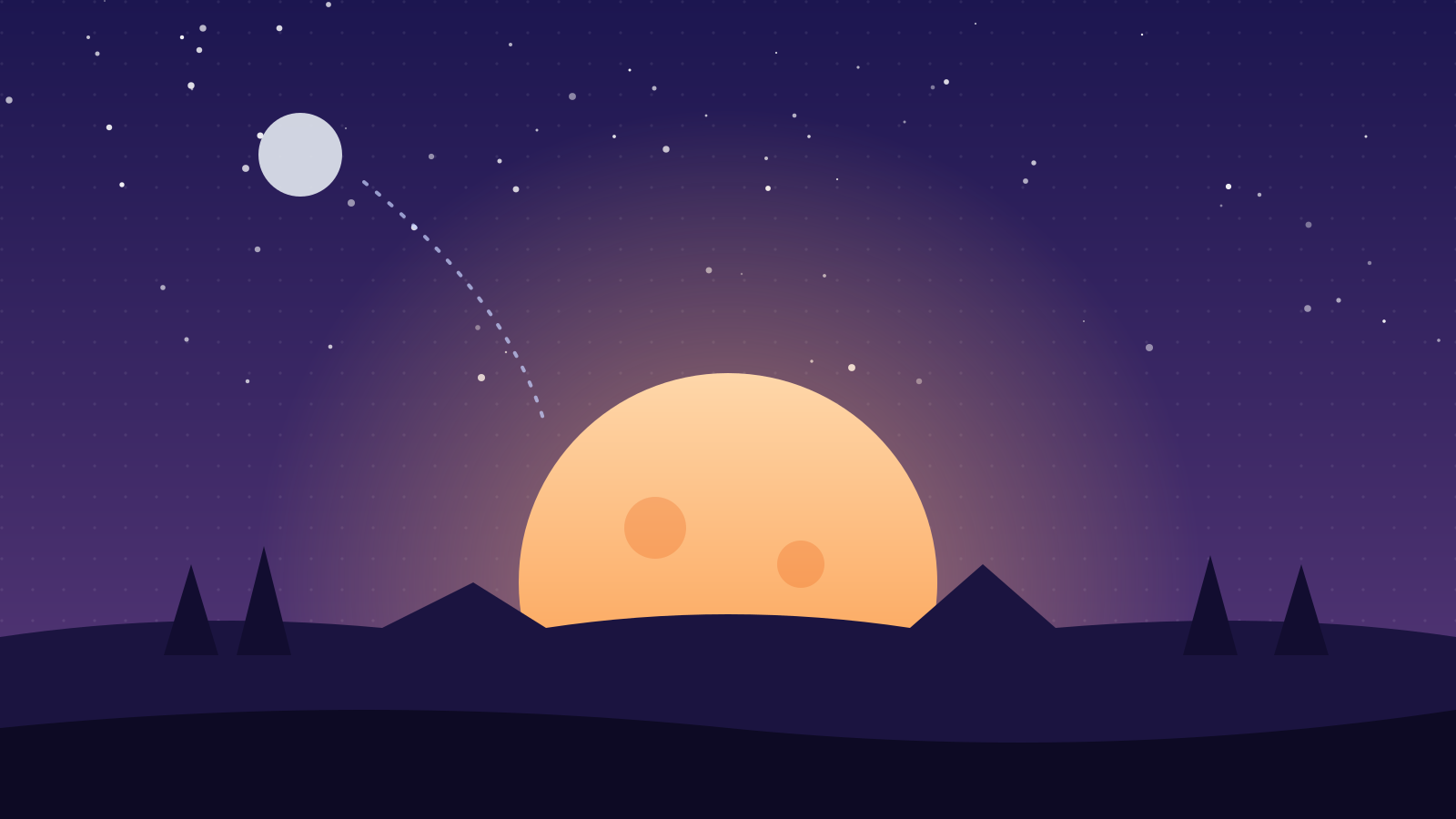
The Moon looks bigger near the horizon because of an illusion in the brain, not because it is closer or magnified by the air. Its angular size is about half a degree wherever it is in the sky; near the horizon it is actually slightly farther away. The leading explanation is that we perceive the sky as a flattened dome, so the brain judges the horizon Moon to be farther away and therefore larger. Trees, buildings and hills next to it add a sense of scale that the empty overhead sky lacks.
In this article (7)
You turn a corner on an autumn evening and there it is: a giant orange full Moon sitting on the rooftops, so large it seems unreal. A few hours later, high in the sky, it looks ordinary again. Nothing about the Moon has changed. The change happened in your brain, and scientists have argued about why for more than 2,000 years.
The Moon does not change size
The Moon is about 3,474 kilometres across and about 384,000 kilometres away. From Earth it covers an angle of roughly half a degree, about the width of a pea held at arm’s length.
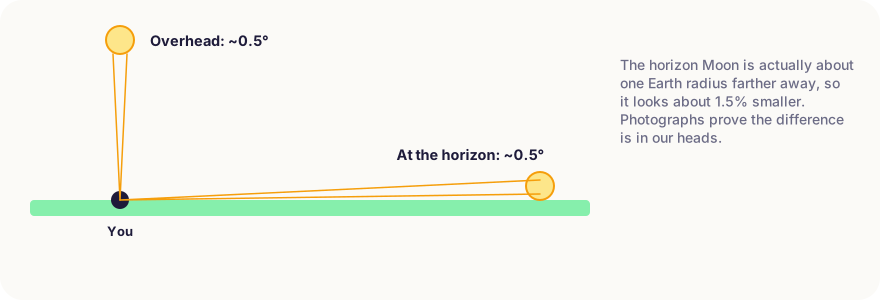
That angle stays essentially the same as the Moon crosses the sky. In fact, when the Moon is on the horizon you are about one Earth radius farther from it than when it is directly overhead, so the horizon Moon is about 1.5% smaller. The camera never lies about this: a photo of the rising Moon and one of the Moon overhead, taken with the same lens, show discs of the same size.
Myth one: the air acts like a lens
A popular explanation is that the thick layer of air near the horizon magnifies the Moon. It does not. Atmospheric refraction bends light so that the low Moon is actually slightly squashed vertically, which is why the rising Sun or Moon can look a little oval. It never makes them bigger.
The orange colour has a separate cause. Near the horizon moonlight passes through much more air, which scatters away blue light and leaves warmer colours, the same effect that colours sunsets.
The leading theory: a flattened sky
Ancient thinkers including Ptolemy noticed the illusion, and the Arab scholar Ibn al-Haytham argued around 1,000 years ago that it has to do with how far away we think the Moon is.
Most people perceive the sky not as a perfect dome but as a flattened bowl. The horizon seems farther away than the point overhead. Our brain links size and distance: if two objects make the same image on the retina, the one we believe is farther away must be bigger. Because the horizon Moon seems more distant, the brain inflates its size.
In 2000 Lloyd Kaufman and James Kaufman tested this with a clever apparatus that let volunteers adjust an artificial moon. Their results supported the idea that perceived distance drives the illusion, although they found that people then judged the large horizon Moon to be closer, a paradox that shows how tangled size and distance perception can be.
Context makes it bigger
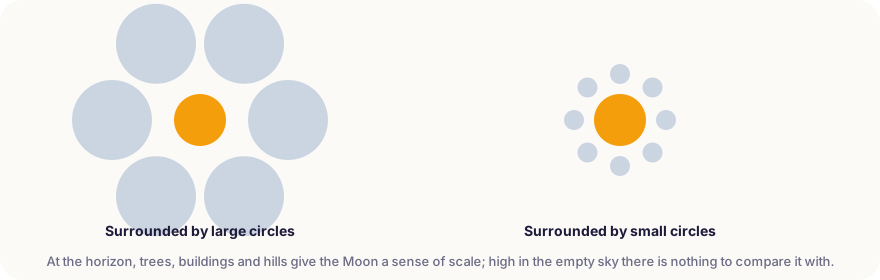
A second ingredient is comparison. Near the horizon the Moon sits next to trees, houses and hills whose size we know. High in the sky there is nothing to compare it with.
Psychologists have known for a long time that the same object can look larger or smaller depending on its surroundings. In the classic Ebbinghaus illusion, a circle surrounded by small circles looks bigger than the same circle surrounded by large ones.
There is no single accepted answer. Most researchers think the Moon illusion combines several effects: perceived distance, comparison with the landscape and possibly how our eyes focus and converge when looking up versus straight ahead.
Test the illusion yourself
You can break the spell with a few simple experiments:
- Use a tube. Look at the rising Moon through a rolled-up sheet of paper so you cannot see the landscape. It often shrinks immediately.
- Measure it. Hold a pencil eraser or a small coin at arm’s length and compare it with the Moon on the horizon, then again a few hours later. It covers the same amount.
- Look upside down. Bend over and look at the Moon between your legs. For many people the illusion weakens.
- Take photos. Photograph the Moon with the same zoom at moonrise and later in the evening, then compare.
The illusion is not only about the Moon
The same effect makes the setting Sun look huge and makes constellations such as Orion or the Big Dipper look larger when they are low in the sky. It even appears in flight simulators and planetarium domes. Never look directly at the Sun to test this.
In short
- The Moon covers about half a degree of sky whether it is low or high; near the horizon it is actually slightly smaller.
- The atmosphere does not magnify it; refraction squashes it slightly.
- The leading explanation is that we see the sky as a flattened dome, so the horizon Moon seems farther and therefore larger.
- Landmarks near the horizon add a sense of scale that the empty sky lacks.
- Looking through a tube, measuring with a coin or taking photos proves it is an illusion.
Frequently asked questions
Is the Moon really closer when it rises?
No. When it is on the horizon you are about one Earth radius farther from it than when it is overhead, so it is about 1.5% smaller in angular size.
Does Earth’s atmosphere magnify the Moon?
No. Refraction in the atmosphere actually squashes the low Moon slightly from top to bottom, making it look a little oval. It does not make it larger.
Does the same illusion affect the Sun and constellations?
Yes. The setting Sun and constellations such as Orion also look larger near the horizon. Never look directly at the Sun to test it.
Why does the Moon look so small in photos?
A camera records only the true angular size. Without the brain’s illusion, the Moon is a small disc covering about half a degree, roughly the width of a pea at arm’s length.
Sources
- Kaufman, L. & Kaufman, J. H. (2000). Explaining the moon illusion. Proceedings of the National Academy of Sciences
- NASA Science – Earth’s Moon
This article is based on peer-reviewed research and publications from trusted institutions, and it is reviewed regularly. How we work →
You might also wonder
All in Space →
What Are Shooting Stars? Meteors, Meteor Showers and Where to See Them
Shooting stars are not stars at all. What makes those streaks of light, why do meteor showers happen on the same dates every year, and how can you see the most?
Why Does Saturn Have Rings? What They Are Made Of and How Old They Are
Saturn’s rings are made of billions of ice chunks, yet they are only metres thick. Where did they come from, why aren’t they a moon, and will they vanish?
Why Is the Night Sky Dark? Olbers’ Paradox and the Age of the Universe
With billions of stars out there, why isn’t the night sky ablaze with light? Olbers’ paradox, the finite age of the universe and cosmic expansion, explained.
Why Does the Moon Change Shape? Moon Phases Explained Simply
Why does the Moon go from crescent to full? Why lunar phases have nothing to do with Earth’s shadow, and how to tell a waxing Moon from a waning one.
What Is a Black Hole? How They Form and What Happens Inside
What is a black hole, how does it form and what is the event horizon? A clear guide to the objects not even light can escape — and their first images.
What Is a Light-Year? Making Sense of Space’s Enormous Distances
Is a light-year a unit of time or distance? How big a light-year really is, why looking at stars means looking into the past, and the scale of the universe.