What Is a Black Hole? How They Form and What Happens Inside
What is a black hole, how does it form and what is the event horizon? A clear guide to the objects not even light can escape — and their first images.
Short answer
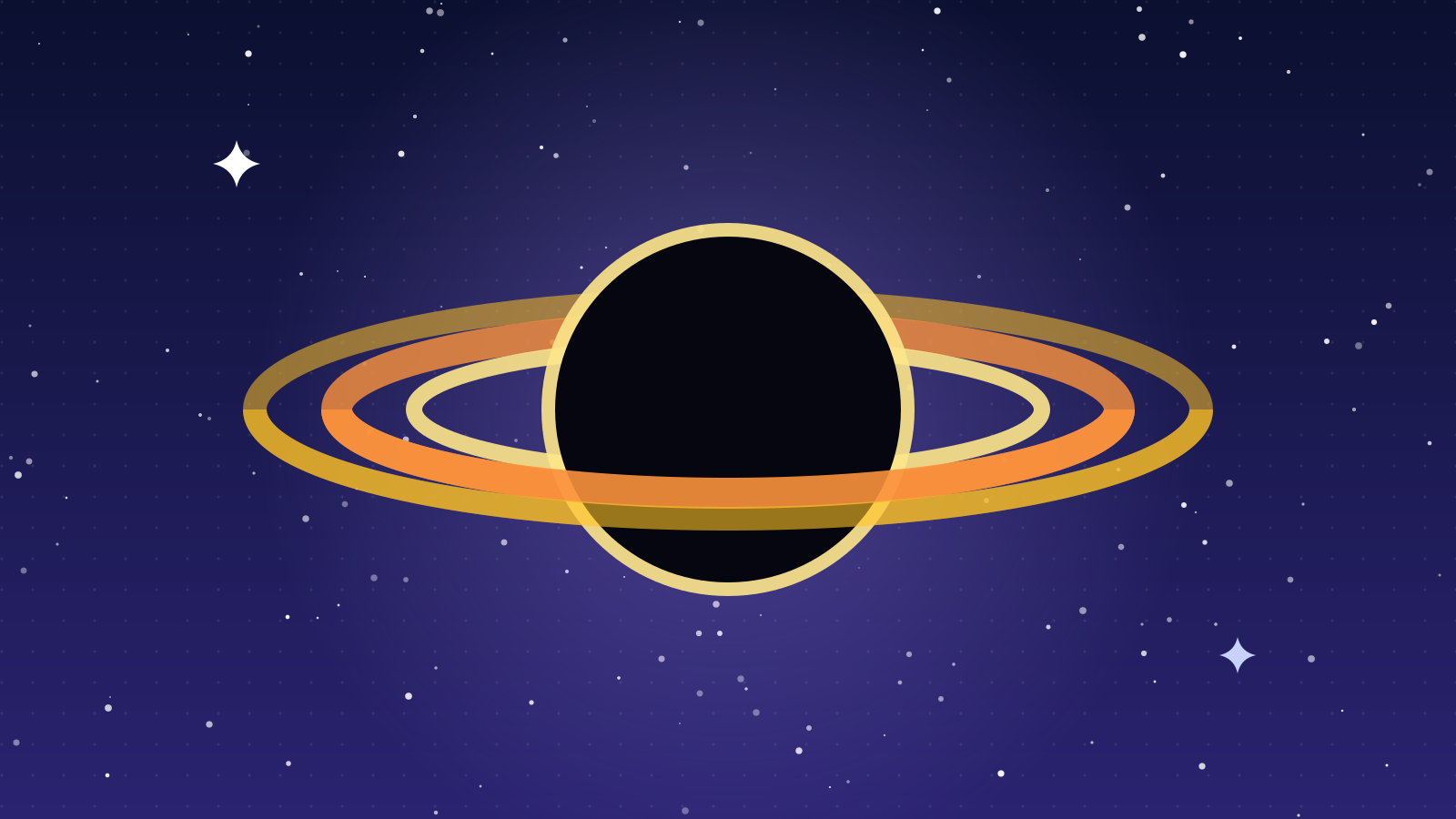
A black hole is a region of space where mass is squeezed into such a small volume that gravity becomes overwhelmingly strong. Inside a boundary called the event horizon, nothing — not even light — can escape. Most black holes form when massive stars collapse at the end of their lives.
In this article (7)
There are places in space where anything that enters — even light — can never come back out. For a long time black holes existed only on paper, as theoretical curiosities. Today we can “hear” them through gravitational waves and even take their picture.
What exactly is a black hole?
A black hole is a region where a huge amount of mass is crammed into a tiny volume. Gravity grows with mass and gets stronger the closer you get. Squeeze enough mass into a small enough space and, within a certain distance, the speed needed to escape exceeds the speed of light.
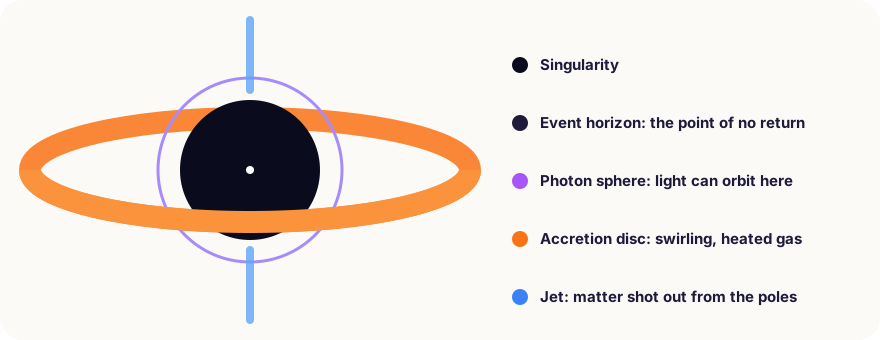
Since nothing travels faster than light, nothing inside that boundary can get out. The boundary is called the event horizon, and it is what makes a black hole “black”: it gives off no light of its own and reflects none that falls onto it.
According to Albert Einstein’s general theory of relativity, published in 1915, mass bends spacetime. Black holes are the most extreme example of that bending — spacetime becomes something like a bottomless well.
How do black holes form?
Most black holes are born when massive stars die:
- A star at least 20 times heavier than the Sun shines for millions of years by fusing elements in its core.
- When the fuel runs out, the outward pressure disappears and the core collapses under its own weight in seconds.
- The star’s outer layers are blasted into space in a huge supernova explosion.
- If the remaining core is heavy enough, no force can stop the collapse, and a black hole forms.
Lighter stars end their lives as white dwarfs or neutron stars instead. Our Sun is far too light to become a black hole; in about five billion years it will fade as a white dwarf.
Types of black holes
| Type | Mass (Sun = 1) | Example |
|---|---|---|
| Stellar-mass | about 3 – 100 | Cygnus X-1 |
| Intermediate-mass | 100 – 100,000 | Only a few candidates so far |
| Supermassive | millions – billions | Sagittarius A*, M87* |
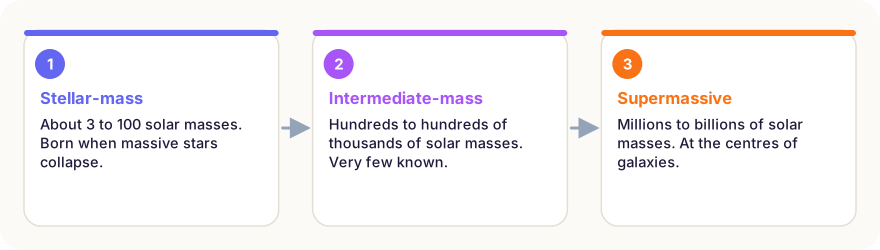
Almost every large galaxy has a supermassive black hole at its centre. Sagittarius A* at the heart of the Milky Way weighs about 4 million Suns. How these giants grew so large remains one of astronomy’s biggest open questions.
How do we see something invisible?
A black hole emits no light, but its effect on its surroundings gives it away:
- Orbiting stars: Astronomers tracked stars racing around an invisible point at the centre of the Milky Way for decades — work that earned the 2020 Nobel Prize in Physics.
- Accretion discs: Gas spiralling into a black hole heats up through friction to millions of degrees and glows in X-rays.
- Gravitational waves: In 2015 the LIGO detectors directly measured ripples in spacetime from two merging black holes for the first time.
- Images: The Event Horizon Telescope, which links radio telescopes around the world, captured the dark shadow of the black hole in galaxy M87 in 2019 and of Sagittarius A* in 2022, each ringed by glowing gas.
What happens if you fall in?
Imagine approaching a black hole feet first. Gravity pulls on your feet much more strongly than on your head. The difference grows so large that your body is stretched lengthwise and squeezed sideways — something physicists jokingly call “spaghettification”.
Here is a twist: around small black holes this is fatal long before you reach the event horizon. Around supermassive black holes the difference is so gentle that you could cross the horizon without noticing.
Then there is time. Someone watching from far away would see you slow down as you near the horizon, your image reddening and fading. For you, time would pass normally. This is an extreme case of gravitational time dilation, predicted by general relativity.
What happens inside the event horizon, we simply do not know. The theory predicts a singularity of infinite density at the centre, but most physicists expect that picture to change once we have a theory uniting gravity and quantum physics.
Are black holes dangerous?
Despite what science fiction suggests, black holes are not cosmic vacuum cleaners. From afar, a black hole pulls just like a star of the same mass. If the Sun were suddenly replaced by a black hole of equal mass, Earth would notice the darkness — and keep orbiting exactly as before.
The nearest known black hole, Gaia BH1, is about 1,560 light-years away, no threat to the Solar System.
In short
Black holes are regions where extreme compression of mass bends spacetime without limit. They are born from dying stars, grow into giants at the centres of galaxies and let nothing escape from beyond the event horizon. Yet through their effects on their surroundings we can observe them — and use them to test the most fundamental laws of the universe.
Frequently asked questions
Do black holes suck up everything around them?
No. From a distance a black hole pulls like any other object of the same mass. If the Sun were suddenly replaced by a black hole of equal mass, Earth would keep orbiting as before.
Has a black hole been photographed?
Yes. The Event Horizon Telescope imaged the shadow of the black hole at the centre of galaxy M87 in 2019, and of Sagittarius A* at the heart of the Milky Way in 2022.
Where is the nearest black hole to Earth?
The nearest known one is Gaia BH1, about 1,560 light-years away. It poses no danger to the Solar System.
Do black holes last forever?
According to Stephen Hawking, black holes slowly evaporate by emitting radiation. For a stellar-mass black hole, though, this would take vastly longer than the current age of the universe.
Sources
This article is based on peer-reviewed research and publications from trusted institutions, and it is reviewed regularly. How we work →
You might also wonder
All in Space →
Why Is the Night Sky Dark? Olbers’ Paradox and the Age of the Universe
With billions of stars out there, why isn’t the night sky ablaze with light? Olbers’ paradox, the finite age of the universe and cosmic expansion, explained.

Why Does the Moon Change Shape? Moon Phases Explained Simply
Why does the Moon go from crescent to full? Why lunar phases have nothing to do with Earth’s shadow, and how to tell a waxing Moon from a waning one.
What Is a Light-Year? Making Sense of Space’s Enormous Distances
Is a light-year a unit of time or distance? How big a light-year really is, why looking at stars means looking into the past, and the scale of the universe.
How Does the Sun Shine? The Story of Nuclear Fusion in Its Core
How does the Sun produce light and heat, how does its energy reach us and when will it burn out? Nuclear fusion in the core and the Sun’s layers, explained.

Why Do Stars Twinkle? The Atmosphere Behind the Flicker
Why do stars twinkle while planets shine steadily? How starlight bends in Earth’s atmosphere, and how astronomers fight the twinkle to get sharp images.
Why Is Mars Red? The Rusty Secret of the Red Planet
What gives Mars its red colour? The iron-oxide dust covering its surface, the 2025 discovery of traces of water, and why Martian sunsets are blue.