Why Is Mars Red? The Rusty Secret of the Red Planet
What gives Mars its red colour? The iron-oxide dust covering its surface, the 2025 discovery of traces of water, and why Martian sunsets are blue.
Short answer
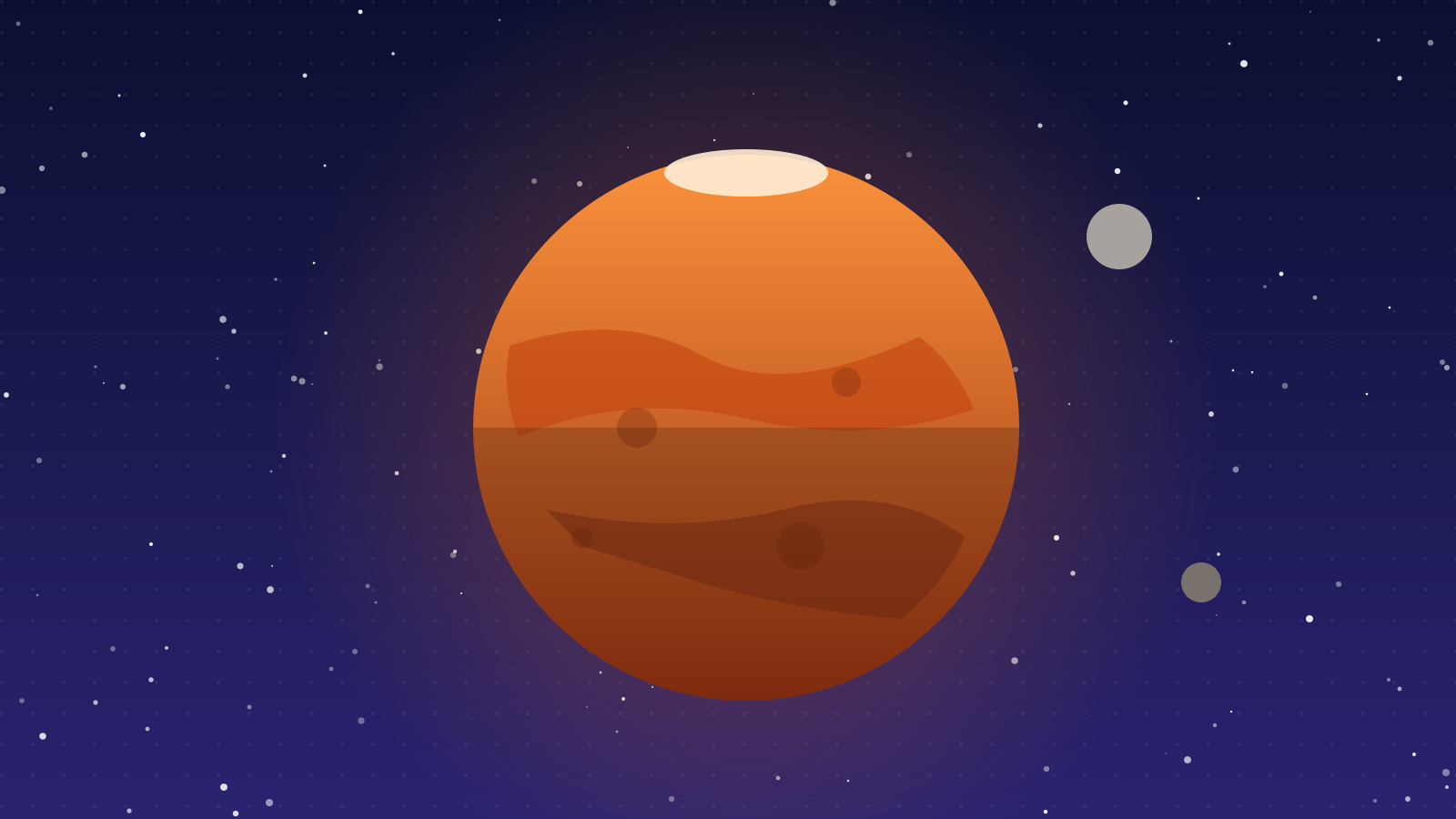
Mars is red because of iron oxides — essentially rust — in the fine dust that covers its surface. Over billions of years, iron in volcanic rock reacted with water and the atmosphere, rusted and crumbled into dust that winds spread across the whole planet. In most places the dust layer is very thin, with dark grey volcanic rock underneath.
In this article (8)
Glowing orange-red in the night sky, Mars has caught people’s attention for thousands of years. The Romans named it after their god of war, and today we know it as the “Red Planet”. But where does the colour come from? The answer is something you have seen on an old knife or a bicycle chain: rust.
A planet-wide layer of rust
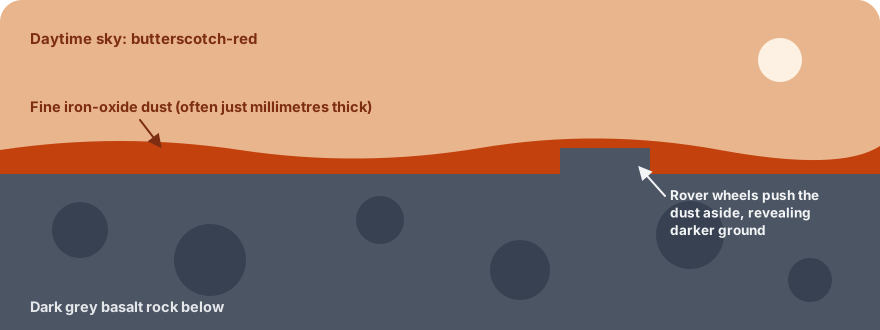
The surface of Mars is covered by an extremely fine layer of dust, usually just millimetres to a few centimetres thick. The dust is as fine as flour and rich in iron oxides.
Iron oxides are compounds of iron and oxygen. On Earth, the most familiar example is the reddish-brown rust that forms on iron left in the rain. Iron oxides reflect red and orange light while absorbing much of the blue and green, so when we look at Mars we see a reddish colour.
Where did the iron come from — and how did it rust?
Like Earth, Mars is a rocky planet, and much of its crust is volcanic basalt, which is rich in iron. When the planet was young and active, giant volcanoes brought this rock to the surface. Olympus Mons, the largest volcano in the Solar System, stands about 22 kilometres tall — more than two and a half times the height of Everest.
For iron in rock to turn into rust, it needs oxygen and usually water. Scientists discuss several possible routes:
- Rusting with water: early in its history Mars had rivers, lakes and perhaps an ocean on its surface. Water slowly oxidised the iron in the rocks.
- Reactions with the atmosphere: ultraviolet light from the Sun splits water vapour and carbon dioxide in the air, producing oxidising chemicals that may have slowly rusted iron over billions of years.
- Crumbling and spreading: meteorite impacts, temperature swings and wind ground the rocks into dust, and winds spread that dust across the planet.
The surprise of 2025: water hidden in the rust
For many years the main mineral thought to give Martian dust its colour was hematite, a dry iron oxide that does not need much water to form. That supported the idea that Mars rusted in a largely dry environment.
In 2025, researchers from Brown University and the University of Bern compared data from orbiting spacecraft and surface rovers with laboratory experiments. The result was striking: the mineral that best explained the colour of Martian dust was ferrihydrite — an iron oxide that contains water in its structure.
Ferrihydrite usually forms quickly where cold water is present. The finding suggests that:
- Mars may have rusted while water still existed on its surface;
- that period may have had a cold but wet climate;
- once formed, the ferrihydrite has survived for billions of years in today’s dry conditions.
The conclusion is not final and needs testing with new measurements. Dust and rock samples planned to be brought back from Mars could answer the question directly.
What colour is the Martian sky?
The dust colours not just the ground but the air as well. The Martian atmosphere is very thin, but fine dust particles are always suspended in it, and they scatter light differently from the gas molecules in Earth’s air:
- By day, the sky looks reddish-brown or “butterscotch”, because the dust scatters red light in all directions while absorbing some of the blue.
- At sunset, a bluish glow surrounds the Sun. The dust scatters blue light most strongly in the forward direction — close around the Sun — and the effect becomes obvious when the Sun is low.
That is the exact reverse of Earth, where the sky is blue and sunsets red. For the details, see our article Why is the sky blue?.
Dust storms that wrap the planet
Mars has no rain and no plants, so dust cannot be held down and is easily lifted by the wind. Local dust storms are frequent, and every few Martian years a global dust storm shrouds the whole planet for weeks.
The global storm of 2018 darkened the sky so much that the solar-powered Opportunity rover ran out of power. After almost 15 years of work, it never sent another signal. During storms, dust is redistributed in layers all over the planet — which is why Mars looks a similar shade of red everywhere.
Mars versus Earth
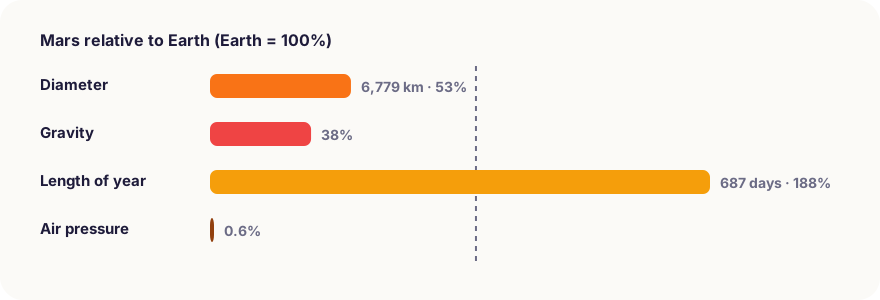
Mars resembles Earth in many ways, but it is a much smaller and colder world:
| Feature | Mars | Earth |
|---|---|---|
| One day (sol) | 24 h 37 min | 24 h |
| One year | 687 Earth days | 365 days |
| Average temperature | about −60 °C | about 15 °C |
| Atmosphere | Very thin, mostly carbon dioxide | Nitrogen and oxygen |
| Moons | Phobos and Deimos | The Moon |
Although a Martian day is very close to ours, the thin atmosphere cannot hold heat. On a summer afternoon at the equator it can reach 20 °C, then drop below −70 °C the same night.
What lies beneath the red?
The redness of Mars is really a surface “paint”. When NASA’s rovers drill into rocks or dig into the soil with their wheels, they expose dark grey and blackish rock beneath. In some places, pale clay and salt minerals formed by water have also been found under the dust.
In other words, the colour we see from space is not the colour of the whole planet, but of a thin coat of rust covering it.
In short
Mars is red because of the fine iron-oxide dust coating its surface. Billions of years ago, iron in volcanic rock reacted with water and the atmosphere, rusted, crumbled and was spread around the planet by the wind. The 2025 findings suggest this rust formed while the planet was still cold and wet. The Red Planet’s colour may be a memento of its watery past.
Frequently asked questions
Is Mars red on the inside?
No. The redness comes mostly from the thin layer of surface dust. When rover wheels scuff the dust or drills bore into rocks, dark grey basalt appears underneath.
Why is there so much dust on Mars?
There is no rain to bind the dust to the ground and no vegetation, so winds lift it constantly. In some years, global dust storms cover the entire planet for weeks.
Is there water on Mars?
Liquid water cannot last on the surface today, but there is a great deal of ice at the poles and underground. Dry river valleys and water-bearing minerals in the dust show that water was once abundant.
Can you see Mars with the naked eye?
Yes. It appears as a bright point with a distinctive orange-red tint. It is especially bright around opposition, when it comes closest to Earth, roughly every 26 months.
Sources
- NASA Science – Mars: Facts
- Valantinas et al. (2025) – Detection of ferrihydrite in Martian red dust records ancient cold and wet conditions on Mars, Nature Communications
- ESA – Mars Express
This article is based on peer-reviewed research and publications from trusted institutions, and it is reviewed regularly. How we work →
You might also wonder
All in Space →
Why Is the Night Sky Dark? Olbers’ Paradox and the Age of the Universe
With billions of stars out there, why isn’t the night sky ablaze with light? Olbers’ paradox, the finite age of the universe and cosmic expansion, explained.

Why Does the Moon Change Shape? Moon Phases Explained Simply
Why does the Moon go from crescent to full? Why lunar phases have nothing to do with Earth’s shadow, and how to tell a waxing Moon from a waning one.

What Is a Black Hole? How They Form and What Happens Inside
What is a black hole, how does it form and what is the event horizon? A clear guide to the objects not even light can escape — and their first images.

What Is a Light-Year? Making Sense of Space’s Enormous Distances
Is a light-year a unit of time or distance? How big a light-year really is, why looking at stars means looking into the past, and the scale of the universe.

How Does the Sun Shine? The Story of Nuclear Fusion in Its Core
How does the Sun produce light and heat, how does its energy reach us and when will it burn out? Nuclear fusion in the core and the Sun’s layers, explained.

Why Do Stars Twinkle? The Atmosphere Behind the Flicker
Why do stars twinkle while planets shine steadily? How starlight bends in Earth’s atmosphere, and how astronomers fight the twinkle to get sharp images.