Why Is the Sky Blue? Rayleigh Scattering Explained Simply
Why is the sky blue and why are sunsets red? A clear explanation of how sunlight scatters in the atmosphere, and why we see blue instead of violet.
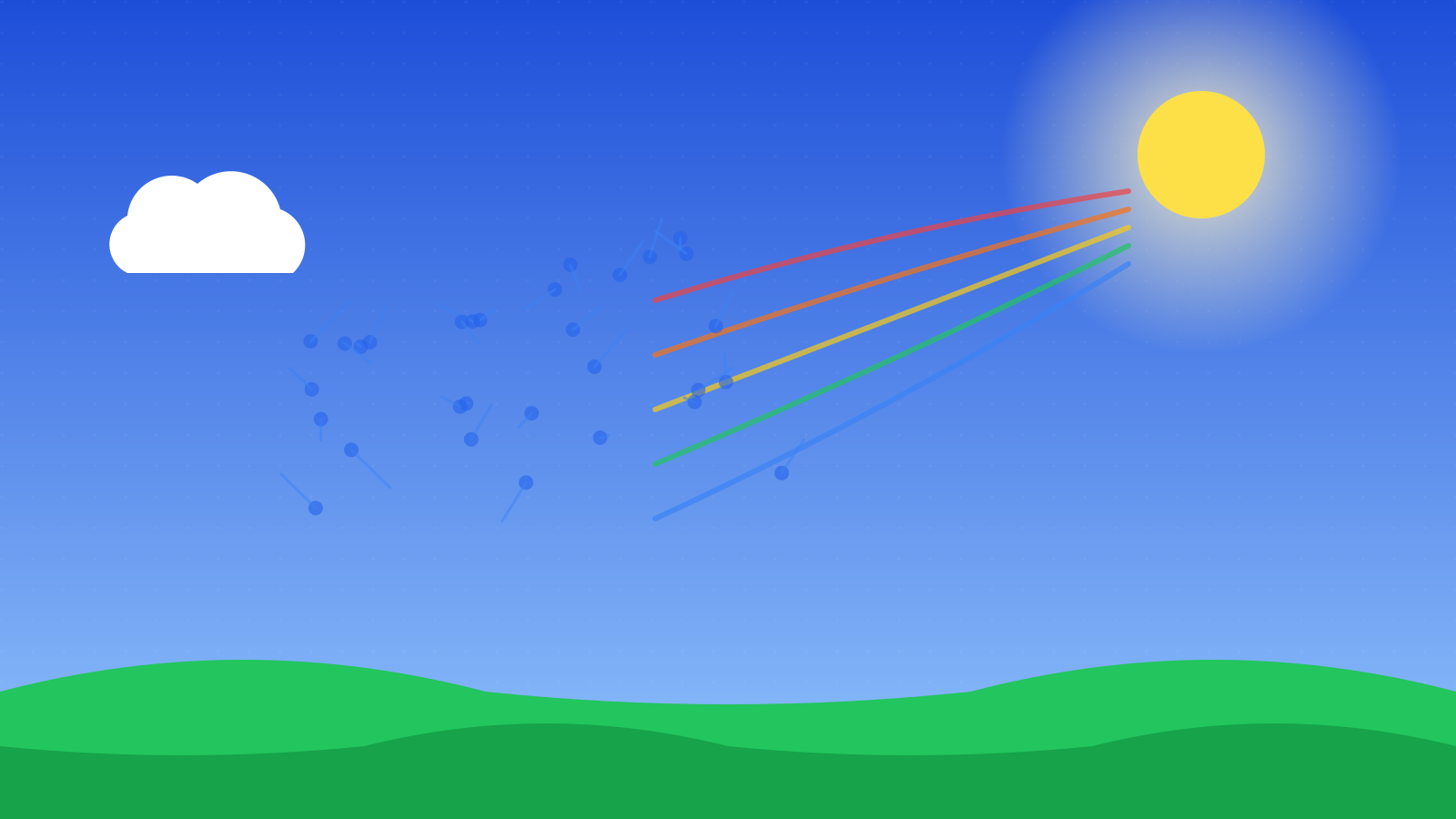
Short answer
When sunlight hits nitrogen and oxygen molecules in the air, short-wavelength blue light is scattered about 5–6 times more than long-wavelength red light. This is called Rayleigh scattering. Because scattered blue light reaches our eyes from every direction of the sky, the sky looks blue.
In this article (7)
The deep blue you see on a clear day is not a property of the air itself. It is the result of white sunlight being scattered by the atmosphere. The sky has no colour of its own; what we see depends on how light interacts with the molecules floating above us.
Sunlight is a mixture of colours
Sunlight is not a single colour. It contains the whole rainbow — red, orange, yellow, green, blue and violet. Each colour has a different wavelength:
- Red light has a long wavelength (about 700 nanometres).
- Blue light is shorter (about 450 nanometres).
- Violet is the shortest visible light (about 400 nanometres).
When all of these arrive together, we see white. That is why a prism can split a beam of sunlight into a band of colours.
Rayleigh scattering: tiny molecules, big effect
When sunlight enters the atmosphere it meets nitrogen and oxygen molecules, which make up most of the air. These molecules are far smaller than the wavelength of light, and when light hits particles this small it is scattered in all directions.
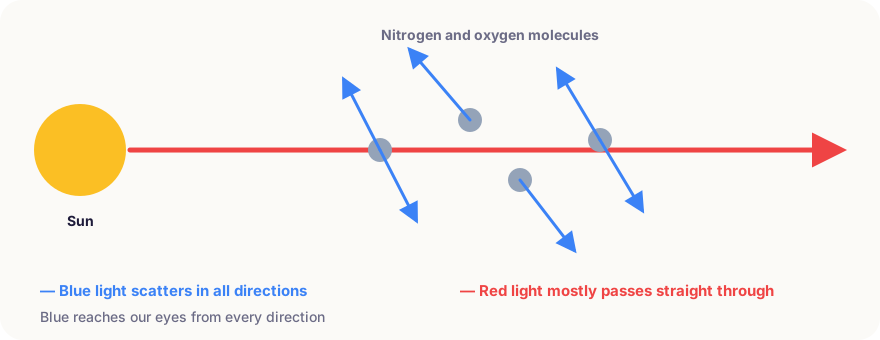
Here is the key: the strength of this scattering is inversely proportional to the fourth power of the wavelength. Shorten the wavelength a little and scattering rises a lot. British physicist Lord Rayleigh worked out this relationship in 1871, which is why the effect bears his name.
A quick calculation shows how big the difference is:
| Colour | Wavelength | Scattering vs. red |
|---|---|---|
| Red | ~700 nm | 1× |
| Green | ~530 nm | ~3× |
| Blue | ~450 nm | ~5.8× |
| Violet | ~400 nm | ~9.4× |
Blue light is scattered almost six times more than red. So wherever you look in the sky, the light reaching your eyes from that direction is mostly scattered blue light.
So why blue and not violet?
The table raises an obvious question: if violet scatters even more, why isn’t the sky violet? There are three reasons:
- The Sun emits less violet. Violet makes up a noticeably smaller share of sunlight than blue.
- The upper atmosphere absorbs some of it. Part of the violet and ultraviolet light is absorbed high up, especially by the ozone layer.
- Our eyes are poor at seeing violet. The colour-sensing cone cells in our retina respond most strongly to green-yellow light and least to violet. When the brain interprets the incoming mix, the result is “sky blue”.
In other words, there is violet in skylight — our eyes and brain simply read the mixture as blue.
Why are sunsets red?
At midday, with the Sun high overhead, sunlight passes through a relatively thin layer of air. At sunset, when the Sun sits near the horizon, its light has to cross a layer of atmosphere dozens of times thicker.
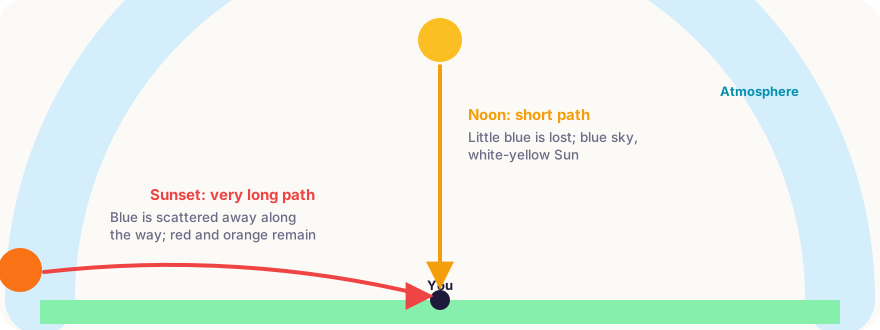
Along that long path the blue light is scattered away again and again and never reaches us directly. What remains is the orange and red light that resists scattering. Dust, smoke or volcanic ash in the air can make sunset colours even more intense.
Why are clouds white — and sometimes grey?
The water droplets and ice crystals in clouds are thousands of times larger than nitrogen and oxygen molecules. Particles this size scatter all colours roughly equally, without sorting them by wavelength. This is called Mie scattering, and an even mix of all colours looks white.
When a cloud becomes very thick, most light is scattered and absorbed inside it and little reaches the bottom. That is why rain clouds look dark grey.
What colour is the sky on other planets?
The colour of a sky depends on what its atmosphere is made of:
- Mars: Fine dust in the thin atmosphere scatters red light more, so the daytime sky is reddish-brown while sunsets look surprisingly blue.
- The Moon: With no atmosphere, the sky is black even in daylight.
- Uranus and Neptune: Methane absorbs red light, giving these planets their blue-green look.
In short
A blue sky comes from three things working together: white sunlight, tiny air molecules that scatter short wavelengths far more than long ones, and the way our eyes perceive colour. The same physics explains red sunsets, white clouds and the strange skies of Mars.
Frequently asked questions
If violet light scatters even more, why isn’t the sky violet?
The Sun emits less violet than blue, some violet is absorbed high in the atmosphere, and our eyes are much less sensitive to violet. Combined, our brain perceives the sky as blue.
Why are sunsets red and orange?
When the Sun is low, its light travels through far more air. Most of the blue is scattered out along the way, leaving mainly orange and red light to reach us.
Why are clouds white?
Cloud droplets are much larger than the wavelength of light, so they scatter all colours roughly equally (Mie scattering). An even mix of all colours looks white.
Why is the sky black in space?
There is no atmosphere in space to scatter light. Light only comes directly from sources, so the Sun appears bright against a black background.
Sources
This article is based on peer-reviewed research and publications from trusted institutions, and it is reviewed regularly. How we work →
You might also wonder
All in Earth & Nature →
How Do Snowflakes Form? Why They Have Six Sides and Are All Different
Every snowflake grows from a speck of dust in a cloud. Why snow crystals have six sides, how temperature shapes them, and whether no two are really alike.

What Causes Wind? Pressure, Sunshine and a Spinning Earth
Wind is air moving from high to low pressure, driven by the Sun heating Earth unevenly. How sea breezes, trade winds and the jet stream form, explained simply.
How Do Tornadoes Form? From Spinning Air to a Funnel Cloud
Most strong tornadoes grow out of supercell thunderstorms, where wind shear and rising air create a rotating column. How they form and how they are rated.
How Do Tsunamis Form? Why a Small Ripple at Sea Becomes a Wall of Water
Most tsunamis start when an undersea earthquake suddenly lifts the seafloor. How they cross oceans at jet speed, grow at the coast, and how to stay safe.

What Causes the Northern Lights? How the Aurora Gets Its Colours
The aurora is created when particles from the Sun hit gases high in our atmosphere. Why it glows green, red and purple, and where and when to see it.
Why Do Leaves Change Colour in Autumn? The Science of Yellow, Orange and Red
Why do leaves turn yellow or red in autumn, and why do trees drop them? The pigments in leaves, colourful autumns and why America is redder than Europe.