How Do Tsunamis Form? Why a Small Ripple at Sea Becomes a Wall of Water
Most tsunamis start when an undersea earthquake suddenly lifts the seafloor. How they cross oceans at jet speed, grow at the coast, and how to stay safe.
Short answer
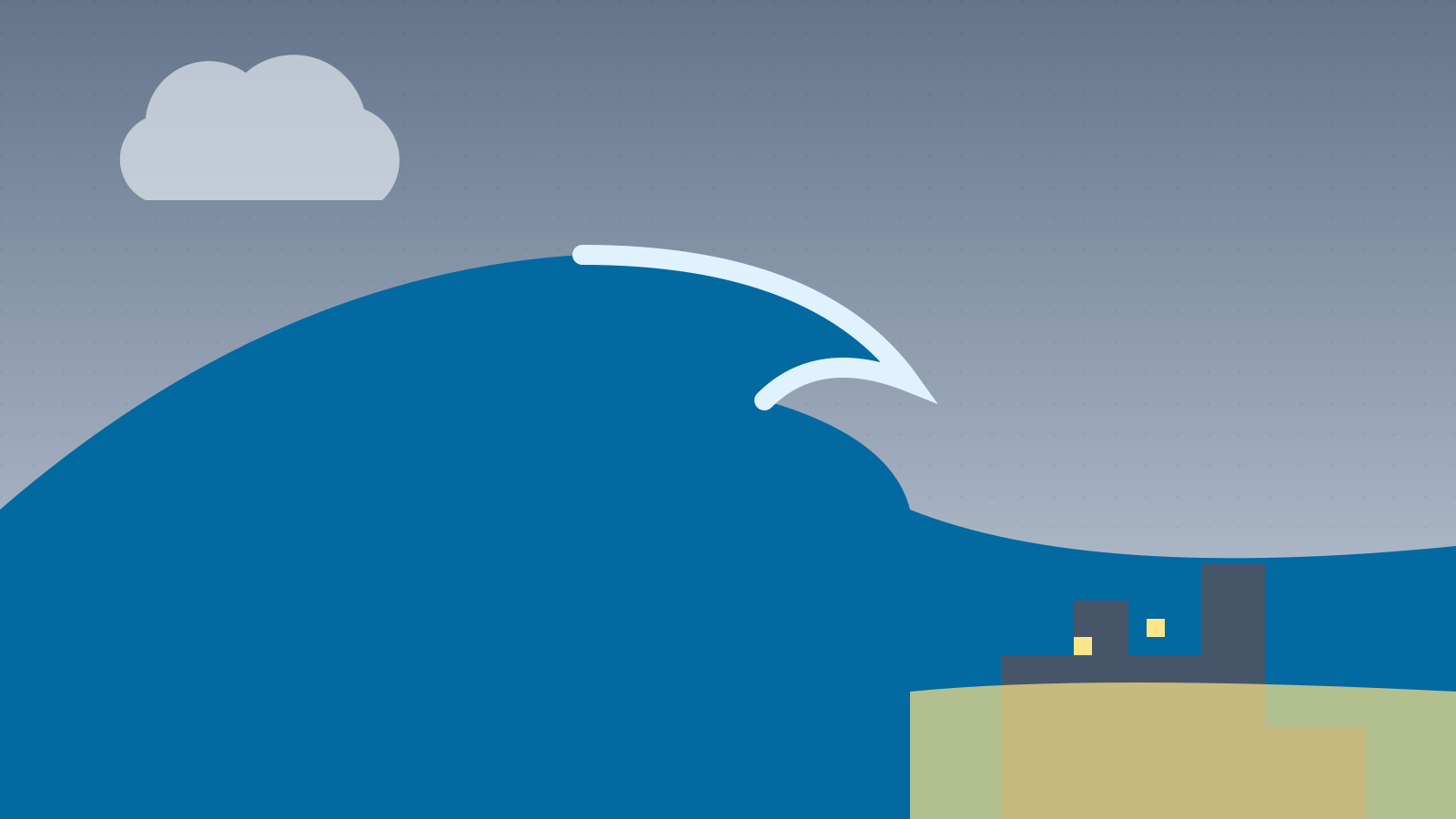
A tsunami is a series of powerful waves usually caused by a large undersea earthquake that suddenly lifts or drops the seafloor, displacing the whole column of water above it. Landslides, volcanic eruptions and, rarely, meteorite impacts can also cause tsunamis. In the deep ocean, tsunami waves travel as fast as a jet plane, about 800 kilometres per hour, but are often less than a metre high and pass ships unnoticed. As they reach shallow water near the coast, they slow down, the water piles up and the waves can grow many metres high, flooding far inland. A sudden retreat of the sea is a natural warning sign.
In this article (7)
On a beach, a tsunami often begins in silence. The sea draws back, exposing the seabed far beyond the usual low tide. Fish flop on the sand. A few minutes later, a wall of water arrives that does not break and retreat like a normal wave, but keeps coming, flooding streets and fields. How does the ocean produce such a force?
Not a normal wave
Ordinary waves are made by wind blowing over the sea surface. They move only the top few metres of water and have wavelengths of tens of metres. A tsunami is different: it moves the entire depth of the ocean, from the surface to the seabed, and its wavelength can be hundreds of kilometres. That is why it carries so much energy.
How a tsunami starts
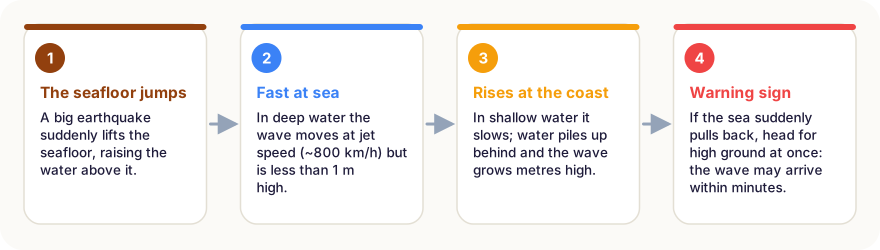
Most tsunamis are caused by large earthquakes under the sea, especially at subduction zones, where one tectonic plate slides beneath another. The plates can lock together for centuries, building up strain. When they finally slip, the seafloor can jump up or down by several metres over an area hundreds of kilometres long. The water above is lifted or dropped with it, and as it tries to settle back, waves race away in all directions.
Not every undersea earthquake makes a tsunami. It usually needs to be strong, typically above about magnitude 7, shallow, and to move the seafloor vertically.
Fast and invisible at sea
In the deep ocean, a tsunami travels at astonishing speed, around 800 kilometres per hour, as fast as a passenger jet. It can cross the entire Pacific Ocean in less than a day. Yet in deep water its height is often less than a metre, spread over a huge wavelength. Ships at sea may not notice it pass beneath them.
Growing at the coast
As the tsunami approaches the coast and the water becomes shallower, it slows down. The front of the wave slows first, while the water behind keeps coming, so the water piles up and the wave grows taller, sometimes 10 metres or more. Bays and narrow inlets can funnel it even higher.
Often the first thing people see is the sea pulling back, when the trough of the wave arrives first. This is a crucial natural warning: the crest is coming, sometimes within minutes.
What to know about tsunamis
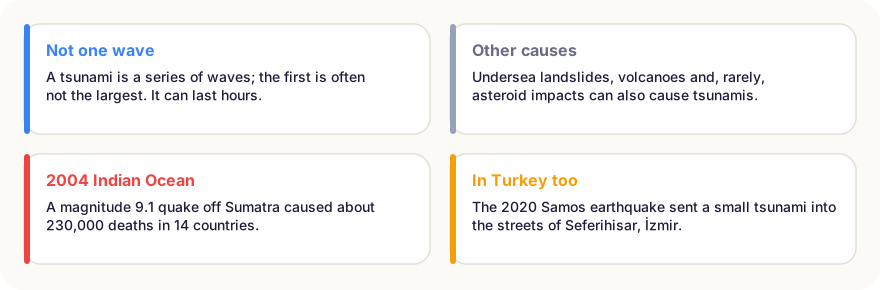
- It is a series of waves. A tsunami can last for hours, and the first wave is often not the largest. Never return to the shore after the first wave.
- Other causes: undersea landslides, volcanic eruptions and, rarely, asteroid impacts can also create tsunamis.
- 2004: a magnitude 9.1 earthquake off Sumatra caused the deadliest tsunami in recorded history, killing about 230,000 people in 14 countries around the Indian Ocean.
- 2011: the magnitude 9.0 Tōhoku earthquake in Japan caused waves that flooded large areas of coast and led to the Fukushima nuclear accident.
- Turkey: the Aegean and eastern Mediterranean have experienced tsunamis throughout history. In October 2020, the magnitude 7.0 Samos earthquake sent a small tsunami into the streets of Seferihisar in İzmir.
Staying safe
If you are on the coast and feel a strong earthquake, or see the sea suddenly retreat, move immediately to high ground or well inland. Do not wait for an official warning, and do not go to look at the exposed seabed. Today, warning centres use seismometers, deep-ocean pressure sensors and tide gauges to detect tsunamis and alert coastal areas, but natural signs can arrive faster than any alarm.
In short
- A tsunami is a series of waves that moves the entire depth of the ocean.
- Most are caused by undersea earthquakes that suddenly move the seafloor.
- At sea they travel at about 800 km/h but are often under a metre high.
- Near the coast they slow down and grow, sometimes over 10 metres high.
- A sudden retreat of the sea is a warning sign: head for high ground at once.
- Tsunamis also occur in the Aegean, as in Seferihisar in 2020.
Frequently asked questions
What is the difference between a tsunami and a normal wave?
Normal waves are made by wind and move only the surface water. A tsunami moves the entire depth of the ocean, has a wavelength of up to hundreds of kilometres and carries vastly more energy.
What should I do if the sea suddenly pulls back?
Leave the beach immediately and go to high ground or well inland, without waiting for an official warning. The first wave may arrive within minutes, and later waves can be larger.
Can tsunamis happen in Turkey?
Yes. The Aegean and eastern Mediterranean have a history of tsunamis. In October 2020, the magnitude 7.0 Samos earthquake caused a tsunami that flooded streets in Seferihisar, İzmir.
How are tsunamis detected?
Seismometers detect the earthquake within minutes, and deep-ocean pressure sensors and coastal tide gauges confirm whether a tsunami has formed. Warning centres then alert coastal areas.
Sources
This article is based on peer-reviewed research and publications from trusted institutions, and it is reviewed regularly. How we work →
You might also wonder
All in Earth & Nature →
How Do Snowflakes Form? Why They Have Six Sides and Are All Different
Every snowflake grows from a speck of dust in a cloud. Why snow crystals have six sides, how temperature shapes them, and whether no two are really alike.
What Causes Wind? Pressure, Sunshine and a Spinning Earth
Wind is air moving from high to low pressure, driven by the Sun heating Earth unevenly. How sea breezes, trade winds and the jet stream form, explained simply.
How Do Tornadoes Form? From Spinning Air to a Funnel Cloud
Most strong tornadoes grow out of supercell thunderstorms, where wind shear and rising air create a rotating column. How they form and how they are rated.

What Causes the Northern Lights? How the Aurora Gets Its Colours
The aurora is created when particles from the Sun hit gases high in our atmosphere. Why it glows green, red and purple, and where and when to see it.

Why Do Leaves Change Colour in Autumn? The Science of Yellow, Orange and Red
Why do leaves turn yellow or red in autumn, and why do trees drop them? The pigments in leaves, colourful autumns and why America is redder than Europe.

How Do Rainbows Form? Light, Raindrops and the Secret of 42 Degrees
How do rainbows form, why are they curved and why do they appear opposite the Sun? Double rainbows, colour order and why you can never reach the end.