What Causes the Northern Lights? How the Aurora Gets Its Colours
The aurora is created when particles from the Sun hit gases high in our atmosphere. Why it glows green, red and purple, and where and when to see it.
Short answer
The northern lights, or aurora borealis, are caused by charged particles from the Sun colliding with gases high in Earth’s atmosphere. The Sun constantly blows out a stream of particles called the solar wind. Earth’s magnetic field deflects most of them, but guides some down towards the polar regions. There, about 100 to 300 kilometres up, they crash into oxygen and nitrogen atoms and molecules, giving them extra energy, which they release as light. Oxygen produces the common green glow and, higher up, red; nitrogen adds blue and purple. The same happens around the South Pole, where it is called the aurora australis.
In this article (7)
Shimmering curtains of green light ripple across a dark winter sky, sometimes edged with pink and purple, folding and moving as if alive. For thousands of years people have told stories about the northern lights. Today we know they are a giant natural light show powered by the Sun.
Wind from the Sun
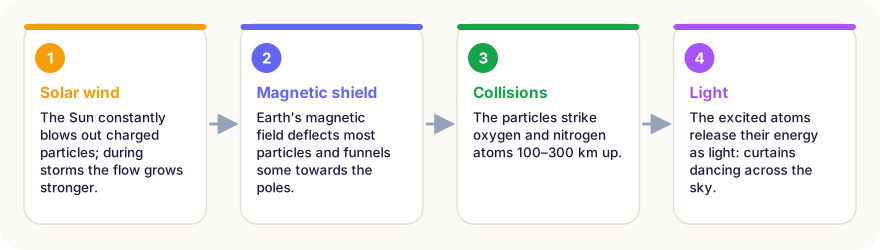
The Sun does not only send us light. It also constantly blows out a stream of electrically charged particles, mainly electrons and protons, called the solar wind. It travels at hundreds of kilometres per second and reaches Earth in a few days. During solar storms, such as coronal mass ejections, the Sun hurls out huge clouds of particles that make the flow much stronger.
Earth’s magnetic shield
Earth is surrounded by a magnetic field, generated deep in its molten iron core. This field forms a protective bubble, the magnetosphere, which deflects most of the solar wind. But the field lines curve down into the planet near the magnetic poles. When the solar wind disturbs the magnetosphere, energy and particles are funnelled along these lines towards the polar regions.
The light show
High in the atmosphere, about 100 to 300 kilometres up, the incoming particles collide with oxygen and nitrogen. The collisions give these atoms and molecules extra energy. When they settle back down, they release that energy as light, much like the gas in a neon sign glows when electricity passes through it.
Because the particles arrive along the field lines, the aurora forms an oval ring around each magnetic pole. In the north it is called the aurora borealis; in the south, the aurora australis.
Why the colours differ
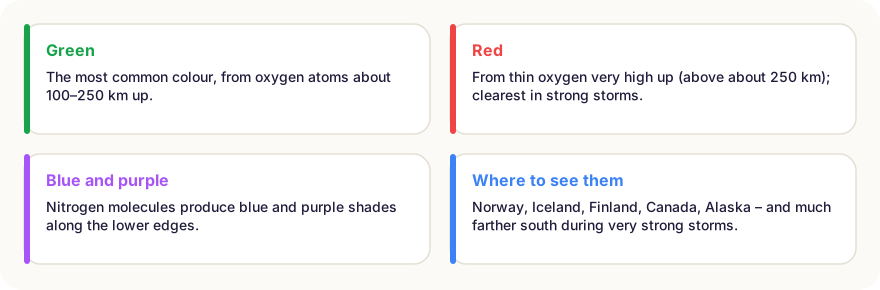
- Green, the most common colour, comes from oxygen atoms at about 100 to 250 kilometres.
- Red comes from oxygen much higher up, above about 250 kilometres, where the air is very thin. It is strongest during intense storms.
- Blue and purple come from nitrogen, often visible along the lower edges of the curtains.
Cameras often show more colour than our eyes, because our night vision is poor at seeing colour in dim light.
Where and when to see it
The best places lie under the auroral oval, roughly 65 to 72 degrees north: northern Norway, Iceland, Finnish Lapland, northern Sweden, Canada and Alaska. Choose a clear, dark night between about September and March, far from city lights, and check an aurora forecast.
Auroras are more frequent around solar maximum, the peak of the Sun’s roughly 11-year activity cycle. During the exceptional geomagnetic storm of 10–11 May 2024, auroras were seen and photographed far to the south, including in southern Europe and parts of Turkey, where they are normally almost never visible.
More than a pretty sight
The same solar storms that create beautiful auroras can also disrupt satellites, GPS and radio communications, and in extreme cases damage power grids. That is why agencies such as NOAA’s Space Weather Prediction Center watch the Sun around the clock.
In short
- Auroras are caused by charged particles from the Sun, the solar wind.
- Earth’s magnetic field guides some of them towards the polar regions.
- They hit oxygen and nitrogen 100–300 km up, which then release light.
- Green and red come from oxygen; blue and purple from nitrogen.
- The best viewing is under the auroral oval, on dark, clear nights from September to March.
- Auroras are stronger near the peak of the Sun’s 11-year cycle.
Frequently asked questions
Where is the best place to see the northern lights?
Places under the auroral oval, roughly between 65 and 72 degrees north, such as northern Norway, Iceland, Finnish Lapland, northern Sweden, Canada and Alaska, see auroras most often.
When is the best time to see the aurora?
On clear, dark nights from about September to March, away from city lights, usually between about 9 pm and 2 am local time. Aurora forecasts based on solar activity help predict good nights.
Can you hear the northern lights?
Some people report faint crackling or clapping sounds during strong auroras. Researchers have recorded such sounds and suggest they may come from electrical discharges near the ground, but they are rare and still being studied.
Why are auroras stronger some years?
The Sun goes through a roughly 11-year cycle of activity. Around solar maximum there are more sunspots, solar flares and eruptions, which produce more frequent and intense auroras.
Sources
This article is based on peer-reviewed research and publications from trusted institutions, and it is reviewed regularly. How we work →
You might also wonder
All in Earth & Nature →
How Do Snowflakes Form? Why They Have Six Sides and Are All Different
Every snowflake grows from a speck of dust in a cloud. Why snow crystals have six sides, how temperature shapes them, and whether no two are really alike.

What Causes Wind? Pressure, Sunshine and a Spinning Earth
Wind is air moving from high to low pressure, driven by the Sun heating Earth unevenly. How sea breezes, trade winds and the jet stream form, explained simply.
How Do Tornadoes Form? From Spinning Air to a Funnel Cloud
Most strong tornadoes grow out of supercell thunderstorms, where wind shear and rising air create a rotating column. How they form and how they are rated.
How Do Tsunamis Form? Why a Small Ripple at Sea Becomes a Wall of Water
Most tsunamis start when an undersea earthquake suddenly lifts the seafloor. How they cross oceans at jet speed, grow at the coast, and how to stay safe.

Why Do Leaves Change Colour in Autumn? The Science of Yellow, Orange and Red
Why do leaves turn yellow or red in autumn, and why do trees drop them? The pigments in leaves, colourful autumns and why America is redder than Europe.

How Do Rainbows Form? Light, Raindrops and the Secret of 42 Degrees
How do rainbows form, why are they curved and why do they appear opposite the Sun? Double rainbows, colour order and why you can never reach the end.