How Do Tornadoes Form? From Spinning Air to a Funnel Cloud
Most strong tornadoes grow out of supercell thunderstorms, where wind shear and rising air create a rotating column. How they form and how they are rated.
Short answer
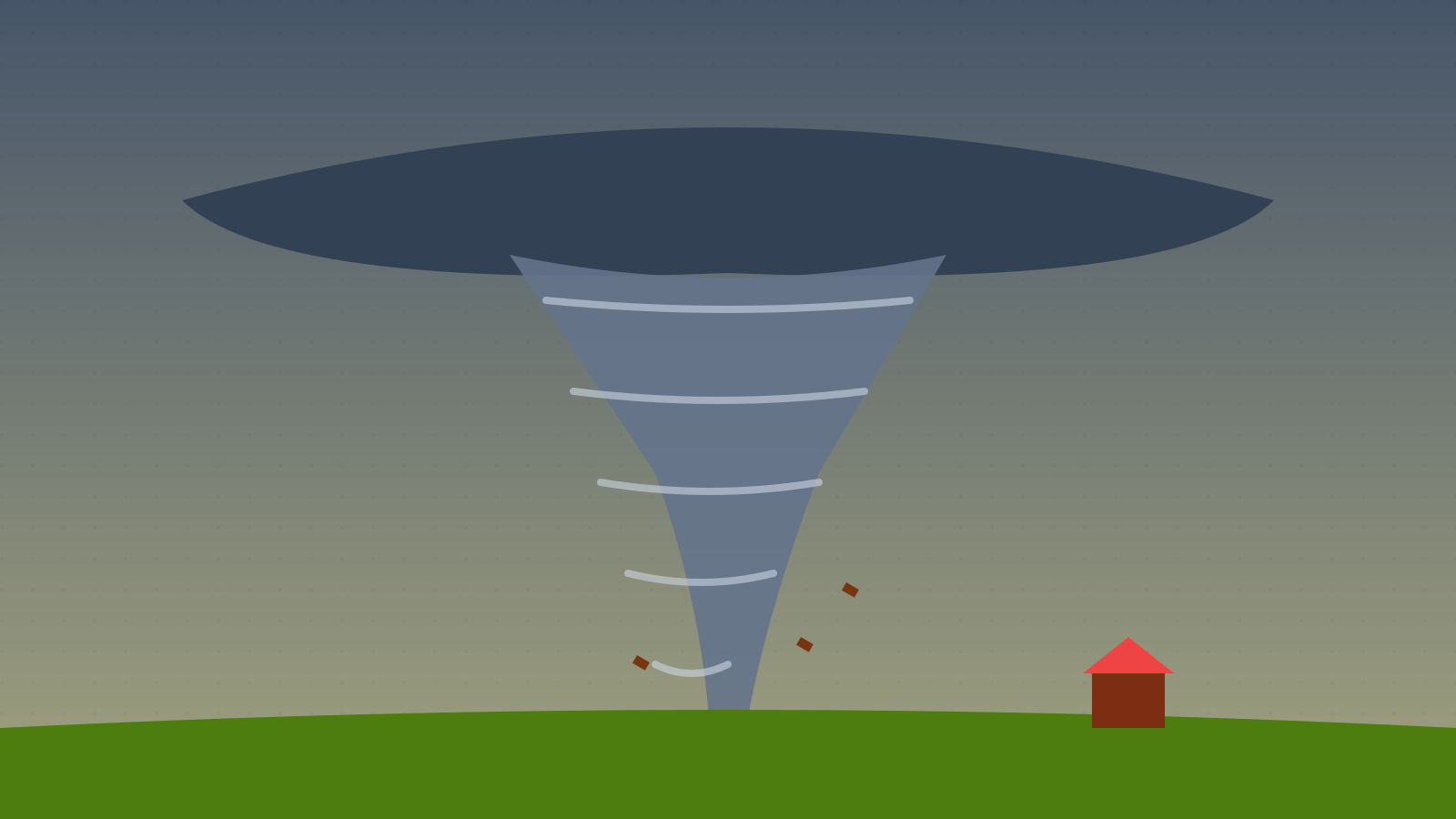
A tornado is a violently rotating column of air that reaches from a thunderstorm down to the ground. Most strong tornadoes form in supercells, powerful thunderstorms with a rotating updraft. It starts with wind shear, when winds near the ground and higher up blow at different speeds or directions, setting the air spinning like a horizontal tube. A strong updraft tilts this spinning tube upright, creating a rotating column inside the storm called a mesocyclone. Under the right conditions, part of this rotation tightens and stretches down to the ground as a tornado, with winds that can exceed 300 kilometres per hour.
In this article (6)
The sky turns a strange greenish grey, the wind drops, and then a funnel lowers from the base of a dark cloud and touches the ground, roaring like a train. Tornadoes are the most violent winds on Earth. They can destroy one house and leave the one next door almost untouched. How does a thunderstorm produce such a concentrated whirlwind?
The ingredients
Tornadoes need a special combination of conditions:
- Warm, moist air near the ground, which provides energy.
- Cooler, drier air higher up, making the atmosphere unstable so warm air rises fast.
- Something to lift the air, such as a cold front.
- Wind shear: winds that change speed and direction with height.
Wind shear is what turns an ordinary thunderstorm into a rotating one.
From spin to funnel
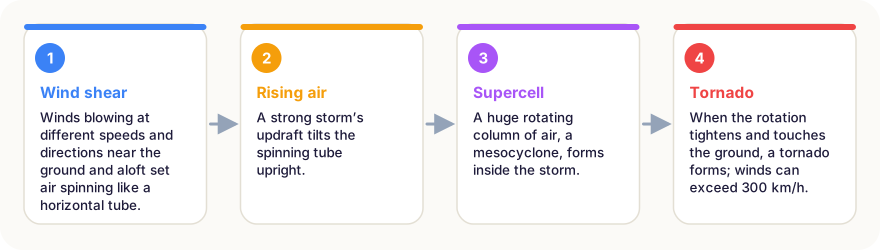
- Horizontal spin. When winds near the ground are slower, or blow from a different direction, than winds higher up, the air between them starts to roll, like a pencil rolled between your hands. This creates an invisible, horizontal tube of spinning air.
- Tilting upright. A strong thunderstorm has a powerful updraft of rising warm air. When the updraft meets the spinning tube, it lifts and tilts it upright, so the storm itself begins to rotate.
- The supercell. A thunderstorm with a deep, persistent rotating updraft is called a supercell. Its rotating core, a few kilometres wide, is the mesocyclone.
- The tornado. Under the right conditions, often involving a downdraft wrapping around the rotation, part of the mesocyclone tightens and stretches towards the ground. Like a spinning ice skater pulling in their arms, it spins faster as it narrows. When this violently rotating column touches the ground, it is a tornado.
Scientists still cannot predict exactly which supercells will produce tornadoes. Only a minority do, and research projects with mobile radars continue to chase storms to find out why.
How strong are tornadoes?
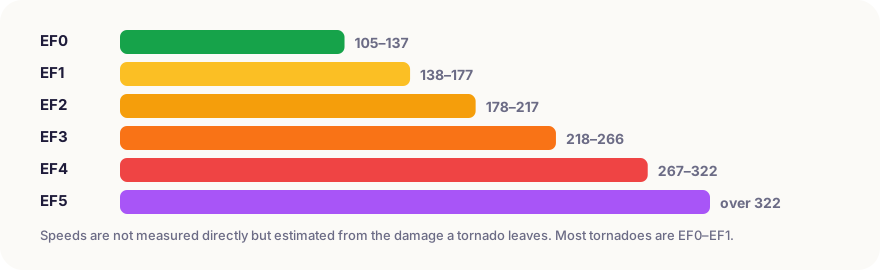
Tornado winds are rarely measured directly, because instruments in their path are usually destroyed. Instead, experts survey the damage and estimate the wind speed using the Enhanced Fujita (EF) scale, introduced in the United States in 2007 to replace the original scale developed by meteorologist Ted Fujita in 1971. It runs from EF0, with light damage, to EF5, with winds above 322 km/h that can sweep well-built houses off their foundations. Most tornadoes are weak, EF0 or EF1; only a small fraction reach EF4 or EF5.
Where tornadoes happen
Tornadoes have been recorded on every continent except Antarctica. The United States has by far the most, around 1,200 a year, many of them in the central plains known as Tornado Alley, where warm, humid air from the Gulf of Mexico collides with cool, dry air from Canada and the Rocky Mountains. Bangladesh, Argentina and parts of Europe also see regular tornadoes.
Turkey gets tornadoes too, though they are generally less frequent and weaker. Waterspouts often form over the Mediterranean and Black Sea, and tornadoes that move ashore have caused deaths and damage in the Antalya region.
Staying safe
When a tornado warning is issued, go to a basement or a small interior room without windows on the lowest floor, such as a bathroom, and cover your head. Stay away from windows. Cars and mobile homes offer little protection. Modern Doppler radar can spot the rotation in storms and give warnings minutes before a tornado strikes.
In short
- A tornado is a violently rotating column of air reaching from a storm to the ground.
- Wind shear makes the air spin horizontally; a strong updraft tilts it upright.
- Most strong tornadoes form in rotating thunderstorms called supercells.
- Tornadoes are rated by damage on the Enhanced Fujita scale, from EF0 to EF5.
- The United States has about 1,200 tornadoes a year; Turkey has them too, near its coasts.
- In a warning, shelter in a basement or windowless interior room.
Frequently asked questions
What is the difference between a tornado and a hurricane?
A hurricane is a huge storm hundreds of kilometres wide that forms over warm oceans and lasts for days. A tornado is far smaller, usually tens to hundreds of metres wide, forms under a thunderstorm over land and typically lasts minutes.
What should I do if a tornado warning is issued?
Go to a basement or an interior room without windows on the lowest floor, such as a bathroom or closet, and protect your head. Cars and mobile homes offer little protection.
Do tornadoes happen in Turkey?
Yes, though they are less common and usually weaker than in the US. Waterspouts and tornadoes have been recorded along the Mediterranean and Black Sea coasts, including deadly tornadoes in the Antalya region.
What is a waterspout?
A waterspout is a rotating column of air over water. Some form like tornadoes under strong storms; many are weaker “fair-weather” waterspouts that form under growing clouds.
Sources
- NOAA National Severe Storms Laboratory – Tornado basics
- NOAA Storm Prediction Center – The online tornado FAQ
This article is based on peer-reviewed research and publications from trusted institutions, and it is reviewed regularly. How we work →
You might also wonder
All in Earth & Nature →
How Do Snowflakes Form? Why They Have Six Sides and Are All Different
Every snowflake grows from a speck of dust in a cloud. Why snow crystals have six sides, how temperature shapes them, and whether no two are really alike.
What Causes Wind? Pressure, Sunshine and a Spinning Earth
Wind is air moving from high to low pressure, driven by the Sun heating Earth unevenly. How sea breezes, trade winds and the jet stream form, explained simply.
How Do Tsunamis Form? Why a Small Ripple at Sea Becomes a Wall of Water
Most tsunamis start when an undersea earthquake suddenly lifts the seafloor. How they cross oceans at jet speed, grow at the coast, and how to stay safe.

What Causes the Northern Lights? How the Aurora Gets Its Colours
The aurora is created when particles from the Sun hit gases high in our atmosphere. Why it glows green, red and purple, and where and when to see it.
Why Do Leaves Change Colour in Autumn? The Science of Yellow, Orange and Red
Why do leaves turn yellow or red in autumn, and why do trees drop them? The pigments in leaves, colourful autumns and why America is redder than Europe.

How Do Rainbows Form? Light, Raindrops and the Secret of 42 Degrees
How do rainbows form, why are they curved and why do they appear opposite the Sun? Double rainbows, colour order and why you can never reach the end.