How Do Snowflakes Form? Why They Have Six Sides and Are All Different
Every snowflake grows from a speck of dust in a cloud. Why snow crystals have six sides, how temperature shapes them, and whether no two are really alike.

Short answer
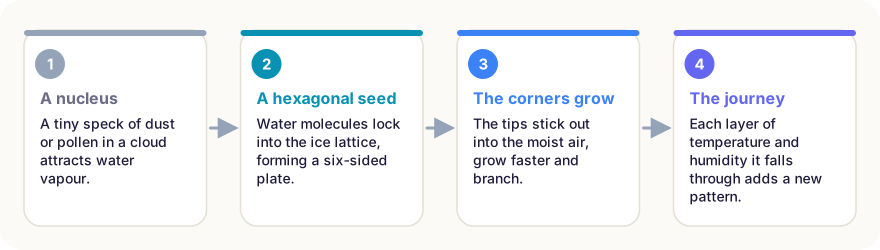
A snowflake starts as a tiny speck of dust or pollen in a cold cloud. Water vapour freezes onto it and the water molecules lock into ice’s hexagonal crystal lattice, which is why snow crystals have six sides. As the crystal falls, its corners stick out into the moist air and grow faster, sprouting branches. The exact shape depends on the temperature and humidity: thin plates form near −2 °C, needles and columns around −5 °C, and the classic branching stars near −15 °C. Because every crystal takes a slightly different path through the cloud, complex snowflakes are practically never identical.
In this article (7)
Catch a snowflake on a dark glove and look closely before it melts. You may see a perfect six-pointed star, more intricate than any jewellery. It formed in a cloud a kilometre or more above your head, grew for perhaps half an hour as it fell, and is made of about a quintillion water molecules arranged with astonishing precision.
It begins with a speck of dust
Cold clouds are full of tiny water droplets. Surprisingly, these droplets can stay liquid far below 0 °C, down to about −40 °C, if there is nothing to help them freeze. They need a starting point.
That starting point is usually a microscopic particle: a grain of dust, clay, pollen or even bacteria floating in the air. Water molecules attach to it and freeze, forming a tiny ice crystal. Once it exists, the crystal grows quickly by taking water vapour straight from the air. The surrounding supercooled droplets evaporate and feed it.
Why six sides?
The answer lies in the shape of the water molecule. Each H₂O molecule is bent, and in ice the molecules link to their neighbours through hydrogen bonds at fixed angles. The arrangement that results is a lattice of hexagonal rings, the structure of ordinary ice.
Because the building blocks fit together in a hexagonal pattern, the crystal grows with six-fold symmetry. Even the smallest snow crystals are simple hexagonal prisms, like tiny pencils or coins with six sides.
How branches grow
If a hexagonal plate grew evenly, it would stay a hexagon. But the six corners of the crystal stick out slightly further into the air than the flat faces. There, they meet more water vapour and grow a little faster.
The faster a corner grows, the further it sticks out, and the faster it grows again. This runaway effect, known as a branching instability, turns corners into arms and arms into branches. Because all six arms experience the same conditions at the same moment, they grow in step with each other, which is why snowflakes look so symmetrical.
Temperature decides the shape
In the 1930s the Japanese physicist Ukichiro Nakaya grew the first artificial snow crystals in his laboratory in Hokkaido. He discovered that the shape of a crystal depends mostly on the temperature and on how much water vapour is available.
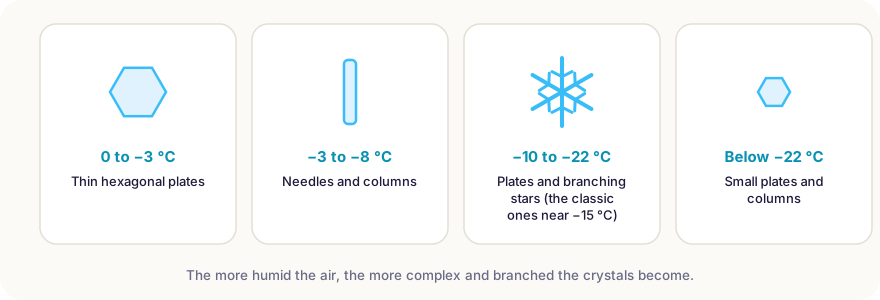
Strangely, the shape flips back and forth as temperature falls: plates, then needles and columns, then plates and stars again, then columns. Scientists are still working out exactly why; it depends on subtle differences in how quickly molecules attach to the flat faces and the edges of the crystal at different temperatures.
Nakaya famously described snow crystals as letters sent from heaven: by reading a crystal’s shape, you can tell what conditions it passed through.
Why are no two snowflakes alike?
A falling snowflake drifts through layers of air with slightly different temperatures and humidity. Each change alters how it grows, adding a new ring, branch or plate. Because no two crystals follow exactly the same path, and because each contains so many molecules, the chance of two complex snowflakes being identical is practically zero.
The farmer Wilson Bentley from Vermont proved this visually. In 1885 he became the first person to photograph a snow crystal by attaching a camera to a microscope, and he went on to photograph more than 5,000 of them.
Why snow is white
A single snow crystal is as clear as glass. But snow on the ground is a loose jumble of countless crystals with air between them. Light entering a snowdrift is reflected and scattered by all those tiny surfaces, in every direction and almost equally for all colours. The result is white. Deep inside a dense snowbank or glacier, where there is less air, a faint blue can appear because ice absorbs a little red light.
In short
- Snowflakes grow from water vapour freezing onto a tiny particle in a cold cloud.
- They have six sides because water molecules form a hexagonal lattice in ice.
- Corners grow faster than faces, creating branches that grow in step.
- Temperature sets the basic shape: plates, needles, columns or stars; humidity adds complexity.
- Complex snowflakes are practically never identical because each takes its own path.
- Snow is white because its many crystal surfaces scatter all colours of light.
Frequently asked questions
Are no two snowflakes really alike?
For complex snowflakes, practically yes: each one contains vast numbers of molecules and takes a unique path through changing conditions. Very small, simple crystals such as tiny hexagonal prisms can look almost identical.
Why is snow white if ice is clear?
Snow is a jumble of countless tiny ice crystals with many surfaces. Light is reflected and scattered by all of them in every direction, and all colours are scattered equally, so snow looks white.
Can it be too cold to snow?
Not really, but very cold air holds very little moisture, so heavy snowfall is more common at temperatures not far below freezing. Extremely cold places such as inland Antarctica get very little snow.
What is the difference between snow, sleet and hail?
Snow grows as ice crystals directly from water vapour. Sleet forms when raindrops freeze on the way down, and hail grows in thunderstorm updrafts as layers of ice build up around a frozen core.
Sources
- Libbrecht, K. G. (2005). The physics of snow crystals. Reports on Progress in Physics
- Kenneth Libbrecht, Caltech – SnowCrystals.com: Guide to snowflakes
This article is based on peer-reviewed research and publications from trusted institutions, and it is reviewed regularly. How we work →
You might also wonder
All in Earth & Nature →
What Causes Wind? Pressure, Sunshine and a Spinning Earth
Wind is air moving from high to low pressure, driven by the Sun heating Earth unevenly. How sea breezes, trade winds and the jet stream form, explained simply.

Why Do Leaves Change Colour in Autumn? The Science of Yellow, Orange and Red
Why do leaves turn yellow or red in autumn, and why do trees drop them? The pigments in leaves, colourful autumns and why America is redder than Europe.

How Do Rainbows Form? Light, Raindrops and the Secret of 42 Degrees
How do rainbows form, why are they curved and why do they appear opposite the Sun? Double rainbows, colour order and why you can never reach the end.

Why Is the Ocean Salty? Where Sea Salt Really Comes From
Why is seawater salty when rivers are fresh? How salt reaches the ocean from rocks and the seafloor, and why some seas are much saltier than others.

Why Is the Sky Blue? Rayleigh Scattering Explained Simply
Why is the sky blue and why are sunsets red? A clear explanation of how sunlight scatters in the atmosphere, and why we see blue instead of violet.

How Do Clouds Form and Why Does It Rain? A Water Droplet’s Journey Through the Sky
How do clouds form, why doesn’t a cloud carrying tonnes of water fall, and how is a raindrop made? The sky-high stages of the water cycle, explained.