How Do Rainbows Form? Light, Raindrops and the Secret of 42 Degrees
How do rainbows form, why are they curved and why do they appear opposite the Sun? Double rainbows, colour order and why you can never reach the end.
Short answer
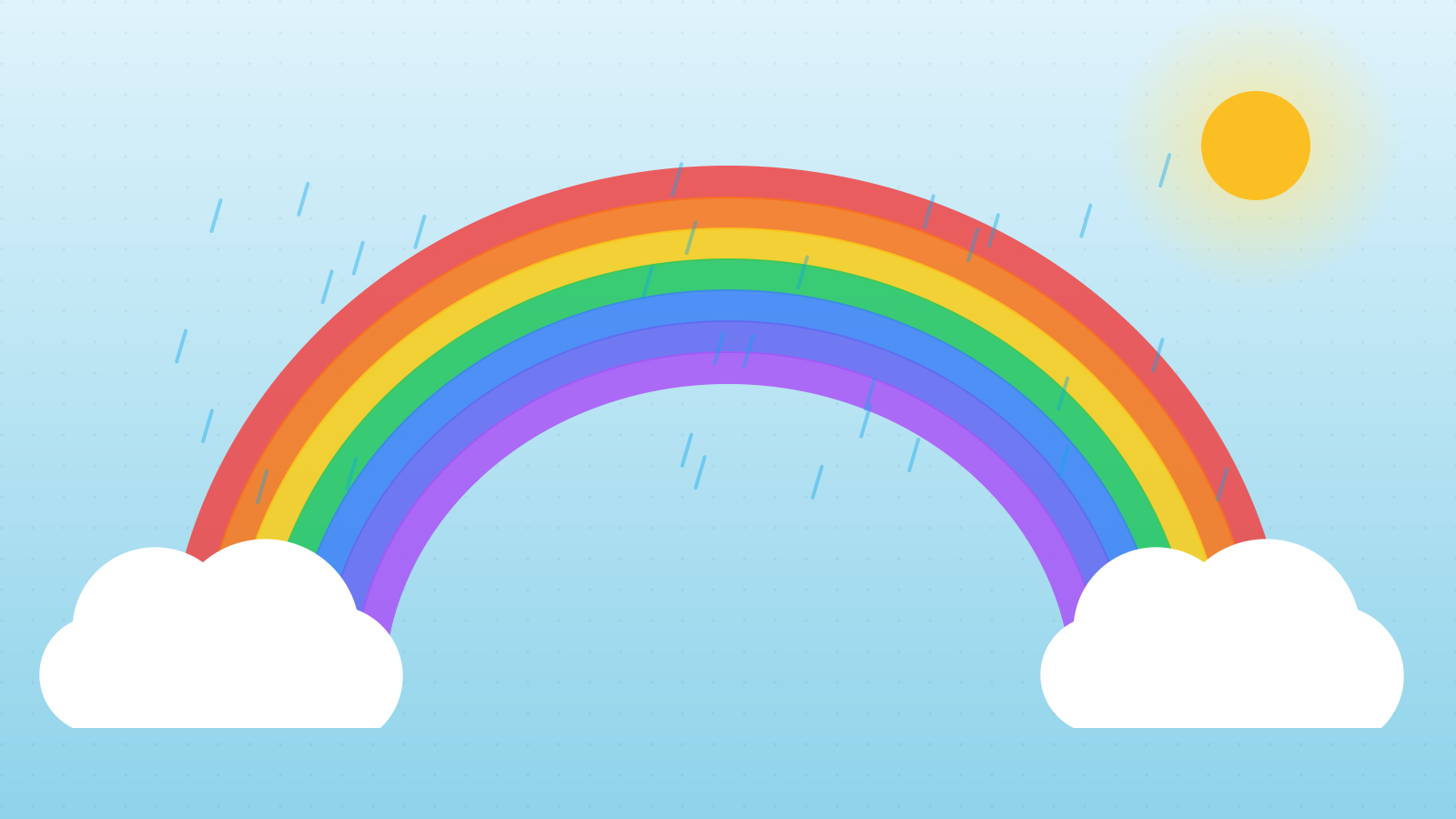
Sunlight bends (refracts) as it enters a raindrop, reflects off the back of the drop and bends again as it leaves. Each colour bends by a slightly different amount, so white light splits into its colours. Because the light comes back out at an angle of about 42 degrees, a rainbow appears as an arc in the sky opposite the Sun when the Sun is behind you.
In this article (8)
Just after a shower, the Sun breaks through the clouds and a coloured arc appears in the sky. Rainbows have inspired myths and legends throughout human history — and the physics behind them is every bit as impressive.
Three ingredients for a rainbow
To see a rainbow, three things must happen at once:
- Sunlight: the Sun has to be shining, ideally low in the sky.
- Water droplets: there must be rain, mist, waterfall spray or the spray from a garden hose in the air in front of you.
- The right position: the Sun must be behind you and the droplets in front of you.
When all three line up, every raindrop acts like a tiny prism.
What happens inside a single drop?
When sunlight enters a spherical water droplet, three things happen:
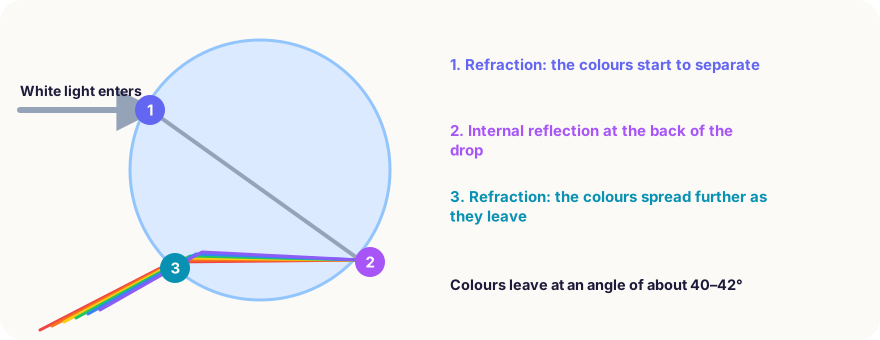
- Refraction: light slows down and changes direction as it passes from air into water.
- Reflection: the light hits the back of the drop and part of it bounces back.
- Second refraction: the light bends again as it leaves the drop and returns to the air.
The key to this journey is that each colour bends slightly differently, an effect called dispersion. Short-wavelength violet light bends a little more than long-wavelength red. So the light leaving the drop has been split into its colours.
The secret of 42 degrees
Light coming back out of a drop does not spread evenly in all directions. It is concentrated at a particular angle: about 42 degrees from the direction of the incoming sunlight.
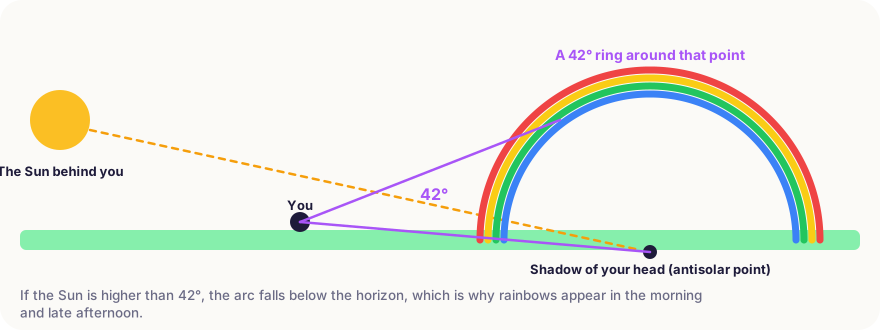
Picture it like this: find the point directly opposite the Sun — the shadow of your own head. All the drops that sit 42 degrees away from that point send bright light towards you. Together, those drops form a circle around that point. That is why a rainbow is curved.
The colours are sorted by this angle:
- Red is at about 42 degrees, on the outer edge of the arc.
- Violet is at about 40 degrees, on the inner edge.
Each drop sends you only one colour. The rainbow you see is built from millions of drops at different heights, each contributing its own colour.
Why are rainbows usually seen in the morning and late afternoon?
The centre of a rainbow is the point opposite the Sun, and that point sinks below the horizon as the Sun climbs. If the Sun is more than 42 degrees above the horizon, the entire rainbow lies below the horizon and cannot be seen from the ground. That is why rainbows appear most often early in the morning and late in the afternoon, when the Sun is low.
Double rainbows: why are the colours reversed?
Sometimes a fainter second arc appears above the main rainbow. This secondary rainbow forms when light reflects twice inside the drops.
- It appears at about 51 degrees, outside the main arc.
- Its colours are reversed: red on the inside, violet on the outside.
- It is fainter, because some light is lost at each reflection.
The sky between the two arcs is noticeably darker than its surroundings. This is called Alexander’s dark band: drops in this region do not direct light towards your eyes, so it looks darker. The sky inside the main rainbow, by contrast, is usually brighter.
Why can’t you reach the end of a rainbow?
Legend says treasure is buried where a rainbow ends. Sadly, you can never get there. A rainbow is not an object standing in one place — it is an image that depends on your position.
As you walk, the 42-degree angle moves with you and different drops take over sending light to your eyes. The rainbow stays the same distance away. For the same reason, two people standing side by side actually see different rainbows made by different drops.
Night rainbows and fogbows
Rainbows do not only happen by day:
- Moonbows: bright light from a full Moon can also create a rainbow in raindrops. The light is so dim that our eyes cannot pick out the colours and it usually looks whitish, though the colours show up in photographs.
- Fogbows: when fog droplets are very small, the colours blur together into a broad white arc.
In short
Rainbows form when sunlight is refracted and reflected inside raindrops and split into its colours. Because the light returns at an angle of about 42 degrees, we see an arc around the point directly opposite the Sun. Every rainbow belongs only to the person watching it — which is why, however far you walk, you will never reach its end.
Frequently asked questions
Can you reach the end of a rainbow?
No. A rainbow is not an object in a particular place but a play of light seen from a particular angle. As you move, the rainbow moves with you.
How many colours does a rainbow have?
The colours actually blend into one another without sharp boundaries. The tradition of seven colours comes from Isaac Newton, who added indigo to match the seven notes of a musical scale.
Why are rainbows most common in the morning and late afternoon?
To see a rainbow, the Sun must be less than 42 degrees above the horizon. Around midday the Sun is usually higher, so the rainbow sits below the horizon.
Do two people see the same rainbow?
No. Each eye sees its own rainbow, made by the particular drops that send light at exactly the right angle to it. Even two people standing side by side technically see different rainbows.
Sources
This article is based on peer-reviewed research and publications from trusted institutions, and it is reviewed regularly. How we work →
You might also wonder
All in Earth & Nature →
Why Do Leaves Change Colour in Autumn? The Science of Yellow, Orange and Red
Why do leaves turn yellow or red in autumn, and why do trees drop them? The pigments in leaves, colourful autumns and why America is redder than Europe.
Why Is the Ocean Salty? Where Sea Salt Really Comes From
Why is seawater salty when rivers are fresh? How salt reaches the ocean from rocks and the seafloor, and why some seas are much saltier than others.
Why Is the Sky Blue? Rayleigh Scattering Explained Simply
Why is the sky blue and why are sunsets red? A clear explanation of how sunlight scatters in the atmosphere, and why we see blue instead of violet.
How Do Clouds Form and Why Does It Rain? A Water Droplet’s Journey Through the Sky
How do clouds form, why doesn’t a cloud carrying tonnes of water fall, and how is a raindrop made? The sky-high stages of the water cycle, explained.
What Causes Tides? The Moon’s Invisible Pull on the Oceans
Why does the sea rise and fall twice a day? How the Moon and Sun create tides, why there are two high tides and why some coasts get huge tides and others none.
How Do Volcanoes Erupt? Magma, Gases and Why Some Explode
How do volcanoes form, and why do some ooze gentle lava while others explode violently? Follow magma’s journey from deep underground to the surface.