What Causes Tides? The Moon’s Invisible Pull on the Oceans
Why does the sea rise and fall twice a day? How the Moon and Sun create tides, why there are two high tides and why some coasts get huge tides and others none.
Short answer
Tides happen because the gravity of the Moon — and, to a lesser extent, the Sun — pulls on different parts of Earth with different strengths. Ocean water on the side facing the Moon is pulled hardest and bulges towards it. Earth’s centre is pulled harder than the water on the far side, so a second bulge forms there too. As Earth rotates, coasts pass through both bulges, so most places get two high tides and two low tides a day.
In this article (8)
Take a morning walk on an ocean beach and you might see the water pulled back hundreds of metres — then, a few hours later, the same beach completely underwater. This regular breathing of the sea is called the tide, and behind this vast movement of water lies the invisible pull of the Moon, about 384,000 kilometres away.
How does the Moon pull on the oceans?
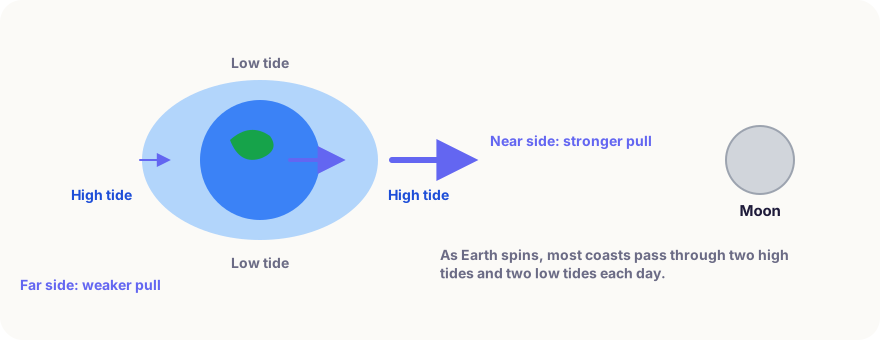
Every object in the universe attracts every other through gravity, and that pull weakens quickly with distance. The Moon pulls on Earth and everything on it. But because Earth is a large body, about 12,700 kilometres across, the Moon’s pull is not the same everywhere:
- the side facing the Moon is about 6,400 kilometres closer and is pulled hardest;
- Earth’s centre is pulled with medium strength;
- the far side is pulled most weakly.
What matters is not the pull itself but this difference, which scientists call the tidal force.
Why are there two high tides?
A bulge on the side facing the Moon is easy to understand. But there is also a bulge on the opposite side of Earth — the most puzzling part of tides.
Think of it this way:
- water on the near side is pulled more strongly than Earth’s centre and shifts towards the Moon;
- Earth’s centre is pulled more strongly than water on the far side, so Earth itself is effectively pulled towards the Moon, leaving the far-side water behind.
The result is that the oceans stretch into a slightly elongated shape along the line pointing to the Moon: two bulges, one facing the Moon and one facing directly away, with two troughs between them.
Two high tides, two low tides
Earth spins on its axis roughly every 24 hours, carrying coasts through the bulges and troughs in turn:
- passing under a bulge, the sea rises (high tide);
- passing under a trough, the sea falls (low tide).
But the Moon does not stay put — it orbits Earth in the same direction. So it takes not 24 hours but about 24 hours and 50 minutes for a coast to return to the same position relative to the Moon. As a result, most coasts have high tides about 12 hours and 25 minutes apart, and tide times shift about 50 minutes later each day.
The Sun’s role: spring and neap tides
The Sun is far more massive than the Moon but much further away. Because tidal force weakens with distance even faster than gravity does, the Sun’s tidal effect is only about half the Moon’s. Even so, it noticeably changes how big tides are.
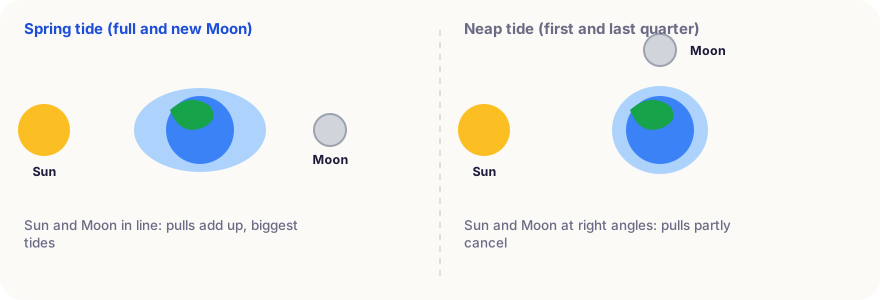
- Spring tides: at full Moon and new Moon, the Sun, Earth and Moon line up and their tidal forces add together. High tides are higher and low tides lower. The name has nothing to do with the season; it refers to the water “springing up”.
- Neap tides: when the Moon is at first or last quarter, the Sun and Moon form a right angle with Earth. Their forces partly cancel and the tidal range is at its smallest.
This cycle repeats about every two weeks, in step with the Moon’s phases — which we explain in Why does the Moon change shape?.
Why isn’t it the same everywhere?
In theory, the tidal range in the open ocean is only about half a metre. Along coasts, though, it varies enormously, depending on the shape of the coastline and the depth of the seabed:
| Place | Approximate tidal range |
|---|---|
| Bay of Fundy (Canada) | Up to 16 metres |
| Mont-Saint-Michel (France) | Nearly 14 metres |
| Bristol Channel (UK) | Over 12 metres |
| German North Sea coast | 2–4 metres |
| Mediterranean coasts | Usually 20–40 centimetres |
| Black Sea | A few centimetres |
Funnel-shaped bays squeeze and amplify the incoming tide. In the Bay of Fundy, the natural sloshing period of the water is very close to the tidal cycle, creating resonance — like pushing a swing at just the right moment — and an extraordinary range.
Enclosed seas, by contrast, have tiny tides. The Mediterranean connects to the Atlantic only through the Strait of Gibraltar, about 14 kilometres wide, so the ocean’s tidal wave barely gets in. The Black Sea and the Baltic are even more cut off. In such seas, wind and air pressure often change the sea level more than the tide does.
Surprising effects of tides
Tides do more than move the sea:
- The land moves too: the Moon’s pull also flexes Earth’s solid crust. Wherever you are, the ground rises and falls by a few tens of centimetres each day without you noticing.
- Earth is slowing down: friction between the tides and the seabed very slowly brakes Earth’s rotation. Days lengthen by about 2 milliseconds per century; in the age of the dinosaurs, a day was noticeably shorter than 24 hours.
- The Moon is moving away: the same interaction transfers energy to the Moon, pushing it into an orbit about 3.8 centimetres further away each year — measured by bouncing lasers off mirrors left on the Moon by Apollo astronauts.
- Habitats: tidal flats, regularly flooded and exposed by the tide, are home to countless creatures. The Wadden Sea along the coasts of the Netherlands, Germany and Denmark is one of the most famous examples.
Energy from the tides
Tides are extremely regular and can be predicted precisely years in advance, making them a reliable renewable energy source. France’s La Rance power station has generated electricity from tidal currents since 1966, and South Korea’s Sihwa Lake station is one of the largest in the world. Such plants, however, can only be built on a few coasts with very large tidal ranges.
In short
Tides arise because the gravity of the Moon and Sun pulls on Earth’s near and far sides with different strengths. That difference creates two bulges in the oceans, and as Earth rotates, coasts experience two high tides and two low tides a day. Spring tides come when the Sun and Moon line up, neap tides when they form a right angle. The shape of the coast largely determines the range — which is why it reaches 16 metres in Canada but only a few centimetres in the Black Sea.
Frequently asked questions
Why aren’t tides at the same time every day?
Because the Moon orbits Earth, it returns to the same position in the sky about 50 minutes later each day. So high and low tides also shift about 50 minutes later every day.
Where are the biggest tides in the world?
In the Bay of Fundy in Canada, the difference between high and low tide can reach 16 metres. Around Mont-Saint-Michel in France, ranges approach 14 metres.
Why do some seas have almost no tides?
Enclosed seas connected to the ocean only through narrow straits — such as the Mediterranean, the Black Sea and the Baltic — receive little of the ocean’s tidal wave, so their tides are usually tiny.
Can tides generate electricity?
Yes. France’s La Rance tidal power station has produced electricity from tidal currents since 1966. Because tides can be predicted precisely years ahead, they are a reliable renewable energy source.
Sources
- NASA Science – Tides
- NOAA National Ocean Service – Tides and Water Levels
- NOAA National Ocean Service – Tide Cycles
This article is based on peer-reviewed research and publications from trusted institutions, and it is reviewed regularly. How we work →
You might also wonder
All in Earth & Nature →
Why Do Leaves Change Colour in Autumn? The Science of Yellow, Orange and Red
Why do leaves turn yellow or red in autumn, and why do trees drop them? The pigments in leaves, colourful autumns and why America is redder than Europe.
How Do Rainbows Form? Light, Raindrops and the Secret of 42 Degrees
How do rainbows form, why are they curved and why do they appear opposite the Sun? Double rainbows, colour order and why you can never reach the end.
Why Is the Ocean Salty? Where Sea Salt Really Comes From
Why is seawater salty when rivers are fresh? How salt reaches the ocean from rocks and the seafloor, and why some seas are much saltier than others.
Why Is the Sky Blue? Rayleigh Scattering Explained Simply
Why is the sky blue and why are sunsets red? A clear explanation of how sunlight scatters in the atmosphere, and why we see blue instead of violet.
How Do Clouds Form and Why Does It Rain? A Water Droplet’s Journey Through the Sky
How do clouds form, why doesn’t a cloud carrying tonnes of water fall, and how is a raindrop made? The sky-high stages of the water cycle, explained.
How Do Volcanoes Erupt? Magma, Gases and Why Some Explode
How do volcanoes form, and why do some ooze gentle lava while others explode violently? Follow magma’s journey from deep underground to the surface.