How Do Volcanoes Erupt? Magma, Gases and Why Some Explode
How do volcanoes form, and why do some ooze gentle lava while others explode violently? Follow magma’s journey from deep underground to the surface.
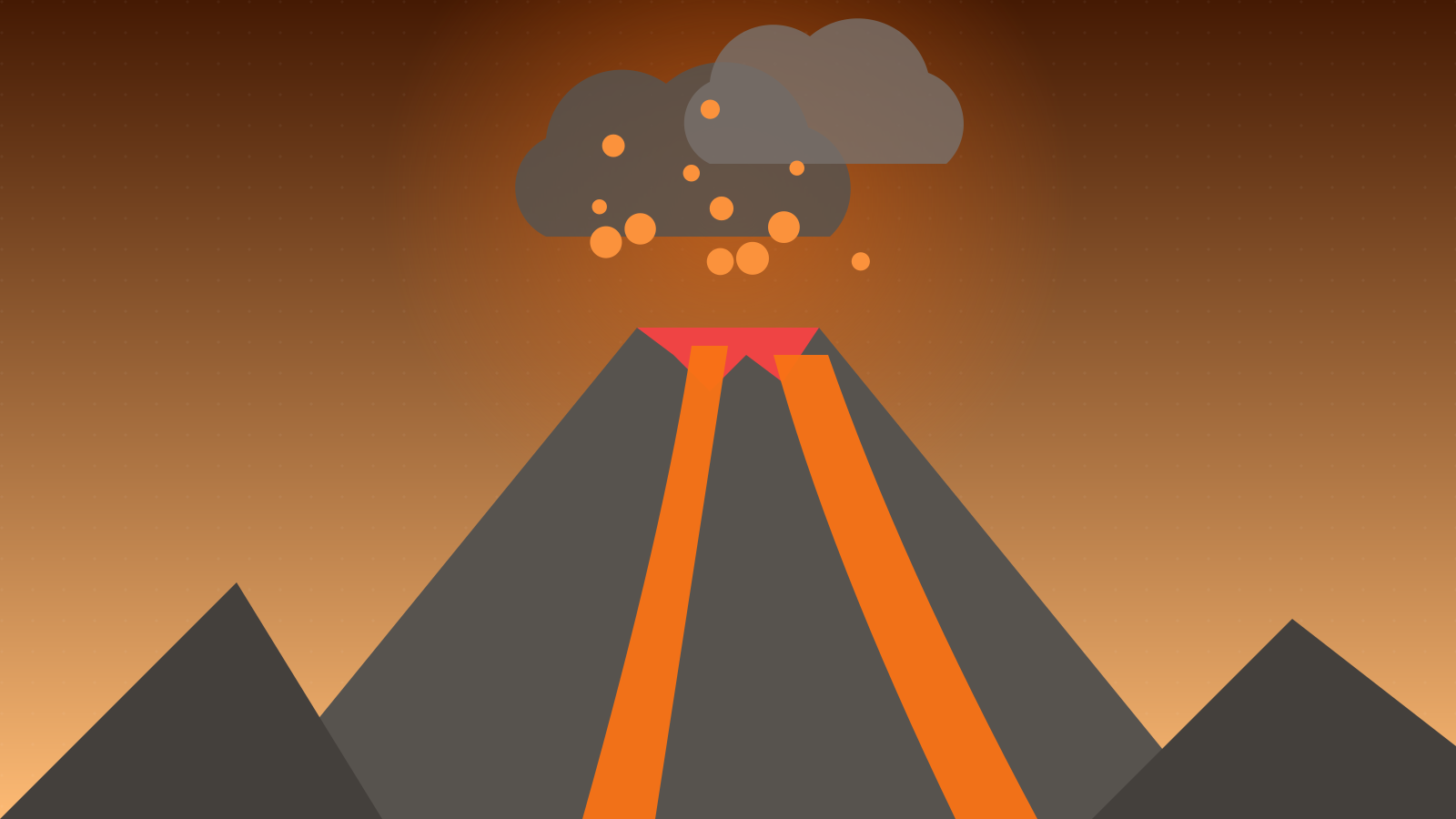
Short answer
Rock melting deep underground forms magma. Because magma is lighter than the surrounding rock, it rises and collects in magma chambers near the surface. Magma contains dissolved water vapour, carbon dioxide and sulphur gases. As it rises and the pressure drops, those gases form expanding bubbles; when the gas pressure overcomes the rock above, the volcano erupts. The stickier the magma, the harder it is for gas to escape — and the more violent the eruption.
In this article (7)
Giant ash clouds rising from a summit, fountains of lava lighting up the sky, rivers of glowing rock creeping down a slope — volcanoes are natural windows that show how much energy is still locked inside our planet. Both destructive and life-giving, they are one of the ways Earth renews itself.
Where does magma come from?
Contrary to popular belief, Earth’s interior is not one big ocean of molten rock. The mantle beneath the crust is almost entirely solid — very hot, and flowing very slowly. Rock only melts under special conditions, which arise mainly in three places:
| Where? | How does melting happen? | Example |
|---|---|---|
| Divergent plate boundaries | Hot mantle rock melts as pressure drops | Iceland, mid-ocean ridges |
| Subduction zones | Water carried down by the sinking plate lowers the melting point of rock | Japan, Indonesia, the Andes |
| Hotspots | A plume of hot material rising from the mantle melts the crust | Hawaii, Yellowstone |
The molten rock is called magma. Being lighter than the solid rock around it, it slowly seeps upwards and collects in magma chambers a few kilometres below the surface.
The engine of an eruption: gas
The real force that drives magma to the surface is the gas dissolved in it — mostly water vapour, followed by carbon dioxide and sulphur dioxide.
Think of a bottle of fizzy drink. While it is sealed, the gas stays dissolved and you see no bubbles. Open the cap and the pressure drops; gas rushes out as bubbles. Shake the bottle first and it foams over.
The same happens with magma:
- Deep down, under high pressure, gases stay dissolved in the magma.
- As magma rises, the pressure on it falls and the gases begin to form bubbles.
- As the bubbles expand, the magma’s volume grows and it is pushed upwards.
- When the gas pressure overcomes the strength of the rock above, magma bursts up through a channel called the conduit to the surface.
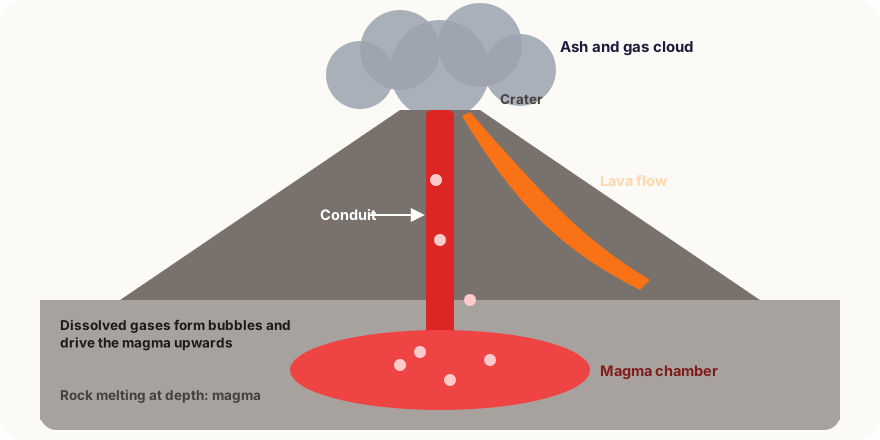
Once magma reaches the surface it is called lava, usually at temperatures between 700 and 1,200 °C.
Why are some volcanoes gentle and others violent?
Hawaiian volcanoes usually produce rivers of lava that flow calmly down their slopes — people can watch from a few metres away. Volcanoes such as Vesuvius, which destroyed Pompeii in AD 79, or Mount St. Helens, which blew away part of a mountain in 1980, are known for terrifying explosions. The secret lies in how sticky the magma is.
The most important factor controlling stickiness is the amount of silica (silicon dioxide):
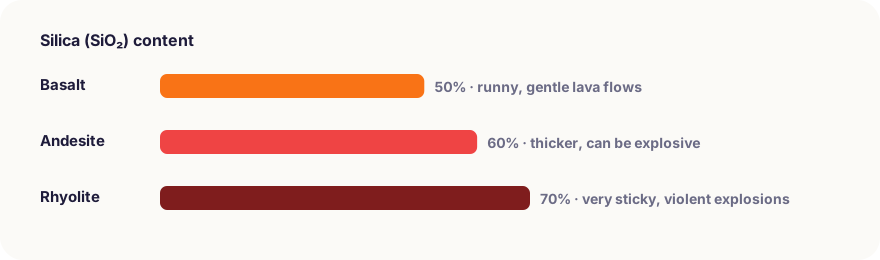
- Basaltic magma (about 50% silica) is runnier than honey. Gas escapes easily, so eruptions tend to be gentle with long lava flows — as in Hawaii and Iceland.
- Andesitic magma (about 60% silica) is thicker. Gas builds up and eruptions can be more violent; volcanoes at subduction zones are usually of this type.
- Rhyolitic magma (about 70% silica) is as sticky as toothpaste. Gas is effectively trapped until it finally shatters the magma, blasting it out as ash, pumice and glowing rock fragments.
One of the deadliest volcanic hazards is the pyroclastic flow: an avalanche of gas and ash at hundreds of degrees that races down a slope at well over 100 kilometres per hour. Pyroclastic flows were the main cause of death at Pompeii and Herculaneum.
Volcanoes can change the climate
Big eruptions affect more than their surroundings. Sulphur dioxide blasted into the upper atmosphere forms tiny droplets of acid that reflect part of the sunlight back into space.
- The 1991 Pinatubo eruption lowered the average global temperature by about half a degree for around two years.
- The 1815 eruption of Tambora led to the cold “year without a summer” of 1816 in Europe and North America, with failed harvests and famine.
Smaller eruptions can also cause major disruption: in 2010, ash from Iceland’s Eyjafjallajökull grounded flights across Europe for days.
Can eruptions be predicted?
Volcanoes give far more “warning” than earthquakes. Volcano observatories closely monitor:
- Small earthquakes: rising magma cracks rock, causing swarms of small quakes beneath the volcano.
- Ground swelling: as the magma chamber fills, the volcano’s surface bulges by millimetres or centimetres — changes satellites and GPS stations can measure.
- Gas emissions: increasing sulphur dioxide and carbon dioxide can show magma nearing the surface.
Thanks to these signs, many eruptions have been preceded by evacuations that saved thousands of lives — the evacuation before Pinatubo is one of the best-known examples. Even so, predicting exactly when and how violently a volcano will erupt remains difficult.
If there were no volcanoes…
Volcanoes can be destructive, but they also play a big part in making Earth habitable:
- Over billions of years, their gases helped form the atmosphere and oceans.
- Volcanic ash weathers into mineral-rich, extremely fertile soil — which is why the vineyards on the slopes of Etna and Vesuvius are famous.
- Volcanic regions provide geothermal energy; Iceland heats most of its homes this way.
- Places like Hawaii and Iceland are new land built by volcanoes.
In short
Volcanoes form when rock melted deep underground — magma — is driven to the surface by its expanding gases. Runny, low-silica magma produces gentle lava flows, while sticky, silica-rich magma leads to violent explosions. Large eruptions can even cool the global climate. Volcanoes mean danger, but also fertile soil, energy and brand-new land.
Frequently asked questions
How many active volcanoes are there?
About 1,350 volcanoes on land have erupted in the last 10,000 years, and 50 to 70 of them erupt each year. There are far more on the ocean floor, most of which have never been observed.
Can volcanic eruptions be predicted?
Better than earthquakes. Swarms of small earthquakes, swelling of the ground and rising gas emissions can signal an approaching eruption. Pinpointing exactly when and how big an eruption will be is still difficult.
What is a supervolcano?
A volcano capable of an eruption that ejects more than 1,000 cubic kilometres of material. Yellowstone in the USA and Toba in Indonesia are examples. Such eruptions are extremely rare, happening on timescales of tens of thousands of years or more.
Are volcanoes good for anything?
Yes. Volcanic ash weathers into extremely fertile soil, volcanic regions supply geothermal energy, and over billions of years volcanic gases helped form the atmosphere and oceans.
Sources
This article is based on peer-reviewed research and publications from trusted institutions, and it is reviewed regularly. How we work →
You might also wonder
All in Earth & Nature →
Why Do Leaves Change Colour in Autumn? The Science of Yellow, Orange and Red
Why do leaves turn yellow or red in autumn, and why do trees drop them? The pigments in leaves, colourful autumns and why America is redder than Europe.

How Do Rainbows Form? Light, Raindrops and the Secret of 42 Degrees
How do rainbows form, why are they curved and why do they appear opposite the Sun? Double rainbows, colour order and why you can never reach the end.
Why Is the Ocean Salty? Where Sea Salt Really Comes From
Why is seawater salty when rivers are fresh? How salt reaches the ocean from rocks and the seafloor, and why some seas are much saltier than others.

Why Is the Sky Blue? Rayleigh Scattering Explained Simply
Why is the sky blue and why are sunsets red? A clear explanation of how sunlight scatters in the atmosphere, and why we see blue instead of violet.
How Do Clouds Form and Why Does It Rain? A Water Droplet’s Journey Through the Sky
How do clouds form, why doesn’t a cloud carrying tonnes of water fall, and how is a raindrop made? The sky-high stages of the water cycle, explained.

What Causes Tides? The Moon’s Invisible Pull on the Oceans
Why does the sea rise and fall twice a day? How the Moon and Sun create tides, why there are two high tides and why some coasts get huge tides and others none.