Why Is the Ocean Salty? Where Sea Salt Really Comes From
Why is seawater salty when rivers are fresh? How salt reaches the ocean from rocks and the seafloor, and why some seas are much saltier than others.
Short answer
Rainwater slowly wears down rocks and dissolves their minerals, and rivers carry these dissolved salts to the sea. When the Sun evaporates seawater, the water leaves but the salt stays behind. Hot springs on the ocean floor and undersea volcanoes add more. Built up over millions of years, these salts make up about 3.5% of seawater.
In this article (8)
That sharp, salty taste when you get a mouthful of seawater is the result of a process that has been running on our planet for millions of years. But where does the salt come from — and why are rivers fresh when they flow into the same sea?
How much salt is in seawater?
On average, about 3.5% of ocean water is dissolved salt, or roughly 35 grams per litre. Most of it comes from the two elements that make up table salt:
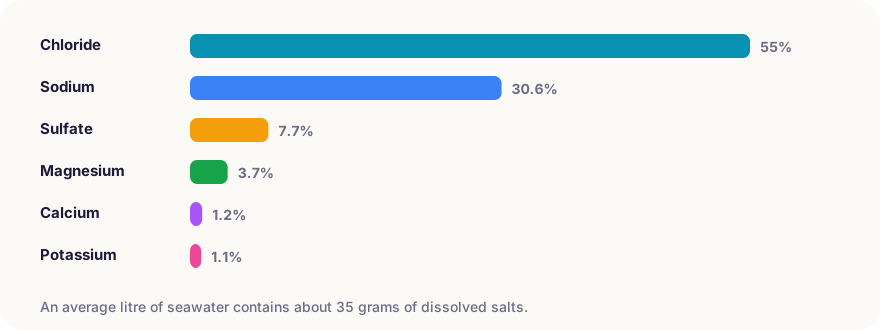
- Chloride: about 55%
- Sodium: about 30%
- The rest is ions such as sulphate, magnesium, calcium and potassium.
Source one: rocks
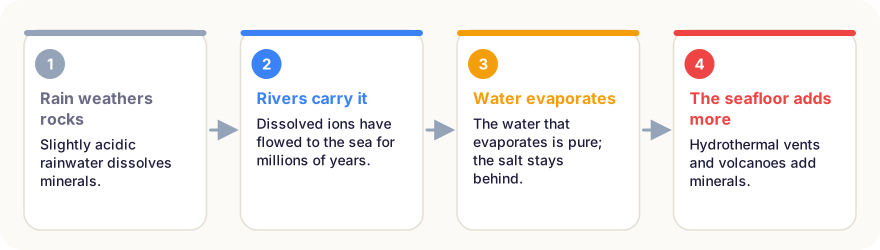
The story starts with rain. As raindrops fall, they dissolve a little carbon dioxide from the air and become slightly acidic — enough to gently but constantly wear away rock.
As rainwater flows over and through rocks, it dissolves minerals. They break apart into tiny electrically charged particles called ions. Streams and rivers collect these ions and carry them to the sea.
River water contains salt too, but so little that we cannot taste it. The real difference happens in the ocean.
Evaporation: the water leaves, the salt stays
When the Sun warms the sea surface, water evaporates into the atmosphere. Dissolved salts cannot go with it, so they stay behind. The evaporated water later falls as rain, weathers more rock and brings fresh salts back to the sea.
This cycle has run without pause for millions of years. Salt delivered by rivers accumulates in the sea year after year, and that is how seawater reached its present saltiness.
Source two: the ocean floor
Some of the salt comes straight from the bottom of the ocean:
- Hydrothermal vents: Seawater seeps into cracks in the seafloor, is heated deep in the crust and dissolves minerals from surrounding rock before gushing back into the ocean.
- Undersea volcanoes: Gases and minerals released during eruptions also enter seawater. Much of the ocean’s chloride is thought to come from volcanic sources like these.
Is the sea getting saltier?
If salt is added every year, you might expect the oceans to keep getting saltier. In fact, ocean salinity has been roughly stable for hundreds of millions of years, because salt also leaves the sea:
- It becomes part of sediments that settle on the seafloor.
- In shallow, warm seas, evaporation leaves thick layers of salt. Much of the rock salt mined today is the remains of ancient seas.
- Some ions are used by marine life to build shells and skeletons.
Because inputs and outputs balance, the ocean behaves like a giant steady-state system.
Why aren’t all seas equally salty?
Salinity varies with evaporation, rainfall and how much fresh water flows in:
| Body of water | Approximate salinity |
|---|---|
| Red Sea | 4% |
| Mediterranean | 3.8% |
| Open ocean average | 3.5% |
| Black Sea (surface) | 1.8% |
| Baltic Sea | around 0.7% |
| Dead Sea | 34% |
The Baltic and Black Sea are less salty because large rivers pour in plenty of fresh water while little seawater is exchanged with the ocean. In the Mediterranean, the warm climate means evaporation exceeds rainfall, so it is saltier than the open ocean. The Dead Sea has no outlet: water leaves only by evaporating, so the salt becomes extremely concentrated — which is why people float so easily there.
Why can’t we drink seawater?
The body must keep the salt level in the blood within a narrow range, and seawater is about four times saltier than blood. To get rid of that extra salt, your kidneys would need more water than the seawater contains. Drinking seawater therefore does not quench thirst; it makes dehydration worse.
In short
Sea salt comes from rocks, from hot springs on the ocean floor and from volcanoes. Rivers deliver it, the Sun evaporates the water and the salt stays behind. Over millions of years, with salt arriving and leaving in balance, this cycle has given the ocean the saltiness we taste today.
Frequently asked questions
If rivers carry salt, why are they fresh?
Rivers contain very little salt and their water is constantly flowing and being replaced. In the sea, water evaporates while salt stays behind and accumulates over millions of years.
Is the ocean getting saltier?
Not really. It is largely in balance: about as much salt leaves seawater — locked into sediments, rocks and the seafloor — as enters it.
Can you drink seawater?
No. Your kidneys would need more water to flush out the extra salt than the seawater provides, leaving you more dehydrated.
Where is the saltiest water on Earth?
The Dead Sea, at about 34% salt, is roughly ten times saltier than the ocean. Don Juan Pond in Antarctica is saltier still.
Sources
This article is based on peer-reviewed research and publications from trusted institutions, and it is reviewed regularly. How we work →
You might also wonder
All in Earth & Nature →
Why Do Leaves Change Colour in Autumn? The Science of Yellow, Orange and Red
Why do leaves turn yellow or red in autumn, and why do trees drop them? The pigments in leaves, colourful autumns and why America is redder than Europe.

How Do Rainbows Form? Light, Raindrops and the Secret of 42 Degrees
How do rainbows form, why are they curved and why do they appear opposite the Sun? Double rainbows, colour order and why you can never reach the end.

Why Is the Sky Blue? Rayleigh Scattering Explained Simply
Why is the sky blue and why are sunsets red? A clear explanation of how sunlight scatters in the atmosphere, and why we see blue instead of violet.
How Do Clouds Form and Why Does It Rain? A Water Droplet’s Journey Through the Sky
How do clouds form, why doesn’t a cloud carrying tonnes of water fall, and how is a raindrop made? The sky-high stages of the water cycle, explained.

What Causes Tides? The Moon’s Invisible Pull on the Oceans
Why does the sea rise and fall twice a day? How the Moon and Sun create tides, why there are two high tides and why some coasts get huge tides and others none.
How Do Volcanoes Erupt? Magma, Gases and Why Some Explode
How do volcanoes form, and why do some ooze gentle lava while others explode violently? Follow magma’s journey from deep underground to the surface.