What Causes Wind? Pressure, Sunshine and a Spinning Earth
Wind is air moving from high to low pressure, driven by the Sun heating Earth unevenly. How sea breezes, trade winds and the jet stream form, explained simply.
Short answer
Wind is air moving from areas of high pressure to areas of low pressure. Those pressure differences exist because the Sun heats Earth unevenly: the equator more than the poles, land faster than sea, dark ground more than snow. Warm air expands and rises, leaving lower pressure near the ground, while cool, dense air sinks and creates higher pressure. Air flows in to even things out. Because Earth spins, the Coriolis effect bends moving air to the right in the Northern Hemisphere and to the left in the Southern Hemisphere, creating swirling weather systems and steady global winds.
In this article (7)
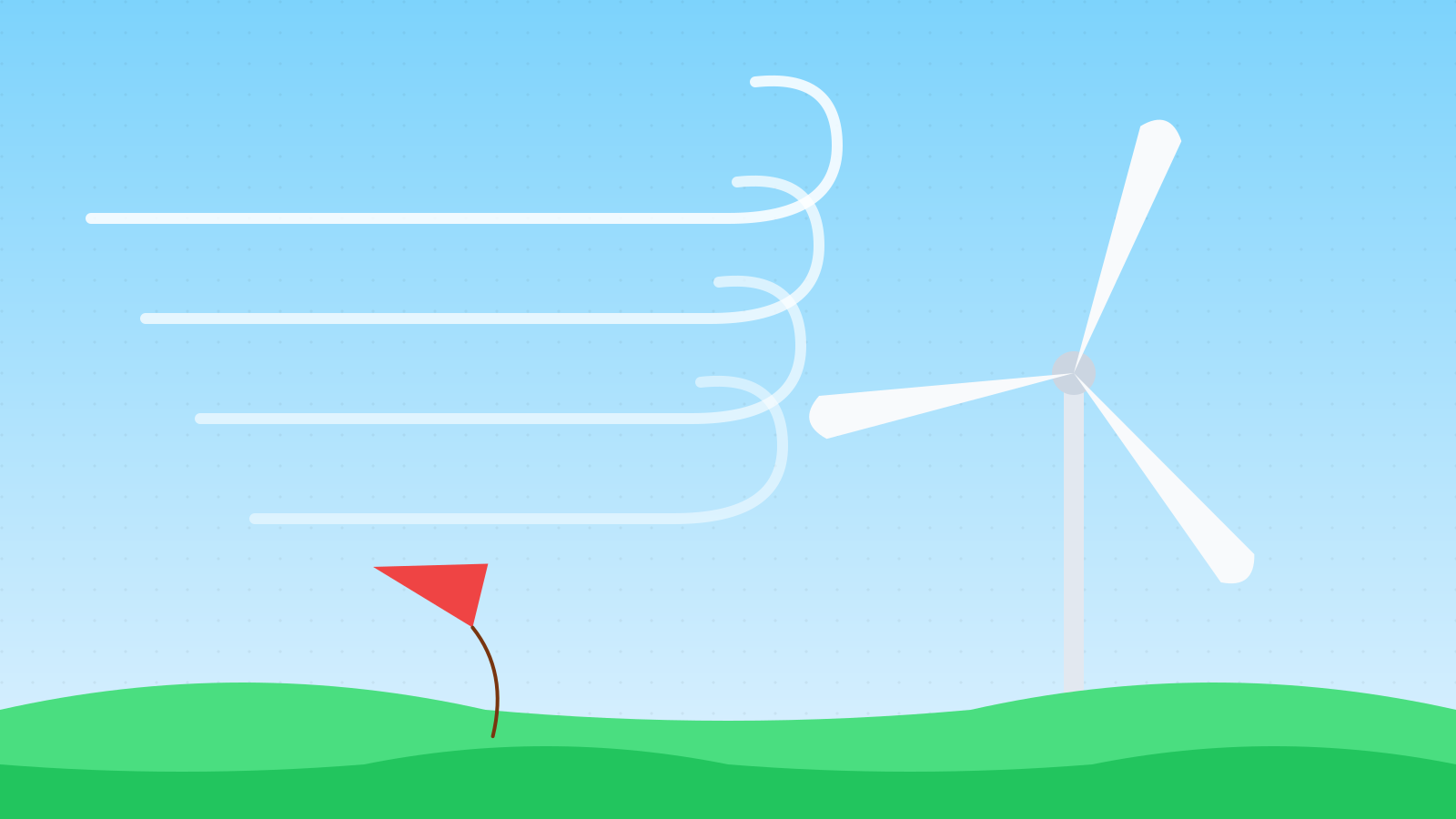
You cannot see wind, but you can see what it does: leaves skittering across the pavement, waves building on a lake, a kite pulling at its string. It can be a gentle breeze on a summer evening or a storm strong enough to tear roofs off houses. Yet it all comes from one simple idea: air moves to balance out differences in pressure.
Air has weight and pressure
The air around us may feel like nothing, but it has mass. The atmosphere presses down on every square metre of Earth’s surface with the weight of about 10 tonnes. This is air pressure, and it is not the same everywhere.
Where air is sinking and piling up, pressure at the surface is high. Where air is rising, pressure at the surface is low. Like water flowing downhill, air moves from high pressure towards low pressure. That movement is wind. The bigger the pressure difference over a given distance, the stronger the wind.
The Sun heats Earth unevenly
The ultimate engine of the wind is the Sun. It does not warm our planet evenly.
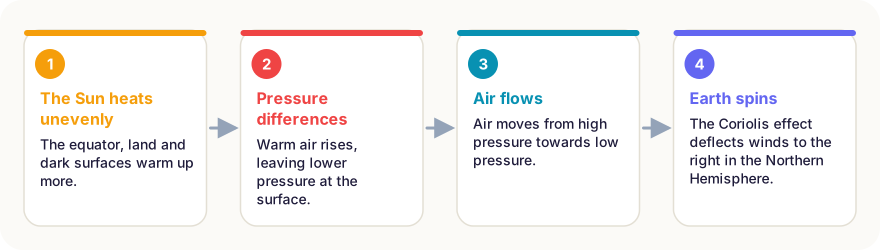
- The equator receives much more direct sunlight than the poles.
- Land heats up and cools down faster than water.
- Dark surfaces such as forests and fields absorb more heat than snow or ice.
Air above a warm surface heats up, expands, becomes lighter and rises. This leaves lower pressure behind at the surface. Cooler, denser air nearby sinks and flows in to replace it.
A small example: the sea breeze
You can feel this on almost any sunny beach. In the morning, land and sea have similar temperatures. As the day goes on, the sand and soil heat up much faster than the water.
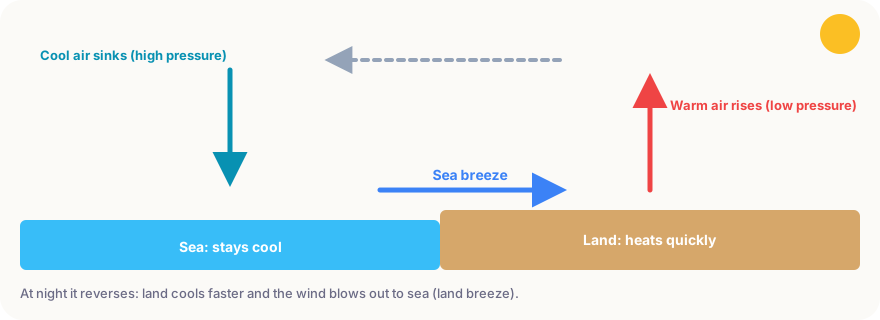
The warm air over the land rises, and cooler air from over the sea flows in to take its place: a sea breeze. At night the land cools faster than the sea, the pattern flips, and a gentler land breeze blows out to sea. Mountains and valleys create similar daily winds, flowing uphill by day and downhill at night.
The spinning Earth bends the wind
If Earth did not rotate, air would flow straight from high to low pressure. But Earth spins, and that changes everything.
As air moves across the surface of a rotating planet, its path appears to curve. This is the Coriolis effect. In the Northern Hemisphere, moving air is deflected to the right; in the Southern Hemisphere, to the left.
The result is that air does not rush straight into a low-pressure area. Instead it spirals around it. In the Northern Hemisphere, winds circle anticlockwise around lows and clockwise around highs. This is why weather maps are full of swirling patterns, and why hurricanes, typhoons and cyclones all spin.
Global winds: a planet-sized machine
On a planetary scale, the same rules create belts of winds that circle the globe. Warm air rises near the equator, flows towards the poles high in the atmosphere, cools and sinks around 30° north and south. This loop is called the Hadley cell.
- Near the surface, air flowing back towards the equator is bent by the Coriolis effect into the steady trade winds, which once carried sailing ships across the oceans.
- Between about 30° and 60°, the prevailing winds blow from the west: the westerlies, which bring much of Europe’s weather from the Atlantic.
- Near the poles, cold, sinking air creates the polar easterlies.
High above, at about 9 to 12 kilometres, narrow rivers of fast-moving air called jet streams flow where warm and cold air masses meet. They can reach more than 300 km/h and steer storms across continents.
Local winds with names
Many regions have winds so familiar that they have their own names. In Turkey, the cold north-easterly poyraz and the warm, gusty south-westerly lodos shape life around the Sea of Marmara. In the Alps, the warm, dry Föhn blows down the mountainsides. Each is a local result of the same physics: pressure differences, terrain and the spinning Earth.
In short
- Wind is air moving from high to low pressure.
- Pressure differences come from the Sun heating Earth unevenly: equator vs poles, land vs sea.
- Sea breezes show the process on a small scale.
- The Coriolis effect bends winds to the right in the Northern Hemisphere, making them spiral around highs and lows.
- On a global scale this creates trade winds, westerlies and jet streams.
Frequently asked questions
Why is it often windier on hills and coasts?
Higher up there is less friction from trees and buildings, so winds blow faster. On coasts, the temperature difference between land and sea creates regular sea and land breezes.
Why does wind blow around a low-pressure area instead of straight into it?
As air moves towards the low, Earth’s rotation deflects it. In the Northern Hemisphere it ends up circling anticlockwise around a low and clockwise around a high; in the Southern Hemisphere the directions are reversed.
What is the jet stream?
Jet streams are narrow bands of very fast wind about 9 to 12 km above the ground, where strong temperature contrasts meet. They can exceed 300 km/h and steer weather systems; planes use them to save fuel.
How is wind speed measured?
With an anemometer, often a set of spinning cups. The Beaufort scale, devised by Francis Beaufort in 1805, describes wind strength from 0 (calm) to 12 (hurricane force) based on its effects.
Sources
This article is based on peer-reviewed research and publications from trusted institutions, and it is reviewed regularly. How we work →
You might also wonder
All in Earth & Nature →
How Do Snowflakes Form? Why They Have Six Sides and Are All Different
Every snowflake grows from a speck of dust in a cloud. Why snow crystals have six sides, how temperature shapes them, and whether no two are really alike.
Why Do Leaves Change Colour in Autumn? The Science of Yellow, Orange and Red
Why do leaves turn yellow or red in autumn, and why do trees drop them? The pigments in leaves, colourful autumns and why America is redder than Europe.
How Do Rainbows Form? Light, Raindrops and the Secret of 42 Degrees
How do rainbows form, why are they curved and why do they appear opposite the Sun? Double rainbows, colour order and why you can never reach the end.
Why Is the Ocean Salty? Where Sea Salt Really Comes From
Why is seawater salty when rivers are fresh? How salt reaches the ocean from rocks and the seafloor, and why some seas are much saltier than others.
Why Is the Sky Blue? Rayleigh Scattering Explained Simply
Why is the sky blue and why are sunsets red? A clear explanation of how sunlight scatters in the atmosphere, and why we see blue instead of violet.
How Do Clouds Form and Why Does It Rain? A Water Droplet’s Journey Through the Sky
How do clouds form, why doesn’t a cloud carrying tonnes of water fall, and how is a raindrop made? The sky-high stages of the water cycle, explained.