Why Do Stars Twinkle? The Atmosphere Behind the Flicker
Why do stars twinkle while planets shine steadily? How starlight bends in Earth’s atmosphere, and how astronomers fight the twinkle to get sharp images.

Short answer
Stars do not really twinkle; the flicker comes from Earth’s atmosphere. Before starlight reaches your eyes, it passes through constantly moving layers of air with different temperatures and densities, and each layer bends the light slightly differently. Stars are so far away that they appear as single points of light, so even tiny deflections show up as changes in brightness and position. This is called scintillation.
In this article (7)
Look up on a clear night and you will see the stars flicker gently, brightening and dimming from moment to moment. The sight has inspired countless nursery rhymes and poems. But stars do not actually twinkle. The flicker we see happens in the last few kilometres of starlight’s journey — in our own atmosphere.
Starlight’s long journey
Light leaving a star travels through the almost empty vacuum of space for years, sometimes thousands of years, before it reaches us. Along the way it moves in a straight line, undisturbed.
The trouble starts at the very end. As soon as the light enters Earth’s atmosphere, it has to pass through around 100 kilometres of constantly moving, mixing air.
How does the atmosphere bend light?
Light changes direction when it passes from one medium into another of different density. This is called refraction — it is why a spoon in a glass of water looks bent.
Air is not uniform either. Warm air is less dense than cold air and bends light slightly less. And the atmosphere is full of constantly moving pockets of air at different temperatures:
- warm air rising from ground heated during the day;
- strong winds and jet streams high up;
- eddies at the boundaries between layers of air moving at different speeds.

Each of these pockets acts like a weak lens, nudging the light slightly off course. As the pockets drift with the wind, the lenses keep moving. As a result, the light reaching your eye:
- brightens one moment and dims the next;
- shifts its position ever so slightly;
- sometimes seems to change colour.
Scientists call this scintillation.
Why do planets shine more steadily?
If you have spotted Venus, Jupiter or Mars in the night sky, you may have noticed that they shine far more calmly than the stars. The reason is distance and apparent size.
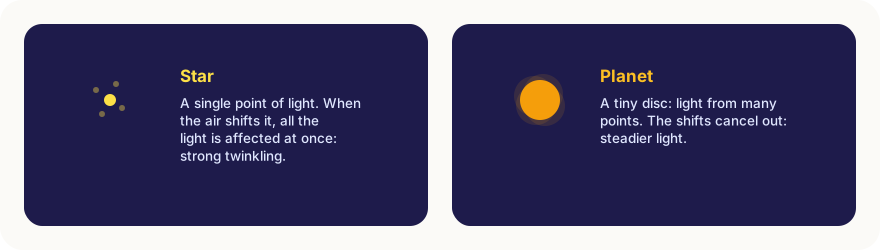
- Stars are so far away that even through large telescopes most appear as single points of light. When the atmosphere shifts that point, all the star’s light is affected at once.
- Planets are much closer and cover a real, if tiny, disc in the sky — too small to notice with the naked eye. Light from each part of the disc passes through different air pockets and is deflected in different directions. On average these deflections cancel out, so the planet looks steadier.
That difference is a handy way to tell stars from planets: a bright point that does not twinkle is probably a planet. Planets can twinkle too, though, when they are very low near the horizon.
Stars near the horizon twinkle more
Light from a star directly overhead takes the shortest path through the atmosphere. Light from a star near the horizon travels much further through the air. Passing through more air pockets, it is bent more — which is why stars low in the sky twinkle far more noticeably.
Bright stars near the horizon show another effect. The atmosphere bends different colours of light by slightly different amounts, so a star’s red, green and blue light can reach your eye at different moments. Sirius, the brightest star in the night sky, can look like a light flashing in many colours when it is low on winter evenings — a sight that has even led to UFO reports.
A big problem for astronomers
Twinkling stars may look romantic, but for astronomers they are a headache. The same turbulence blurs telescope images. Astronomers call this atmospheric blurring “seeing”: the better the seeing — the calmer the atmosphere — the sharper the images.
Three main solutions have been developed.
1. Going higher
Major observatories are usually built on the summits of high, dry and calm mountains, where the layer of air the light must cross is thinner and there is less moisture and turbulence. That is why Chile’s Atacama Desert, Mauna Kea in Hawaii and the Canary Islands are among the world’s most important observing sites.
2. Adaptive optics
Modern large telescopes use a technology called adaptive optics. It works like this:
- The telescope watches a bright reference star, or an artificial “star” created by shining a laser into the upper atmosphere.
- Computers measure how that light is distorted by the atmosphere hundreds or even thousands of times a second.
- A flexible mirror inside the telescope constantly changes shape using hundreds of tiny actuators, applying the exact opposite distortion.
Thanks to this, ground-based telescopes can, for some observations, approach the sharpness of space telescopes.
3. Going to space
The ultimate solution is to leave the atmosphere entirely. Launched in 1990, the Hubble Space Telescope escaped atmospheric blurring and captured images of the universe with unprecedented clarity. Astronauts in space likewise see stars as steady, sharp, non-twinkling points.
What does twinkling say about the weather?
Sailors and farmers once tried to predict the weather by watching how much the stars twinkled — and there is some truth in it. Nights of strong twinkling are usually nights with strong winds high up and a turbulent atmosphere, which can sometimes herald a change in the weather. On its own, though, it is not a reliable forecasting method.
In short
Stars do not really twinkle. Their light travels straight through space but is bent randomly by moving pockets of air at different temperatures once it enters Earth’s atmosphere. Because stars appear as single points, those bends show up as changes in brightness and position; planets, being tiny discs, shine more steadily. To escape the twinkle, astronomers climb mountains, bend mirrors and send telescopes into space.
Frequently asked questions
Why don’t planets twinkle?
Planets are much closer than stars and cover a tiny disc in the sky. Light from different parts of the disc is deflected in different directions by the atmosphere, but the deflections cancel out on average, so planets shine more steadily.
Why do stars near the horizon twinkle more?
Light from a star near the horizon travels through far more atmosphere than light from a star overhead. Passing through more layers of air, it is bent more and the twinkling increases.
Why do some stars seem to change colour?
The atmosphere bends different colours by slightly different amounts. Especially for bright stars low in the sky, those colours reach your eye at different moments, so the star seems to flash red, blue and green. Sirius, the brightest star in the night sky, is the best-known example.
Does twinkling say anything about the weather?
Partly. Nights when stars twinkle strongly are usually nights with strong winds high in the atmosphere. To astronomers that means poor “seeing” — the calmer the air, the sharper the view.
Sources
This article is based on peer-reviewed research and publications from trusted institutions, and it is reviewed regularly. How we work →
You might also wonder
All in Space →
Why Is the Night Sky Dark? Olbers’ Paradox and the Age of the Universe
With billions of stars out there, why isn’t the night sky ablaze with light? Olbers’ paradox, the finite age of the universe and cosmic expansion, explained.

Why Does the Moon Change Shape? Moon Phases Explained Simply
Why does the Moon go from crescent to full? Why lunar phases have nothing to do with Earth’s shadow, and how to tell a waxing Moon from a waning one.
What Is a Black Hole? How They Form and What Happens Inside
What is a black hole, how does it form and what is the event horizon? A clear guide to the objects not even light can escape — and their first images.
What Is a Light-Year? Making Sense of Space’s Enormous Distances
Is a light-year a unit of time or distance? How big a light-year really is, why looking at stars means looking into the past, and the scale of the universe.
How Does the Sun Shine? The Story of Nuclear Fusion in Its Core
How does the Sun produce light and heat, how does its energy reach us and when will it burn out? Nuclear fusion in the core and the Sun’s layers, explained.
Why Is Mars Red? The Rusty Secret of the Red Planet
What gives Mars its red colour? The iron-oxide dust covering its surface, the 2025 discovery of traces of water, and why Martian sunsets are blue.