Why Does the Sensitive Plant Close When You Touch It? Mimosa pudica Explained
Touch a Mimosa pudica leaf and it folds up in seconds. How electrical signals and water pressure move it, why it does it, and can it learn?
Short answer
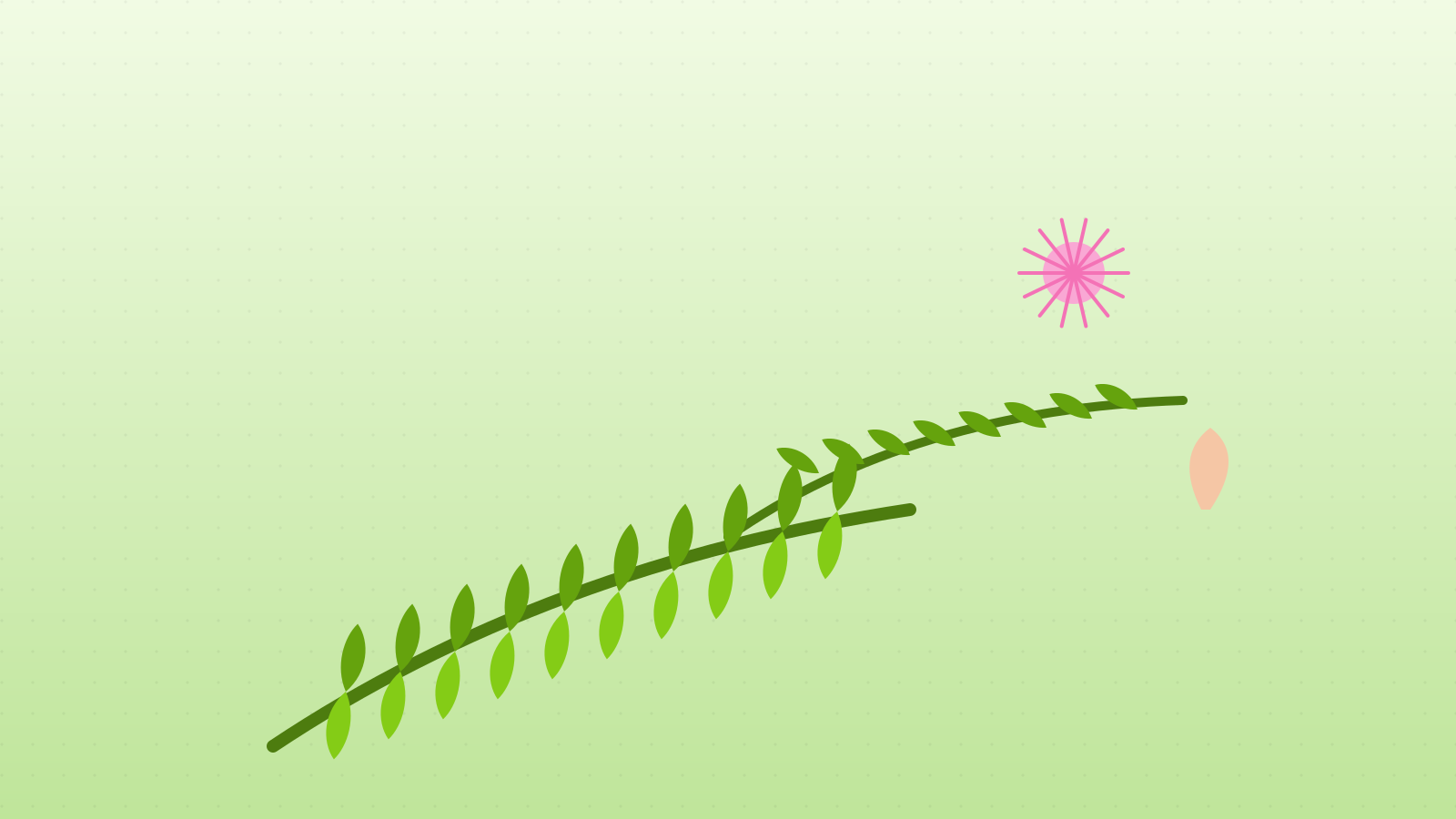
The sensitive plant, Mimosa pudica, folds its leaves when touched because of a fast electrical signal and a sudden loss of water pressure. A touch, shake or burst of heat triggers an electrical signal that travels to joint-like swellings at the base of the leaflets and stalks, called pulvini. Cells on one side of each pulvinus release charged ions and then water, collapsing like deflated balloons, so the leaflets fold together and the stalk droops within seconds. The plant reopens after about 10 to 20 minutes. Scientists think the movement helps deter plant-eating animals and insects, making the plant look smaller and less appetising.
In this article (4)
Brush your finger along its feathery leaves and something astonishing happens: the tiny leaflets fold together pair by pair, as if shy, and the whole leaf droops. In a few seconds, a lush green plant looks wilted. Mimosa pudica, the sensitive plant or touch-me-not, has fascinated people for centuries. How can a plant move so quickly, and why does it bother?
Fast movement without muscles
Plants have no muscles and no nerves. Most plant movements, like a sunflower turning or a shoot bending towards light, happen slowly through growth. The sensitive plant’s reaction is different: it uses water pressure, and it is fast.
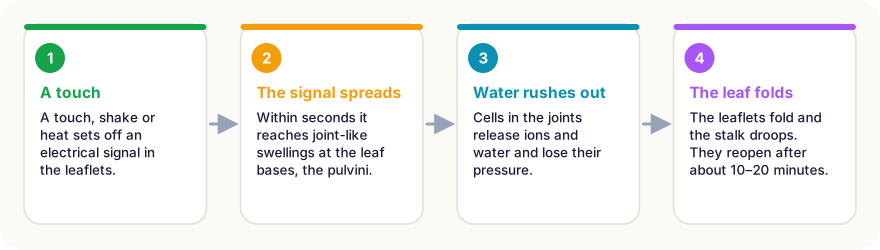
- A trigger. Touch, vibration, a sudden change in temperature or even a strong gust of wind stimulates the leaf.
- An electrical signal. The stimulus sets off an electrical signal, similar in some ways to a nerve impulse, which travels through the leaf in seconds. A strong stimulus can spread to neighbouring leaves.
- The joints. At the base of each leaflet and leaf stalk there are swollen, joint-like structures called pulvini (singular: pulvinus). They are packed with motor cells, kept firm by water pressure.
- Water rushes out. When the signal arrives, motor cells on one side of the pulvinus release charged particles, mainly potassium and chloride ions. Water follows them out of the cells. The cells collapse like deflated balloons, and the leaflets fold together while the stalk drops.
Studies of these motor cells have shown that the cell’s internal skeleton is also involved in the rapid change of shape. After about 10 to 20 minutes, the cells take up water again and the leaves slowly reopen.
Why fold up?
Moving costs energy, and a folded leaf cannot photosynthesise well. So there must be a benefit. Scientists think the main reason is defence:
- A plant that suddenly collapses may startle a grazing animal or dislodge an insect.
- Folded leaves look smaller and wilted, less attractive as food.
- Folding exposes small thorns on the stems.
The plant also folds its leaves every evening and opens them in the morning, a daily rhythm called nyctinasty, controlled by its internal clock.
Can a plant learn?
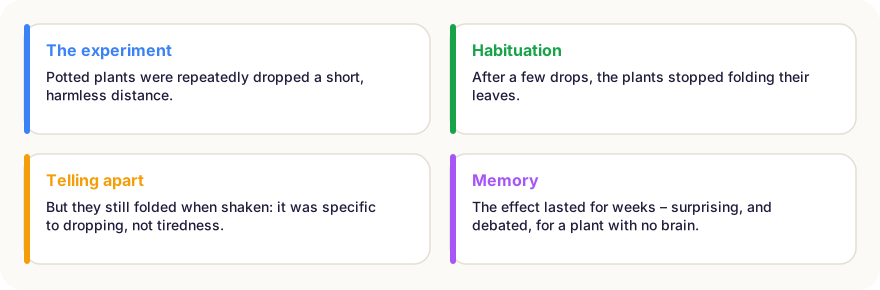
In 2014, ecologist Monica Gagliano and her colleagues tested whether Mimosa could learn to ignore a harmless disturbance. They repeatedly dropped potted plants a short distance, about 15 centimetres, in a way that did not harm them. At first, the plants folded their leaves each time. After a few drops, many stopped bothering.
Was this just exhaustion? To check, the researchers shook the plants, a different kind of disturbance. The plants folded immediately, showing they were not simply too tired to respond. They had stopped responding specifically to being dropped. Even more surprising, plants tested again weeks later still did not fold when dropped. Plants grown in low light, where every bit of photosynthesis counts, learned to ignore the drops faster.
Psychologists call this kind of change habituation. Whether it should be called learning or memory in a plant without a brain is still debated, but the experiment showed that plant behaviour can be surprisingly flexible.
In short
- Mimosa pudica folds its leaves within seconds when touched.
- A touch triggers an electrical signal that reaches joint-like pulvini.
- Motor cells lose ions and water and collapse, folding the leaflets.
- The leaves reopen after about 10–20 minutes.
- Folding probably helps deter animals and insects.
- A 2014 study found the plants stopped reacting to harmless drops and remembered for weeks.
Frequently asked questions
Does touching a sensitive plant hurt it?
Occasional touching does no lasting harm, but each closure costs energy and reduces the leaf’s ability to photosynthesise while it is folded. Constant handling can weaken the plant.
Why does the sensitive plant close at night?
Mimosa also folds its leaves at dusk and opens them in the morning, a daily rhythm called nyctinasty, controlled by its internal clock. This is separate from the quick response to touch.
Where does Mimosa pudica come from?
It is native to Central and South America and has spread to warm regions worldwide. In some tropical countries it is considered a weed.
Can plants really learn?
Plants have no brain or neurons, so many scientists prefer terms like habituation or memory-like behaviour. Whether this counts as learning in the animal sense is still debated.
Sources
- Gagliano, M. et al. (2014). Experience teaches plants to learn faster and forget slower in environments where it matters. Oecologia
- Fleurat-Lessard, P. et al. (1988). Effects of colchicine, vinblastine, cytochalasin B and phalloidin on the seismonastic movement of Mimosa pudica leaf and on motor cell ultrastructure. Journal of Experimental Botany
This article is based on peer-reviewed research and publications from trusted institutions, and it is reviewed regularly. How we work →
You might also wonder
All in Plants →
Do Sunflowers Follow the Sun? Yes, But Only When They Are Young
Young sunflowers turn east to west each day and swing back at night. Mature ones stop and face east. How the plant’s inner clock and bees explain it.
How Do Plants Drink Water? How Trees Lift Water 100 Metres Without a Pump
Plants have no heart, yet the tallest trees lift water over 100 metres. How roots, xylem and evaporation from leaves pull water up from the soil.
Why Are Leaves Green? Chlorophyll, Photosynthesis and a Puzzle
Leaves are green because chlorophyll absorbs red and blue light. But why would plants waste the most abundant colour of sunlight? The surprising answer.
Are Mushrooms Plants? Why Fungi Are Closer to Animals
Mushrooms grow in soil and don’t move, but they are not plants. Why fungi form their own kingdom, how they feed and why they are closer to animals.

How Do Cacti Survive Without Water? The Desert Survival Toolkit
Cacti store water in swollen stems, use spines instead of leaves, breathe at night and grow roots within hours of rain. How they survive in deserts.
Can Plants Make Sounds? Stressed Tomatoes Click in Ultrasound
Thirsty or cut plants emit ultrasonic clicks that microphones can record. What a 2023 study found, how plants signal danger and why they still don’t “scream”.