Do Sunflowers Follow the Sun? Yes, But Only When They Are Young
Young sunflowers turn east to west each day and swing back at night. Mature ones stop and face east. How the plant’s inner clock and bees explain it.

Short answer
Yes, but only while they are young and growing. Young sunflower plants turn their heads from east to west during the day to follow the Sun, then swing back to face east during the night. They do this by growing faster on one side of the stem than the other, and the rhythm is controlled by the plant’s internal circadian clock. Once the flowers open, the stem stops growing and the movement stops, leaving almost all mature sunflowers facing east. A 2016 study found that east-facing flowers warm up faster in the morning and receive about five times more bee visits.
In this article (5)
Its name says it all: the sunflower, in many languages a flower that turns with the Sun. In Turkish it is the “day-turner”, in French tournesol, in Spanish girasol. But walk past a field of sunflowers in full bloom on a summer evening and you may notice something odd: they are all looking the wrong way, towards the east. So do sunflowers really follow the Sun?
Yes, while they are young
The answer is yes, but only for part of their lives. Young sunflower plants, before their flowers open, move remarkably. In the morning their heads face east, towards the rising Sun. During the day they slowly turn, tracking the Sun across the sky to face west in the evening. Then, during the night, they swing back to face east again, ready for sunrise.
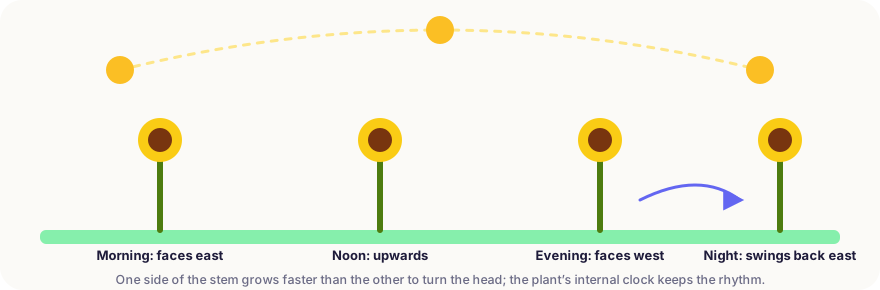
This sun-tracking is called heliotropism.
How a plant turns without muscles
Sunflowers have no muscles or joints. They move by growing unevenly. In 2016 a team led by Stacey Harmer at the University of California, Davis, studied the plants closely. They found that during the day the cells on the east side of the stem grow faster, bending the head towards the west. At night the west side grows faster, bringing the head back to face east.
Crucially, the timing is controlled by the plant’s internal circadian clock, the same kind of 24-hour rhythm that governs our sleep. When the researchers moved plants indoors under a fixed overhead light, they kept turning back and forth for a few days. When they tried artificial “days” that were much longer than 24 hours, the tracking fell apart. And young plants were already turned east before dawn, anticipating the sunrise rather than reacting to it.
Why mature sunflowers face east
As the plant matures, the stem stops growing, so the movement stops. The clock also changes its behaviour so that the head settles in its morning position. That is why almost every mature sunflower faces east.
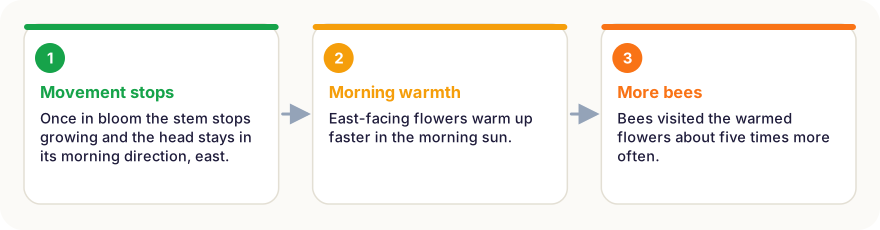
The researchers wanted to know whether facing east brings any benefit. They turned some potted plants to face west and compared them with plants facing east. East-facing flowers warmed up faster in the morning sun, and bees and other pollinators visited them about five times more often. When the west-facing flowers were warmed with a heater in the morning, they attracted more visitors too. Warmth, it seems, makes flowers more attractive to insects that like to start the day warm.
Why track the Sun at all?
Tracking helps young plants grow. In the study, plants that were prevented from moving, by being staked in place or turned around so that they faced the wrong way, had smaller leaves and less biomass. Following the Sun appears to help young sunflowers capture more light while they are building up their leaves.
In short
- Young sunflowers follow the Sun from east to west and swing back east at night.
- They move by growing faster on one side of the stem, not with muscles.
- The rhythm is set by the plant’s internal circadian clock.
- Mature sunflowers stop moving and face east.
- East-facing flowers warm up faster and get about five times more pollinator visits.
- Tracking helps young plants grow bigger.
Frequently asked questions
Do mature sunflowers follow the Sun?
No. A field of fully open sunflowers faces east all day. The tracking only happens while the stem is still growing, before the flower opens.
How does a sunflower turn without muscles?
During the day, cells on the east side of the stem grow faster, bending the head westwards. At night the west side grows faster, turning it back east. The movement is growth, not muscle.
What is it called when plants follow the Sun?
Sun-tracking is called heliotropism. Many plants bend towards light as they grow, but full daily east-west tracking like the young sunflower’s is less common.
Why do sunflowers face east?
East-facing heads warm up faster in the morning sun. Researchers found that warm flowers attract more pollinators, which helps the plant produce seeds.
Sources
This article is based on peer-reviewed research and publications from trusted institutions, and it is reviewed regularly. How we work →
You might also wonder
All in Plants →
How Do Plants Drink Water? How Trees Lift Water 100 Metres Without a Pump
Plants have no heart, yet the tallest trees lift water over 100 metres. How roots, xylem and evaporation from leaves pull water up from the soil.

Why Are Leaves Green? Chlorophyll, Photosynthesis and a Puzzle
Leaves are green because chlorophyll absorbs red and blue light. But why would plants waste the most abundant colour of sunlight? The surprising answer.
Can Plants Make Sounds? Stressed Tomatoes Click in Ultrasound
Thirsty or cut plants emit ultrasonic clicks that microphones can record. What a 2023 study found, how plants signal danger and why they still don’t “scream”.

How Does a Venus Flytrap Work? The Plant That Counts to Five
A Venus flytrap snaps shut in a tenth of a second, but only after counting two touches. How its trigger hairs, electrical signals and snap-buckling leaves work.

What Is the Oldest Tree in the World? Meet Methuselah, Nearly 5,000 Years Old
A bristlecone pine in California called Methuselah is about 4,850 years old. How scientists count tree rings, and how a gnarled pine outlives empires.
How Do Bats See in the Dark? Echolocation Explained
Bats are not blind, but many hunt in total darkness by listening to echoes. How echolocation works, how fast bats call, and how moths fight back.