How Does a Venus Flytrap Work? The Plant That Counts to Five
A Venus flytrap snaps shut in a tenth of a second, but only after counting two touches. How its trigger hairs, electrical signals and snap-buckling leaves work.
Short answer
A Venus flytrap catches insects with a pair of hinged leaves lined with sensitive trigger hairs. When an insect touches a hair, the plant produces an electrical signal, similar to a nerve impulse. One touch is not enough; if a second touch follows within about 30 seconds, the trap snaps shut in roughly a tenth of a second. The speed comes from the leaves’ curved shape suddenly flipping from bulging outwards to bulging inwards. As the trapped insect struggles, it triggers more signals; after about five, the plant seals the trap and releases digestive juices to absorb nutrients from its prey.
In this article (5)
Most plants sit still and wait for sunlight. The Venus flytrap hunts. Its leaves are toothed jaws that close around a fly faster than you can blink. Charles Darwin was so fascinated by it that he spent years experimenting on it. How does a plant without muscles or nerves pull off such a trick?
A trap made from a leaf
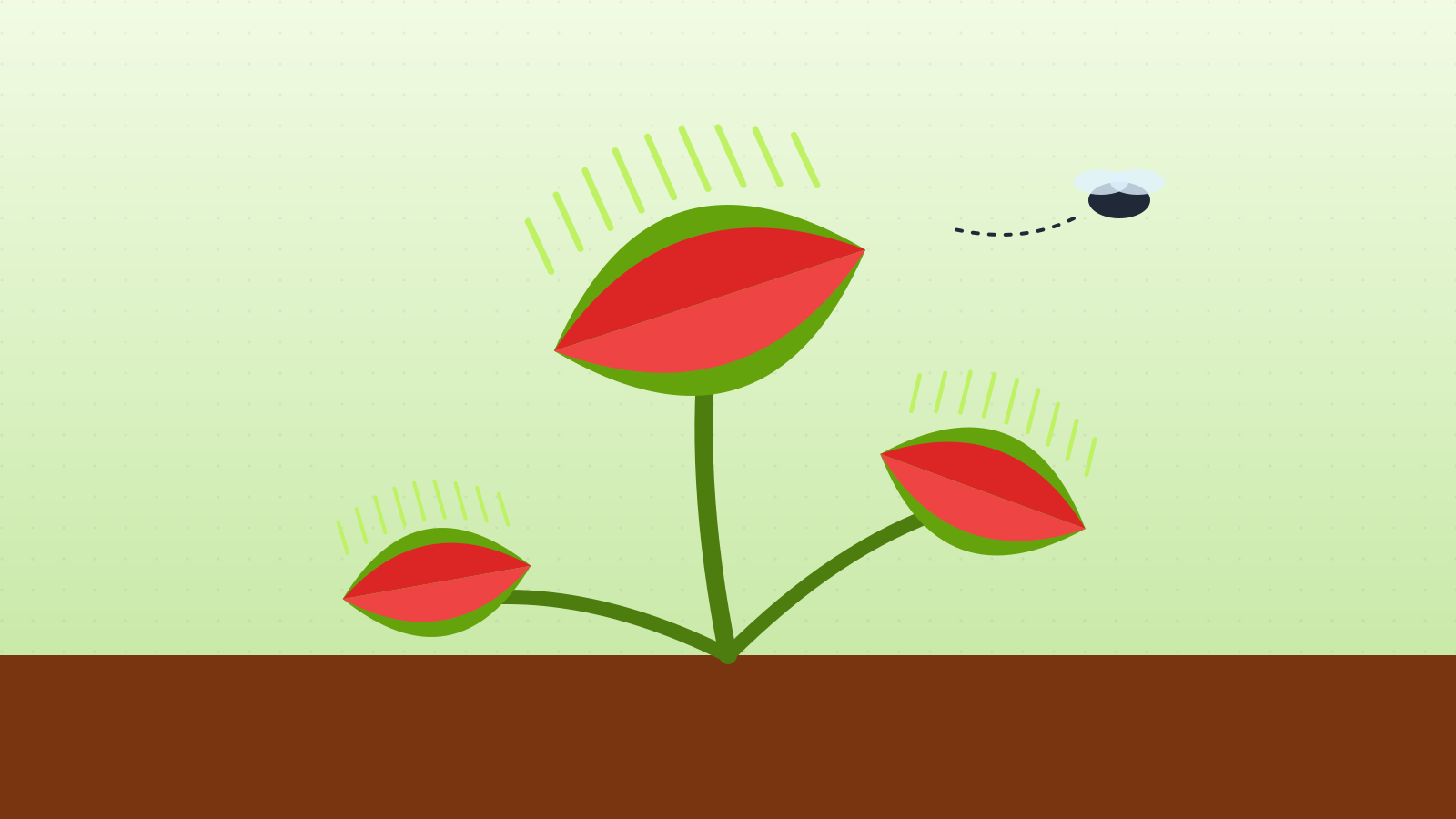
Each trap is a single leaf divided into two lobes joined by a hinge. The inner surfaces are often red, and the edges carry stiff, finger-like bristles. A sweet nectar lures insects inside. On each lobe stand three or so trigger hairs, tiny sensors that are the key to everything.
Counting touches
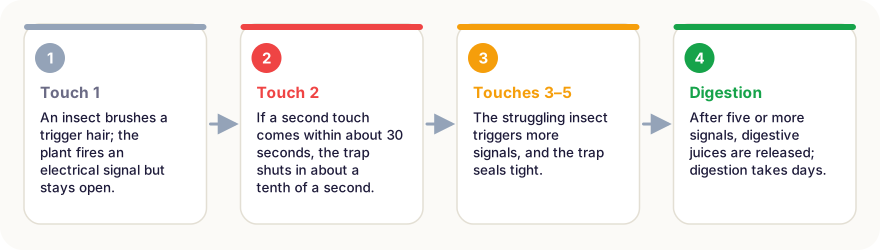
When an insect bends a trigger hair, the plant fires an electrical signal called an action potential, much like the impulses in our nerves. One signal does nothing. The trap “remembers” it for a short time, though. If a second touch arrives within about 30 seconds, the trap snaps shut.
That simple rule filters out false alarms. A falling raindrop or a speck of dust might touch one hair, but it rarely triggers two in quick succession. A live insect walking around inside almost always does.
In 2016 a team led by Rainer Hedrich at the University of Würzburg showed that the counting continues after the trap closes. As the trapped insect struggles, it triggers more signals. After about five, the plant starts producing digestive enzymes and the molecular pumps needed to absorb nutrients. In effect, the plant counts to five before it decides that dinner is worth the effort.
The secret of the snap
Closing in about a tenth of a second is extremely fast for a plant. In 2005, a team led by Yoël Forterre and Lakshminarayanan Mahadevan filmed traps with high-speed cameras and measured the curvature of the lobes. They found that the open lobes are curved outwards, like the outside of a bowl, and held under tension. When triggered, water moves rapidly in the tissues, and the lobes suddenly flip to curve inwards. This snap-buckling works much like a plastic snap bracelet or the lid of a jar popping in.
The first closure is loose, so tiny insects can escape through the bristles; they are not worth digesting. A larger, struggling insect makes the trap seal tight, forming a closed stomach.
Why eat meat?
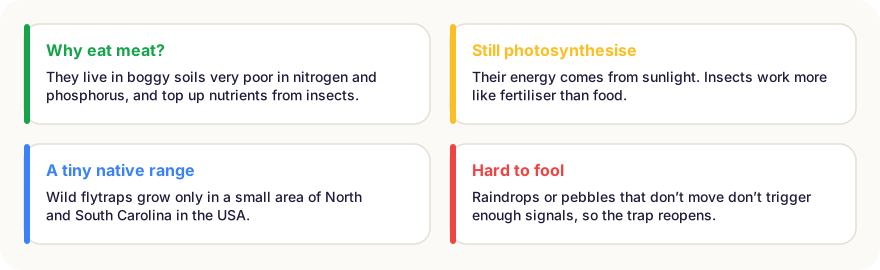
Venus flytraps live in wet, sunny, acidic bogs where the soil contains very little nitrogen and phosphorus. Insects provide those missing nutrients. The plant still gets its energy from photosynthesis, like any other green plant; prey works more like fertiliser than food.
Wild flytraps are found only in a small region of North and South Carolina. Habitat loss and illegal collecting have made them vulnerable, and taking them from the wild is a crime in North Carolina. Plants sold in shops are grown in nurseries.
In short
- A Venus flytrap’s trap is a leaf with two lobes and sensitive trigger hairs.
- Touching a hair fires an electrical signal; two touches within about 30 seconds close the trap.
- The trap shuts in about 0.1 seconds by suddenly flipping the curvature of its lobes.
- After about five signals, it seals and starts digesting its prey.
- Insects supply nitrogen and phosphorus missing from bog soils.
- In the wild it grows only in a small part of North and South Carolina.
Frequently asked questions
Do Venus flytraps need to eat insects?
They can survive without insects because they photosynthesise, but they grow much better with them. Insects supply nitrogen and phosphorus that are scarce in the poor bog soils where the plants live.
Can I feed my flytrap meat or hamburger?
No. Pieces of meat are too rich and often rot inside the trap, which can kill the leaf. Small live insects are best, and an outdoor plant usually catches enough on its own.
What happens if I trigger the trap with my finger?
The trap closes but soon reopens because nothing keeps moving inside. Each closure costs the plant energy, and a trap can only close a limited number of times before it dies off.
How long does a flytrap take to digest an insect?
Usually around a week to ten days, depending on the size of the prey and the temperature. Afterwards the trap reopens, leaving behind the insect’s dry outer skeleton.
Sources
- Forterre, Y. et al. (2005). How the Venus flytrap snaps. Nature
- Böhm, J. et al. (2016). The Venus flytrap Dionaea muscipula counts prey-induced action potentials to induce sodium uptake. Current Biology
This article is based on peer-reviewed research and publications from trusted institutions, and it is reviewed regularly. How we work →
You might also wonder
All in Plants →
Do Sunflowers Follow the Sun? Yes, But Only When They Are Young
Young sunflowers turn east to west each day and swing back at night. Mature ones stop and face east. How the plant’s inner clock and bees explain it.
How Do Plants Drink Water? How Trees Lift Water 100 Metres Without a Pump
Plants have no heart, yet the tallest trees lift water over 100 metres. How roots, xylem and evaporation from leaves pull water up from the soil.
Why Are Leaves Green? Chlorophyll, Photosynthesis and a Puzzle
Leaves are green because chlorophyll absorbs red and blue light. But why would plants waste the most abundant colour of sunlight? The surprising answer.
Can Plants Make Sounds? Stressed Tomatoes Click in Ultrasound
Thirsty or cut plants emit ultrasonic clicks that microphones can record. What a 2023 study found, how plants signal danger and why they still don’t “scream”.
What Is the Oldest Tree in the World? Meet Methuselah, Nearly 5,000 Years Old
A bristlecone pine in California called Methuselah is about 4,850 years old. How scientists count tree rings, and how a gnarled pine outlives empires.
How Do Bats See in the Dark? Echolocation Explained
Bats are not blind, but many hunt in total darkness by listening to echoes. How echolocation works, how fast bats call, and how moths fight back.