How Do Plants Drink Water? How Trees Lift Water 100 Metres Without a Pump
Plants have no heart, yet the tallest trees lift water over 100 metres. How roots, xylem and evaporation from leaves pull water up from the soil.
Short answer
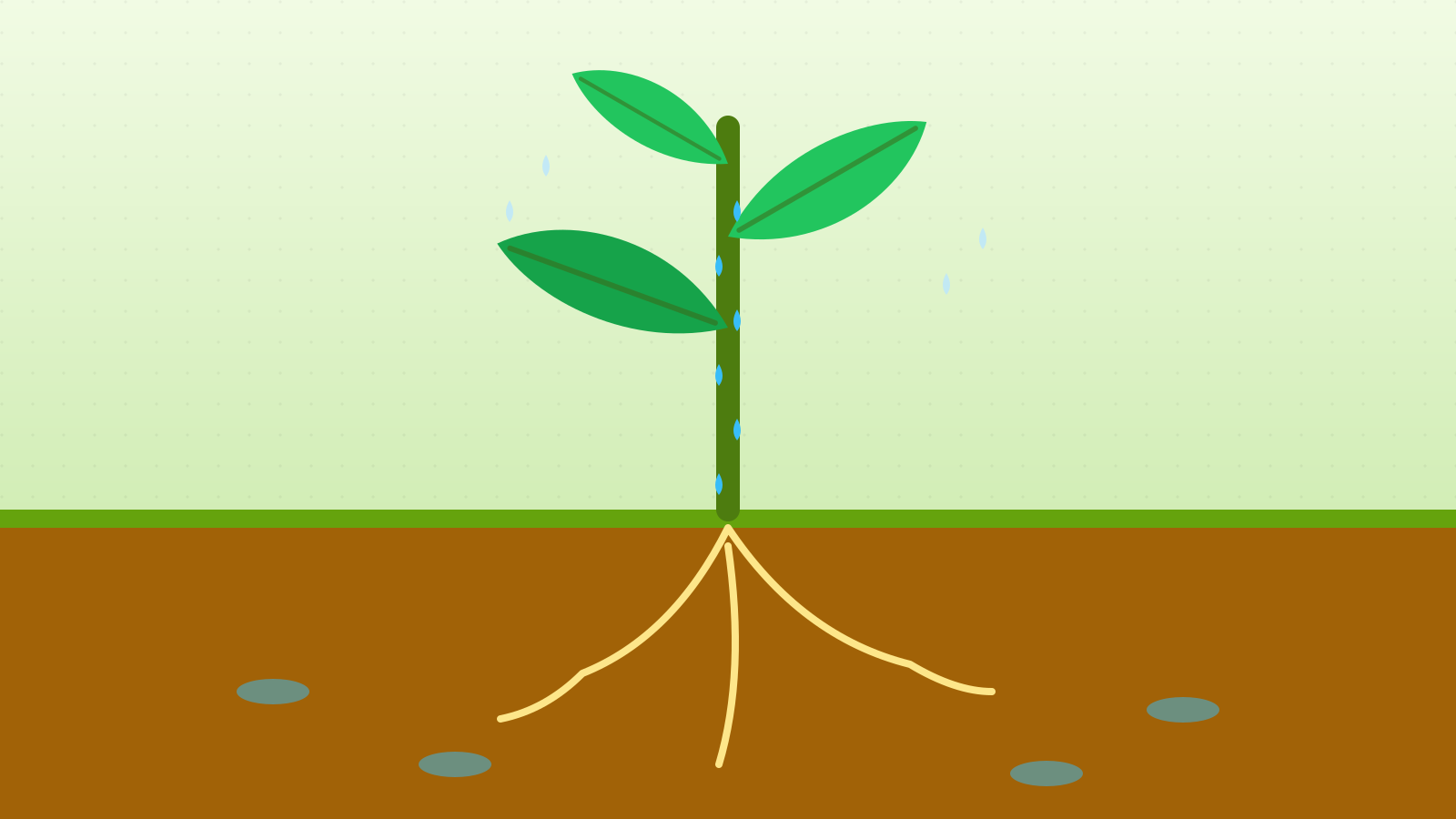
Plants take up water through their roots and move it up to the leaves through thin pipes called xylem. There is no pump. Instead, water evaporates from tiny pores in the leaves, called stomata, a process known as transpiration. Because water molecules cling tightly to each other, each molecule that evaporates pulls on the one behind it, so a continuous column of water is pulled up through the plant from the roots. This cohesion-tension mechanism is powered by the Sun’s energy and can lift water more than 100 metres in the tallest trees.
In this article (6)
The tallest tree on Earth, a coast redwood in California, stands about 116 metres high. Every day, water has to travel from its roots to the leaves at the very top, higher than a 30-storey building. There is no heart, no pump and no moving parts. So how does a plant drink?
It starts at the roots
Water enters a plant through its roots, mainly through millions of microscopic root hairs near the tips. These hairs greatly increase the surface area in contact with moist soil. Water moves into the root cells and then into the plant’s plumbing.
The plumbing: xylem
Running from the roots, through the stem or trunk and out into every leaf, are bundles of thin tubes called xylem. In trees, wood is mostly xylem. The tubes are made of dead cells whose ends and walls have become pipes, forming long continuous channels.
Water in these pipes forms an unbroken column from the roots to the leaves. The question is what moves it.
The engine: evaporation from the leaves
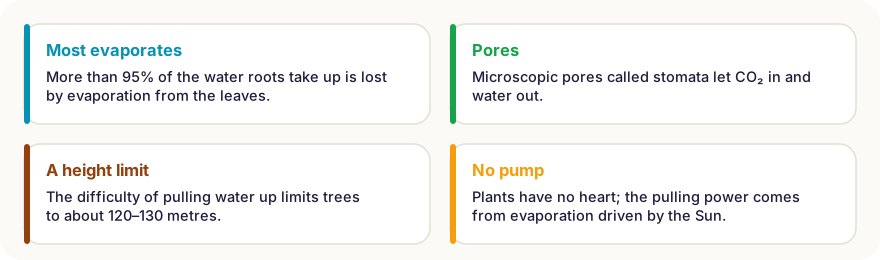
The surface of a leaf is dotted with microscopic pores called stomata. They open to let in carbon dioxide for photosynthesis, but they also let water vapour escape. This loss of water from leaves is called transpiration.
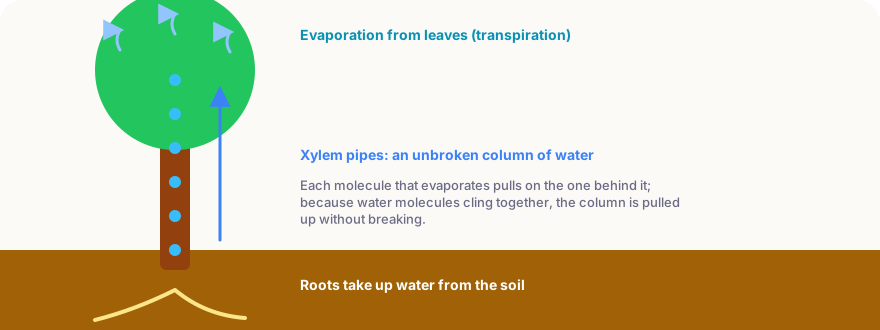
When a water molecule evaporates from a leaf, it leaves a tiny gap. Water molecules are strongly attracted to each other (cohesion) and to the walls of the xylem (adhesion). So the molecule behind is pulled forward to fill the gap, which pulls the one behind it, and so on, all the way down to the roots.
This is called the cohesion-tension theory. The water in the xylem is under tension, a little like a rope being pulled from above. The energy comes from the Sun, which drives evaporation. The plant itself spends almost nothing to lift its water.
Why so much is lost
It seems wasteful: more than 95% of the water taken up by the roots simply evaporates. But transpiration does useful work. It keeps the water column moving, carries dissolved minerals from the soil to the leaves and cools the leaves on hot days, much as sweating cools us.
On hot, dry days plants can close their stomata to save water. The price is that less carbon dioxide enters, so growth slows down. Managing this trade-off is one of the main challenges of a plant’s life.
The limit to tree height
Pulling water ever higher is hard. The higher the leaves, the greater the tension in the water column and the harder it is for the top leaves to get enough water. In 2004 a team led by George Koch climbed the tallest redwoods and measured their leaves at different heights. Leaves near the top were smaller and more water-stressed. Extrapolating, they estimated that the physics of water transport limits trees to a maximum height of about 122–130 metres.
Too much tension can also break the water column. Air bubbles can form in the xylem, an event called embolism, blocking the pipe. Drought makes this more likely, and it is one way that severe droughts kill trees.
In short
- Plants absorb water through their roots, mostly via tiny root hairs.
- Water travels up through thin pipes called xylem.
- Transpiration, evaporation from pores in the leaves, pulls the water up.
- Because water molecules cling together, the column is pulled up without breaking.
- More than 95% of absorbed water evaporates, but it carries minerals and cools the leaves.
- The physics of lifting water limits trees to about 122–130 metres.
Frequently asked questions
Why do plants wilt when they are dry?
Plant cells are kept firm by water pressure inside them. When a plant loses more water than it can take up, the cells lose pressure and the leaves and stems droop. Watering usually restores it if the damage is not too severe.
Do plants drink through their leaves?
Mostly no. Leaves have a waxy surface that limits water uptake; almost all water enters through the roots, especially through tiny root hairs near the tips.
What limits how tall a tree can grow?
A 2004 study of California redwoods found that pulling water ever higher makes it harder for the top leaves to get enough water to grow, which predicts a maximum height of roughly 122–130 metres.
Why do plants close their stomata?
On hot, dry days plants close their pores to save water. The cost is that less carbon dioxide gets in, so photosynthesis slows down.
Sources
- Koch, G. W. et al. (2004). The limits to tree height. Nature
- Encyclopaedia Britannica – Transpiration
This article is based on peer-reviewed research and publications from trusted institutions, and it is reviewed regularly. How we work →
You might also wonder
All in Plants →
Do Sunflowers Follow the Sun? Yes, But Only When They Are Young
Young sunflowers turn east to west each day and swing back at night. Mature ones stop and face east. How the plant’s inner clock and bees explain it.
Why Are Leaves Green? Chlorophyll, Photosynthesis and a Puzzle
Leaves are green because chlorophyll absorbs red and blue light. But why would plants waste the most abundant colour of sunlight? The surprising answer.
Can Plants Make Sounds? Stressed Tomatoes Click in Ultrasound
Thirsty or cut plants emit ultrasonic clicks that microphones can record. What a 2023 study found, how plants signal danger and why they still don’t “scream”.
How Does a Venus Flytrap Work? The Plant That Counts to Five
A Venus flytrap snaps shut in a tenth of a second, but only after counting two touches. How its trigger hairs, electrical signals and snap-buckling leaves work.
What Is the Oldest Tree in the World? Meet Methuselah, Nearly 5,000 Years Old
A bristlecone pine in California called Methuselah is about 4,850 years old. How scientists count tree rings, and how a gnarled pine outlives empires.
How Do Bats See in the Dark? Echolocation Explained
Bats are not blind, but many hunt in total darkness by listening to echoes. How echolocation works, how fast bats call, and how moths fight back.