How Do Bats See in the Dark? Echolocation Explained
Bats are not blind, but many hunt in total darkness by listening to echoes. How echolocation works, how fast bats call, and how moths fight back.
Short answer
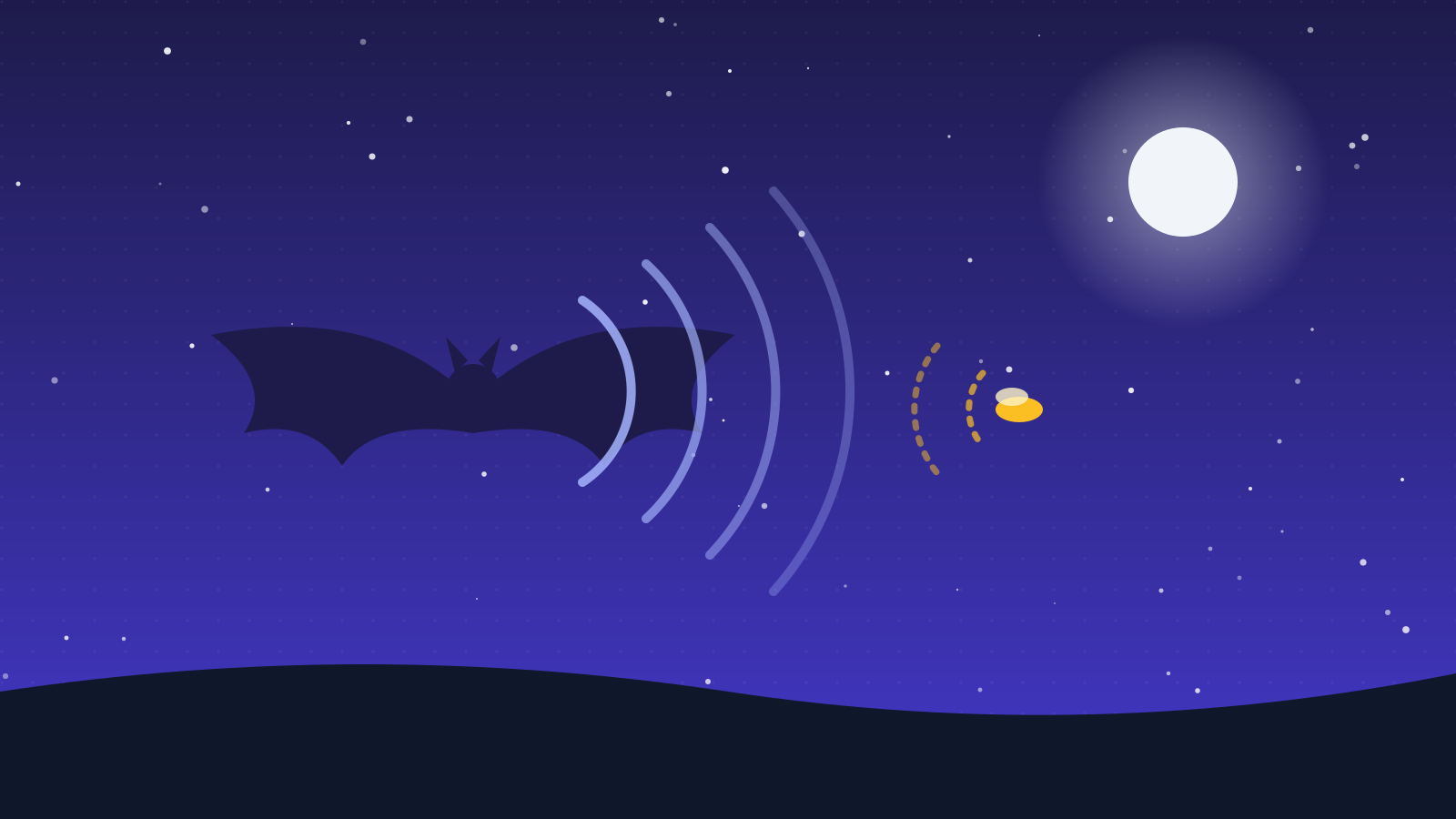
Most bats find their way and catch insects in the dark using echolocation. They make calls that are usually too high-pitched for humans to hear and listen to the echoes that bounce back. The delay of an echo tells them how far away an object is, differences between their two ears show its direction, and changes in pitch reveal whether it is moving. As a bat closes in on prey, it calls faster and faster, up to about 200 times a second. Bats are not blind: all of them can see, and many fruit bats rely mainly on sight and smell.
In this article (7)
At dusk a bat zigzags over a pond, snapping up mosquitoes it could never see in the gloom. It hunts with sound. For a long time nobody could explain how, until scientists realised that bats are shouting into the night and listening for the answer.
A discovery that took 150 years
In the 1790s the Italian scientist Lazzaro Spallanzani found that blindfolded bats could still fly through rooms strung with wires, but bats with blocked ears crashed. He concluded that bats somehow navigate with their ears, but nobody could hear any sound.
The mystery was solved in the late 1930s and 1940s by Donald Griffin, then a student at Harvard. Using a new microphone that could pick up ultrasound, he detected the bats’ high-pitched calls and coined the word echolocation.
How echolocation works
A bat produces short calls, usually in its larynx, and emits them through its mouth or nose. Most calls are ultrasonic, between about 20,000 and 120,000 hertz, beyond the upper limit of human hearing at around 20,000 hertz. Some species go even higher.
When a call hits an object, part of the sound bounces back as an echo. From that echo, the bat’s brain extracts several kinds of information:
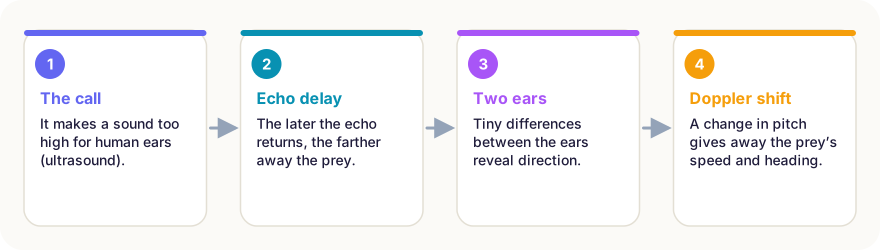
- Distance: sound travels about 340 metres per second, so an echo returning after 6 milliseconds means an object about 1 metre away.
- Direction: the echo reaches the two ears at slightly different times and loudness.
- Size and texture: a large target returns a stronger echo; a fluttering wing makes the echo flicker.
- Movement: if an insect is flying towards or away from the bat, the pitch of the echo shifts slightly, the same Doppler effect that changes the sound of a passing ambulance.
Horseshoe bats are specialists in the Doppler trick. They use long calls at a constant pitch and can detect the tiny flicker of an insect’s beating wings.
Faster and faster: the feeding buzz
Echolocation has a built-in problem: a bat must wait for each echo before the next call, or the sounds overlap. So bats change their calls as they hunt.
While searching, a bat may call about 10 times a second. Once it detects prey, it speeds up. In the final moment before capture, it produces a rapid burst called the feeding buzz, reaching about 200 calls per second.

In 2011 Coen Elemans and colleagues discovered how bats manage this. Their vocal muscles are among the fastest muscles known in mammals, able to contract and relax up to around 200 times a second. Even so, the buzz is limited by these muscles.
Loud, but not to us
Bat calls can be astonishingly loud, up to about 140 decibels close to the bat’s mouth, as loud as a jet engine nearby. To avoid deafening themselves, many bats contract tiny muscles in the middle ear at the instant they call, briefly reducing their sensitivity, and relax them in time to catch the echo.
An evolutionary arms race with moths
Moths are a favourite prey, and many have fought back. Numerous moths have ears tuned to bat frequencies. When they hear a distant bat, they turn away; when a bat is very close, they dive, spiral or drop to the ground.
Some tiger moths go further and produce their own ultrasonic clicks. In some species the clicks warn bats that the moth tastes bad; in others they seem to jam the bat’s sonar at the critical moment. Some bats, in turn, call at frequencies or volumes that moths hear poorly.
Bats are not blind
The phrase “blind as a bat” is wrong. All bats have functioning eyes. Many insect-eating bats use vision for long-distance navigation, for example by recognising the horizon or landmarks at dusk.
Of the roughly 1,400 bat species, the large fruit bats of Africa, Asia and Australia mostly do not echolocate with their larynx. They have big eyes and an excellent sense of smell. A few, such as the Egyptian fruit bat, which also lives in southern Turkey, make simple echolocation clicks with their tongue.
In short
- Most bats use echolocation: they make ultrasonic calls and listen to the echoes.
- Echo delay gives distance, ear differences give direction and pitch changes reveal movement.
- When attacking, bats call up to about 200 times a second in a feeding buzz, powered by superfast muscles.
- Calls can reach about 140 decibels, but they are too high-pitched for us to hear.
- Many moths have evolved ears and even sonar-jamming clicks.
- Bats are not blind; fruit bats rely mostly on sight and smell.
Frequently asked questions
Are bats really blind?
No. “Blind as a bat” is a myth. All bats have eyes and can see; many have good night vision, and large fruit bats see very well. Echolocation adds to vision rather than replacing it.
Do all bats echolocate?
No. Most of the roughly 1,400 bat species do, but most Old World fruit bats do not use laryngeal echolocation. Some, such as the Egyptian fruit bat, make simple clicks with their tongue instead.
Can humans echolocate?
Yes, to a degree. Some blind people learn to navigate by making tongue clicks and listening to the echoes, and brain scans show they process the echoes in visual areas of the brain.
Why do some moths escape bats?
Many moths have ears tuned to bat calls and dive or loop away when they hear them. Some tiger moths even produce ultrasonic clicks that warn bats they taste bad or jam the bats’ sonar.
Sources
- Jones, G. & Holderied, M. W. (2007). Bat echolocation calls: adaptation and convergent evolution. Proceedings of the Royal Society B
- Elemans, C. P. H. et al. (2011). Superfast muscles set maximum call rate in echolocating bats. Science
This article is based on peer-reviewed research and publications from trusted institutions, and it is reviewed regularly. How we work →
You might also wonder
All in Animals →
How Do Chameleons Change Colour? Nanocrystals, Not Pigments
Chameleons don’t change colour mainly to hide. They tune tiny crystals in their skin to signal mood, warn rivals and control temperature. How the trick works.

How Do Fireflies Glow? The Chemistry of Living Light
Fireflies make light without heat using a chemical reaction in their tails. How does bioluminescence work, how is it switched on and off, and why do they flash?

Why Are Flamingos Pink? Food, Pigments and Feather Make-Up
Flamingos are born grey, not pink. Their colour comes from pigments in algae and shrimp, and some even apply “make-up”. The science behind the pink bird.

Why Do Octopuses Have Three Hearts? Blue Blood and Arms That Think
Why do octopuses have three hearts, why is their blood blue and how can their arms “think”? The science behind the body of the ocean’s strangest intelligence.

Why Do Cats Purr? How Purring Works and What It Means
Do cats only purr when they are happy? How purring is produced in the larynx, what new research revealed, and what your cat may actually be telling you.

Why Do Dogs Wag Their Tails? The Hidden Meanings of Tail Language
Does a wagging tail always mean a happy dog? What the height, speed and even the left–right direction of a dog’s wag reveal, according to research.