How Do Fireflies Glow? The Chemistry of Living Light
Fireflies make light without heat using a chemical reaction in their tails. How does bioluminescence work, how is it switched on and off, and why do they flash?
Short answer
Fireflies glow through bioluminescence, a chemical reaction in special light organs in their abdomen. A molecule called luciferin reacts with oxygen, with the help of the enzyme luciferase and the energy molecule ATP, and the energy is released as yellow-green light with almost no heat. Fireflies control their flashes by regulating how much oxygen reaches the light organ, probably using the gas nitric oxide as a switch. Each species flashes in its own pattern to find mates.
In this article (8)
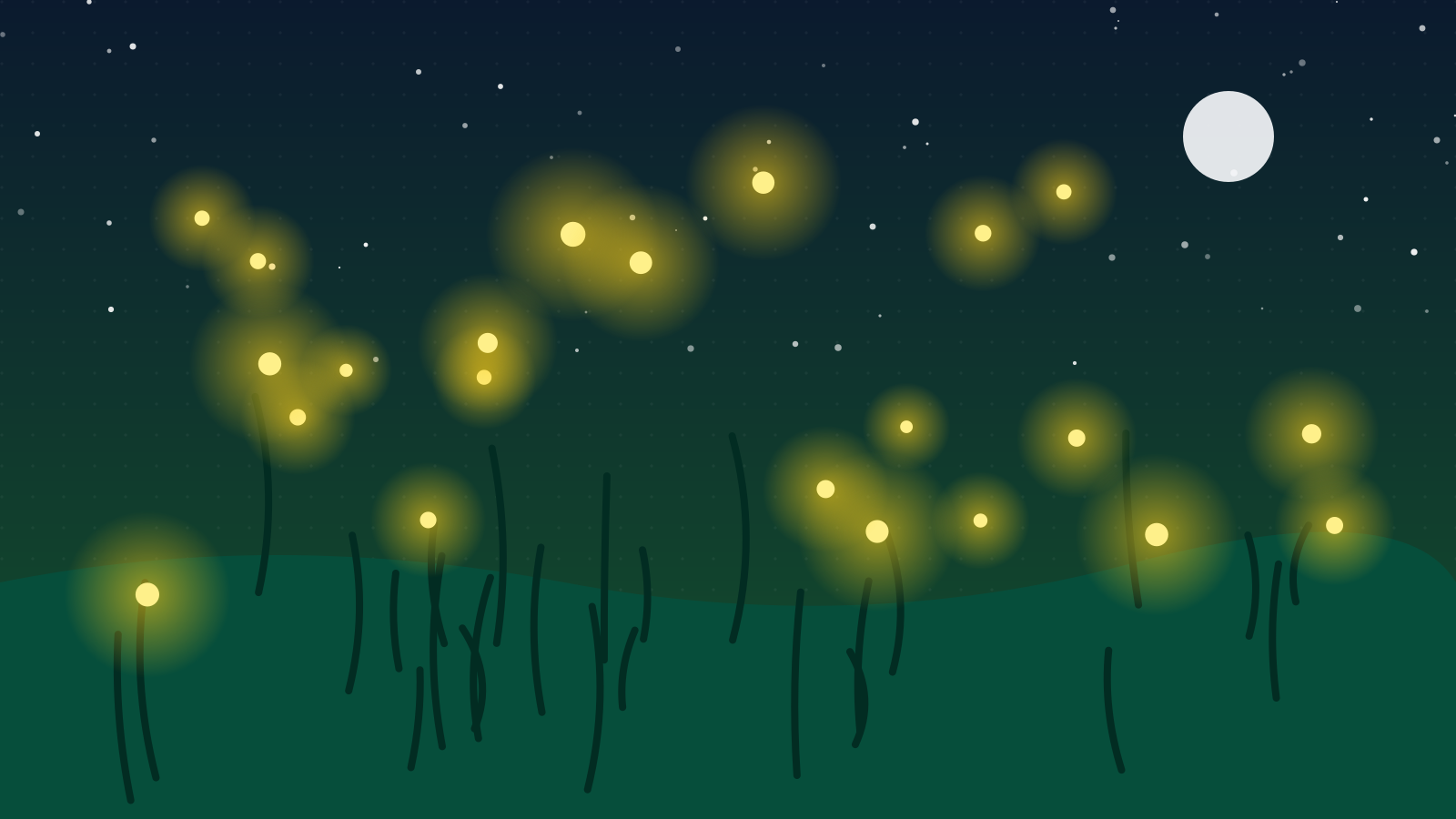
On a warm summer evening, tiny green-gold lights drift up from the grass and blink across the dark. Fireflies have fascinated people for thousands of years. Their light looks magical, but it comes from a surprisingly well-understood piece of chemistry, one so useful that scientists have borrowed it for medical research.
Fireflies are beetles with lanterns
Despite their name, fireflies are not flies but beetles. There are more than 2,000 species, found on every continent except Antarctica. Their light comes from special light organs, usually in the last segments of the abdomen, which look pale yellow in daylight.
The light organ is packed with light-producing cells called photocytes. Behind them is a layer of cells filled with tiny crystals that act like a mirror, reflecting the light outwards. A network of fine air tubes, called tracheae, delivers oxygen directly to the cells.
The chemistry of living light
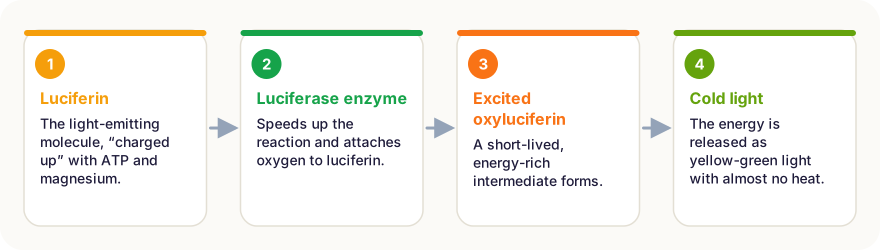
Producing light inside a living body is called bioluminescence. In fireflies it relies on two key molecules:
- luciferin, the molecule that actually emits light;
- luciferase, an enzyme that drives the reaction.
First, luciferin is “charged up” with ATP, the same energy molecule our muscles use, with the help of magnesium. Then luciferase combines the charged luciferin with oxygen. This creates an excited, energy-rich molecule called oxyluciferin. When it relaxes back to its normal state, it releases its extra energy as a particle of light.
Cold light: astonishingly efficient
An old incandescent light bulb turns most of its electricity into heat. Firefly light is called cold light because almost none of the energy is wasted as heat.
In a 2007 study, Japanese researchers led by Yoriko Ando measured the reaction precisely and found that about 41% of the reacting molecules produce a particle of light. That is lower than the 88% once claimed, but still remarkable for a chemical reaction. The colour depends on the species and on conditions such as acidity, ranging from green to yellow and even orange.
How do fireflies switch their light on and off?
The reaction needs oxygen, so controlling oxygen means controlling light. For a long time scientists wondered how fireflies could flash so quickly.
In 2001 Barry Trimmer and colleagues found an important clue: the gas nitric oxide. When a nerve signal reaches the light organ, nitric oxide is released and temporarily stops the cell’s energy factories, the mitochondria, from using up oxygen. Oxygen floods past them to the light-producing chemicals and the firefly lights up. When the nitric oxide disappears, the mitochondria take the oxygen back and the light goes out.
Why do fireflies flash?
For most species, light is a love language. Males fly around flashing a pattern, and females waiting in the grass answer with their own flash after a precise delay. Each species has its own code: the length of the flash, the number of pulses and the pause between them.
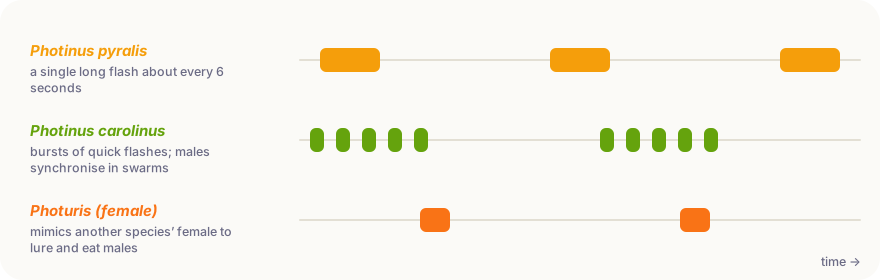
Some fireflies take this to spectacular lengths. In the Great Smoky Mountains of the United States, males of Photinus carolinus flash in synchrony for a few weeks each June, turning the forest into rolling waves of light. The display is so popular that visitors enter a lottery for viewing spots.
There is a darker side too. Females of the genus Photuris can imitate the reply flashes of other species. When a hopeful male lands, she eats him and gains defensive chemicals that make her distasteful to spiders and birds. Biologists call them “femmes fatales”.
Firefly larvae also glow, probably as a warning that they taste bad.
Firefly chemistry in the laboratory
Because luciferase only makes light when ATP is present, scientists use it as a sensitive ATP detector. Hospitals and food factories use luciferase tests to check whether surfaces are clean, since living bacteria contain ATP. Biologists also insert the luciferase gene into cells, mice and plants so that they glow when particular genes are switched on.
Fireflies need dark nights
In many places firefly numbers are falling. The main threats are habitat loss, pesticides and light pollution. Street lights and bright gardens drown out the mating signals, so males and females cannot find each other. Turning off outdoor lights on summer nights is one of the simplest ways to help them.
In short
- Fireflies are beetles that make light in special organs in their abdomen.
- The light comes from luciferin reacting with oxygen and ATP, driven by the enzyme luciferase.
- It is cold light: roughly 41% of reacting molecules produce light, with very little heat.
- Fireflies control their flashes by controlling oxygen, probably with nitric oxide as a switch.
- Each species has a flash code for finding mates; some predators copy it.
- Light pollution is one of the biggest threats to fireflies.
Frequently asked questions
Are fireflies really flies?
No. Fireflies are beetles. There are more than 2,000 species worldwide, and in some of them only the larvae or the wingless females glow, which is why they are also called glow-worms.
Does firefly light get hot?
Barely. Firefly light is called cold light because almost all of the chemical energy is turned into light rather than heat, unlike an old incandescent bulb.
Why are fireflies disappearing?
Many firefly populations are declining because of habitat loss, pesticides and especially light pollution, which makes it hard for them to see each other’s mating flashes.
Is firefly chemistry used in science?
Yes. The luciferase enzyme is widely used in laboratories to detect ATP, for example to check surfaces for bacteria or to track gene activity in cells.
Sources
- U.S. National Park Service – Synchronous fireflies, Great Smoky Mountains
- Ando, Y. et al. (2007). Firefly bioluminescence quantum yield and colour change by pH-sensitive green emission. Nature Photonics
- Trimmer, B. A. et al. (2001). Nitric oxide and the control of firefly flashing. Science
This article is based on peer-reviewed research and publications from trusted institutions, and it is reviewed regularly. How we work →
You might also wonder
All in Animals →
How Do Bats See in the Dark? Echolocation Explained
Bats are not blind, but many hunt in total darkness by listening to echoes. How echolocation works, how fast bats call, and how moths fight back.

How Do Chameleons Change Colour? Nanocrystals, Not Pigments
Chameleons don’t change colour mainly to hide. They tune tiny crystals in their skin to signal mood, warn rivals and control temperature. How the trick works.

Why Are Flamingos Pink? Food, Pigments and Feather Make-Up
Flamingos are born grey, not pink. Their colour comes from pigments in algae and shrimp, and some even apply “make-up”. The science behind the pink bird.

Why Do Octopuses Have Three Hearts? Blue Blood and Arms That Think
Why do octopuses have three hearts, why is their blood blue and how can their arms “think”? The science behind the body of the ocean’s strangest intelligence.

Why Do Cats Purr? How Purring Works and What It Means
Do cats only purr when they are happy? How purring is produced in the larynx, what new research revealed, and what your cat may actually be telling you.

Why Do Dogs Wag Their Tails? The Hidden Meanings of Tail Language
Does a wagging tail always mean a happy dog? What the height, speed and even the left–right direction of a dog’s wag reveal, according to research.