Why Do Cats Purr? How Purring Works and What It Means
Do cats only purr when they are happy? How purring is produced in the larynx, what new research revealed, and what your cat may actually be telling you.
Short answer
Cats purr by vibrating their vocal folds roughly 20–30 times per second. A 2023 study showed that special soft tissue in the vocal folds can produce this low frequency on its own. Purring often signals contentment, but cats also purr when frightened, in pain or asking for something.
In this article (8)
The soft, rumbling sound of a cat on your lap is one of the most familiar noises in the animal world. Yet exactly how cats produce it stayed a mystery for a long time — and what purring means is not as simple as it seems.
What kind of sound is a purr?
A purr is a low, continuous sound that carries on while the cat breathes both in and out. In domestic cats it usually sits at 20 to 30 vibrations per second (20–30 Hz), close to the lowest pitch the human ear can hear. That is why you often feel a purr more than you hear it.
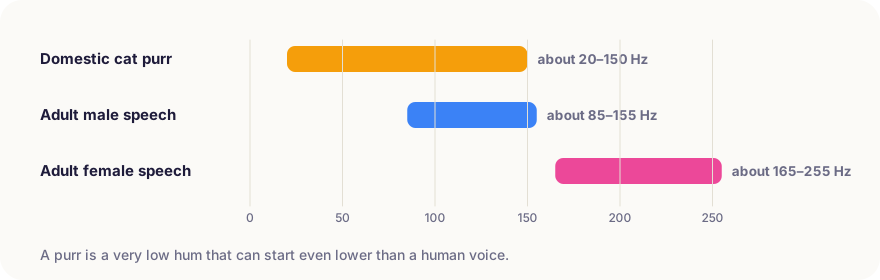
That frequency is surprisingly low for an animal the size of a cat. Sounds that deep are normally made by much larger animals with much longer vocal folds.
The old explanation: rhythmic muscle twitching
For decades the accepted theory was that a “rhythm generator” in the brain sent signals to the larynx muscles 20–30 times a second. With each signal the muscles contracted and relaxed, opening and closing the vocal folds to create the purr.
In this view a purr was something the cat actively “played”, a bit like an extremely fast, repeated cough.
The new finding: the vocal folds vibrate by themselves
In 2023, Christian Herbst and colleagues at the University of Vienna published a study that changed this picture. They examined larynges from cats that had died of natural causes. When they blew warm, humid air through them, the larynges vibrated at purring frequencies — with no nerve signals at all.
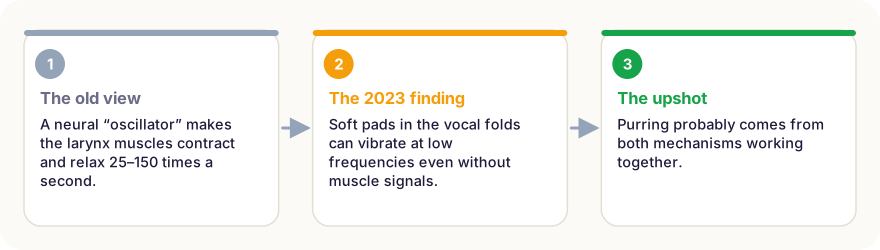
The secret seems to lie in pads of soft connective tissue inside the cat’s vocal folds. These pads add mass, letting the folds vibrate more slowly and therefore at a lower pitch. A similar mechanism produces the creaky “vocal fry” some people use when they speak.
This does not mean the brain plays no part. The nervous system is still needed to start, stop and adjust purring. But the sound itself can arise from the structure of the tissue without the brain driving each vibration.
Why do cats purr?
Most of us link purring with happiness, and often we are right. But cats purr in different situations for different reasons:
- Contentment: while being stroked, lying somewhere warm or relaxing next to their owner.
- Talking to mum: kittens purr while nursing and the mother purrs back. Purring is an “everything’s fine” signal used from the first days of life.
- Self-soothing: cats may purr when stressed, injured, giving birth or even dying. Here purring may be a calming, self-care behaviour.
- Asking for something: there is a special kind of purr cats use around mealtimes — more on that below.
The “feed me” purr
A 2009 study by Karen McComb at the University of Sussex found something intriguing. When cats want food, they embed a high-pitched, cry-like sound inside their purr.
In the research, people heard both kinds of purr and rated the “solicitation purr” as more urgent and less pleasant than an ordinary one — even people who had never owned a cat. The researchers suggest the sound falls in a frequency range similar to a human baby’s cry and may tap into our natural instinct to respond.
So the cat purring in your face at dawn is probably expressing a desire for breakfast rather than affection.
Do big cats purr?
Purring is common across the cat family, but not every species can do it the same way:
| Species | Purrs? | Roars? |
|---|---|---|
| Domestic cat | Yes | No |
| Cheetah, puma, lynx | Yes | No |
| Lion, tiger, jaguar, leopard | Not continuously | Yes |
Big cats that roar have a differently built larynx adapted for powerful, deep calls. They can make short, purr-like sounds, but not the uninterrupted purr a house cat produces while breathing in and out.
Does purring heal?
A claim you often see online is that purring heals bones and wounds. It is based on medical studies showing that low-frequency vibration (roughly 25–50 Hz) can increase bone density in humans.
Whether cats use these frequencies to heal themselves is not proven. The hypothesis is interesting and worth researching, but it should not be presented as established fact.
In short
Cats purr thanks to special tissue in their vocal folds that vibrates on its own, with the brain starting and steering the process. Purring often means contentment, but cats also purr to calm themselves in stressful moments and to ask us for things. To understand what your cat means, look at the situation and body language as well as listening to the sound.
Frequently asked questions
Do cats purr when they are unhappy?
Yes. Cats may purr at the vet, when injured or while giving birth. In these situations purring is thought to have a self-soothing role.
Do lions and tigers purr?
Most big cats that can roar — lions, tigers, leopards and jaguars — cannot purr continuously like a house cat. Species that cannot roar, such as cheetahs, pumas and lynxes, do purr.
Can purring heal bones?
It has been suggested that vibrations around 25–50 Hz may help bone and tissue healing, but there is no strong evidence yet that cats benefit this way. For now it remains an intriguing hypothesis.
Sources
- Herbst et al. (2023) – Domestic cat larynges can produce purring frequencies without neural input, Current Biology
- McComb et al. (2009) – The cry embedded within the purr, Current Biology
This article is based on peer-reviewed research and publications from trusted institutions, and it is reviewed regularly. How we work →
You might also wonder
All in Animals →
Why Do Octopuses Have Three Hearts? Blue Blood and Arms That Think
Why do octopuses have three hearts, why is their blood blue and how can their arms “think”? The science behind the body of the ocean’s strangest intelligence.
Why Do Dogs Wag Their Tails? The Hidden Meanings of Tail Language
Does a wagging tail always mean a happy dog? What the height, speed and even the left–right direction of a dog’s wag reveal, according to research.

How Do Migrating Birds Find Their Way? Sun, Stars and a Magnetic Compass
How do migrating birds cross thousands of kilometres without getting lost? Sun and star compasses, magnetic sensing in the eye and record-breaking journeys.
How Do Bees Make Honey? The Journey from Nectar to Honey
How do bees make honey, why doesn’t honey go off, and how do bees tell each other where the flowers are? The chemistry and communication inside a hive.

Why Do Zebras Have Stripes? Solving a 150-Year-Old Puzzle
Why are zebras striped? We weigh up camouflage, cooling and fly protection, and explain why horseflies struggle to land on a striped coat.
Why Do Cats Always Land on Their Feet? The Physics of the Righting Reflex
How do cats twist in mid-air to land on their feet? The righting reflex, the angular-momentum trick that puzzled physicists, and the real risks of high falls.