How Do Bees Make Honey? The Journey from Nectar to Honey
How do bees make honey, why doesn’t honey go off, and how do bees tell each other where the flowers are? The chemistry and communication inside a hive.
Short answer
Honey bees collect nectar, a sugary liquid, from flowers. As they carry it in their honey stomach, enzymes they add split sucrose into glucose and fructose and produce a little acid. In the hive the nectar is passed from bee to bee, placed in comb cells and fanned with wings until most of its water evaporates. When the water content drops below about 18%, the cell is sealed with wax. The thick, sugary, acidic result is honey.
In this article (8)
A spoonful of honey on your breakfast table is the product of weeks of hard work by thousands of bees. A beehive is an extraordinary factory that combines sugar chemistry, airflow engineering and the ability to communicate by dancing. Its raw material is a sweet reward flowers offer to bees: nectar.
It all starts with a flower
Flowers produce nectar to attract the insects that pollinate them. Nectar is a sweet liquid made mostly of water, containing several sugars, above all sucrose. Depending on the plant, nectar is usually 50–80% water.
Forager bees, which work outside the hive, suck up nectar with their long, tube-like tongues. They do not digest it but store it in a special compartment called the honey stomach (or crop). A forager can carry close to her own body weight in nectar — and may need to visit hundreds of flowers on a single trip to fill up.
Turning nectar into honey
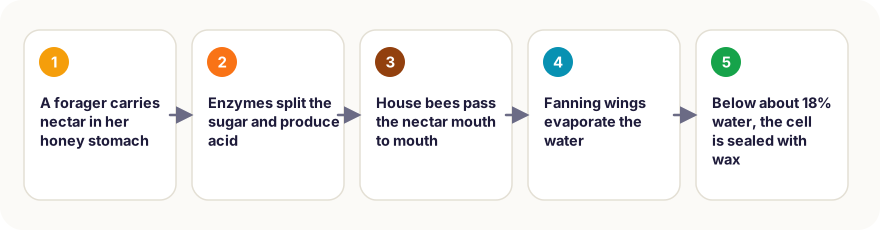
1. The chemistry begins
Even on the way back to the hive, the forager adds enzymes from her glands to the nectar. The most important are:
- Invertase, which splits each sucrose molecule into two smaller sugars, glucose and fructose. These are easier to digest and crystallise less than sucrose.
- Glucose oxidase, which converts a small amount of glucose into gluconic acid and a little hydrogen peroxide. These two substances make honey acidic and resistant to microbes.
2. Passing it on
Back at the hive, the forager hands the nectar over to house bees mouth to mouth, a behaviour called trophallaxis. The house bees hold and work the nectar for a while, adding more enzymes and spreading it out in thin droplets to drive off some of the water.
3. Evaporation
The nectar is then placed in comb cells, still very watery. If it stayed that way it would ferment and spoil, so the bees turn the hive into a giant drying room:
- nectar is spread thinly across the cells to increase its surface area;
- hundreds of bees fan their wings at once, creating a strong airflow through the hive;
- the hive is kept at around 35 °C, speeding up evaporation.
The process can take days. In the end, the water content falls from around 70% to about 17–18%.
4. Sealing
When the honey is ripe, the bees cap each cell with beeswax, secreted as tiny flakes from special glands on the abdomens of young worker bees and chewed into shape. Sealed honey becomes the colony’s food store for winter and for times without flowers.
How do bees tell each other where the flowers are?
When a forager finds a rich patch of flowers, she returns to the hive and tells the others where it is. She does this with the waggle dance, discovered by the Austrian scientist Karl von Frisch, who won a Nobel Prize for it in 1973.
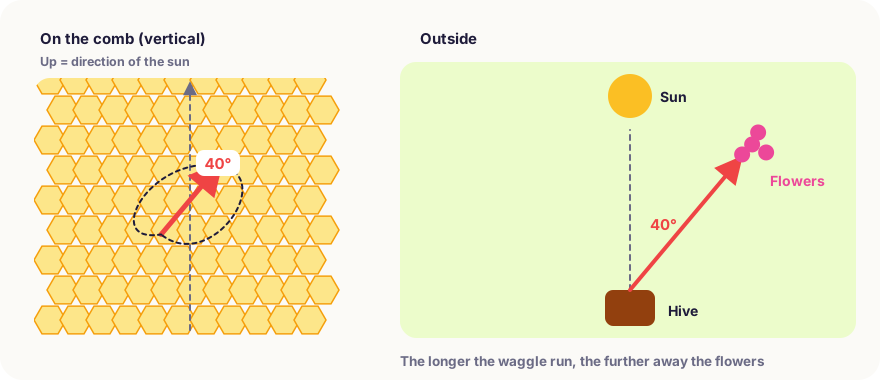
The dance works like this:
- Direction: the bee walks along a straight line on the vertical comb, waggling her abdomen. The angle between that line and “straight up” shows the direction of the flowers relative to the sun. If the line points 40 degrees to the right of up, the flowers lie 40 degrees to the right of the sun.
- Distance: the longer the waggle run lasts, the further away the flowers are.
- Quality: the more vigorously and often she repeats the dance, the richer the source.
The dance was debated for a long time; some scientists thought bees simply followed scent. In a 2005 study published in Nature, researchers fitted bees that had watched a dance with tiny radar transponders and showed that they really did fly in the direction and distance the dance described.
Why doesn’t honey spoil?
Stored properly, honey is one of the few natural foods that can keep for years. There are several reasons:
| Property | Effect on microbes |
|---|---|
| Very low water content (17–18%) | Not enough water for microbes to grow |
| Very high sugar content | Draws water out of microbes by osmosis, drying them out |
| Acidity (pH about 3.5–4.5) | Most bacteria cannot survive |
| A little hydrogen peroxide | A natural antiseptic that kills microbes |
Honey does absorb moisture from the air, though. If the jar is left open, its water content rises and it can ferment — so keep it sealed.
Why does honey crystallise?
Many people believe crystallised honey is fake. It is not. Honey is a supersaturated sugar solution: it holds far more sugar than could normally dissolve. Over time the glucose crystallises and the honey sets.
- Honeys high in glucose, such as rapeseed or sunflower honey, crystallise quickly.
- Honeys high in fructose, such as acacia honey, stay runny for a long time.
- Cool conditions (about 10–15 °C) speed up crystallisation.
Standing crystallised honey in warm water (below 40 °C) makes it runny again. Very high heat damages its enzymes and aroma.
Why does honey vary in colour and flavour?
The colour, flavour and aroma of honey depend on which plants the bees visited. Acacia honey is almost colourless and mild; chestnut honey is dark and slightly bitter. Some honeys, such as forest or honeydew honey, are made not from nectar at all but from the sugary secretions of insects that feed on tree sap.
Why do bees matter?
Honey bees do far more than make honey. They play a major role in pollinating many fruits, vegetables and oilseed crops. Yields of apples, cherries, almonds, melons and sunflowers depend heavily on bees.
In recent years bee colonies around the world have suffered serious losses. Scientists attribute them to a combination of factors including parasitic mites, diseases, some pesticides, poor nutrition and climate change. Protecting bees matters not just for honey but for food security.
In short
Honey bees transform nectar from flowers using enzymes, pass it from bee to bee in the hive and fan their wings to evaporate most of its water. When the water content falls below about 18%, they seal the cells with wax. Thanks to its low moisture, high sugar and acidity, the resulting honey hardly ever spoils. And bees tell each other where the best flowers are with the waggle dance, using the sun as a compass.
Frequently asked questions
Why doesn’t honey go off?
Honey contains very little water and a great deal of sugar, which draws water out of microbes and dries them out. It is also acidic and contains small amounts of hydrogen peroxide. Stored in a sealed jar, honey keeps for a very long time.
Why does honey crystallise? Is crystallised honey fake?
No. Crystallisation is glucose in the honey forming crystals — a natural process. Honeys high in glucose crystallise faster. Standing the jar in warm water makes it runny again.
Can babies eat honey?
Babies under one year old should not be given honey. Bacterial spores that can occur in honey may cause a serious illness called infant botulism in babies whose gut flora is not yet developed.
How much honey does one bee make?
A summer worker bee lives only a few weeks and makes a tiny fraction of a teaspoon of honey in her lifetime. A jar of honey is the combined work of thousands of bees.
Sources
- Riley et al. (2005) – The flight paths of honeybees recruited by the waggle dance, Nature
- USDA Agricultural Research Service – Honey Bee Health and Colony Collapse
This article is based on peer-reviewed research and publications from trusted institutions, and it is reviewed regularly. How we work →
You might also wonder
All in Animals →
Why Do Octopuses Have Three Hearts? Blue Blood and Arms That Think
Why do octopuses have three hearts, why is their blood blue and how can their arms “think”? The science behind the body of the ocean’s strangest intelligence.
Why Do Cats Purr? How Purring Works and What It Means
Do cats only purr when they are happy? How purring is produced in the larynx, what new research revealed, and what your cat may actually be telling you.
Why Do Dogs Wag Their Tails? The Hidden Meanings of Tail Language
Does a wagging tail always mean a happy dog? What the height, speed and even the left–right direction of a dog’s wag reveal, according to research.

How Do Migrating Birds Find Their Way? Sun, Stars and a Magnetic Compass
How do migrating birds cross thousands of kilometres without getting lost? Sun and star compasses, magnetic sensing in the eye and record-breaking journeys.

Why Do Zebras Have Stripes? Solving a 150-Year-Old Puzzle
Why are zebras striped? We weigh up camouflage, cooling and fly protection, and explain why horseflies struggle to land on a striped coat.
Why Do Cats Always Land on Their Feet? The Physics of the Righting Reflex
How do cats twist in mid-air to land on their feet? The righting reflex, the angular-momentum trick that puzzled physicists, and the real risks of high falls.