How Do Migrating Birds Find Their Way? Sun, Stars and a Magnetic Compass
How do migrating birds cross thousands of kilometres without getting lost? Sun and star compasses, magnetic sensing in the eye and record-breaking journeys.

Short answer
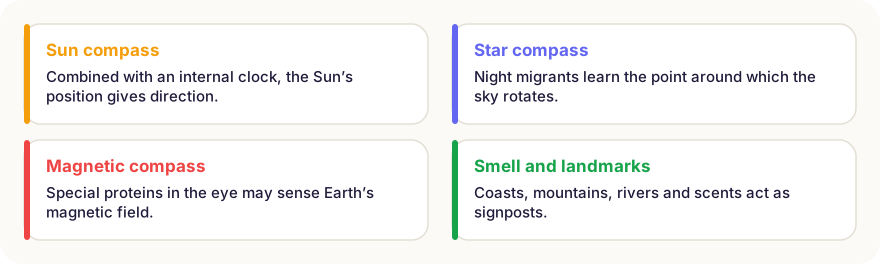
Migrating birds rely not on one compass but on several systems that back each other up. By day they combine the Sun’s position with their internal clock to find direction. Night migrants use the point in the sky around which the stars rotate. Special proteins in their eyes called cryptochromes are thought to let them sense Earth’s magnetic field. Coasts, mountains, rivers and smells also serve as signposts along the way.
In this article (10)
The V-shaped flocks crossing the autumn sky are at the start of journeys thousands of kilometres long. Some fly non-stop across oceans; others cross deserts and mountain ranges. An estimated 2 billion birds migrate between Europe and Africa every year. Without maps, GPS or compasses, how do they find their way?
Why do birds migrate?
The main reason is food. Northern summers bring long days and an abundance of insects and seeds — perfect for raising young. In winter the days shorten, temperatures fall and food runs out.
To keep pace with this cycle, birds live between two worlds: breeding in the north in summer and wintering in the south where food is plentiful. Changing day length triggers hormonal changes; birds feed intensely and store fat before setting off. Even caged migrants become restless when the season arrives, hopping in the direction they would migrate — behaviour scientists call migratory restlessness (Zugunruhe).
Astonishing migration records
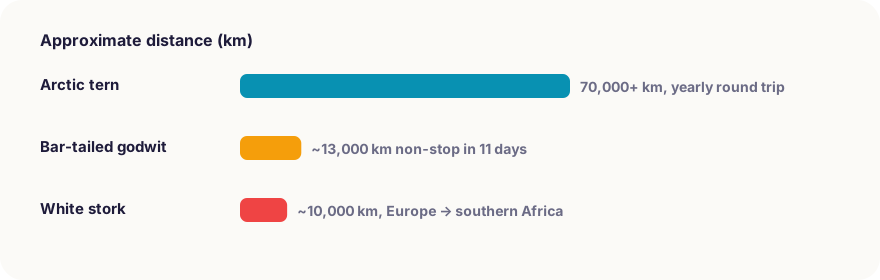
- Arctic tern: breeds around the Arctic and winters around Antarctica. Its yearly round trip can exceed 70,000 kilometres — the longest known migration in the animal kingdom.
- Bar-tailed godwit: can fly from Alaska to New Zealand, over 13,000 kilometres, without stopping, eating or drinking, in about 11 days.
- White stork: travels about 10,000 kilometres from nests in Europe to southern Africa.
Compass one: the Sun
In the 1950s the German biologist Gustav Kramer noticed that caged starlings faced a particular direction during migration season. When he used mirrors to shift the apparent position of the Sun, the birds shifted their orientation by the same angle. They were orienting by the Sun.
But the Sun moves across the sky during the day. How do birds compensate? The answer lies in their internal clock. Birds know the time of day and take into account where the Sun should be at that hour. When experimenters shifted birds’ internal clocks by a few hours using artificial light, their orientation shifted by exactly the predicted angle.
Compass two: the stars
Many small birds — warblers, nightingales, robins — migrate at night. In the 1960s American scientist Stephen Emlen raised indigo buntings in a planetarium.
When Emlen rotated the artificial sky around different points, he discovered that the birds learned the sky’s centre of rotation as “north”. In the real sky, that point lies near the North Star. Rather than memorising specific star patterns, the birds found north by watching which point the stars circled during the night.
Compass three: Earth’s magnetic field
On cloudy nights neither Sun nor stars are visible — yet birds still find their way. In the late 1960s German researchers Wolfgang and Roswitha Wiltschko showed that European robins can sense Earth’s magnetic field: when they artificially altered the field around the cage, the birds changed direction.
A bird’s magnetic compass works differently from ours. Rather than sensing north and south, it senses the inclination of magnetic field lines relative to the ground. The lines dip more steeply towards the poles and run parallel to the ground at the equator. By reading this angle, birds can tell “poleward” from “equatorward”.
A quantum compass in the eye
So how do birds “see” the magnetic field? The leading explanation involves light-sensitive proteins in the retina called cryptochromes.
- When light strikes a cryptochrome molecule, it creates a short-lived structure called a radical pair, with unpaired electrons.
- The behaviour of those electrons differs very slightly depending on the direction of Earth’s weak magnetic field.
- That difference may be passed to the bird’s visual system as a signal — perhaps the bird perceives the magnetic field as a faint pattern overlaid on what it sees.
In 2021, researchers at the University of Oldenburg in Germany and the University of Oxford showed that cryptochrome 4 from migratory European robins is genuinely sensitive to magnetic fields in the laboratory, while the same protein from non-migratory birds was far less so. The finding strengthened the idea that birds carry a kind of quantum compass, though the full details of the mechanism are still being investigated.
Some studies have also suggested that iron-containing cells in birds’ beaks might provide magnetic information, but that idea is controversial and the evidence is weak.
Compass four: smell and landmarks
Birds also watch their surroundings closely along the route:
- Landmarks: coastlines, mountain ranges, river valleys and even motorways can serve as guides.
- Smell: seabirds in particular use scent to find their way over the ocean. Shearwaters with blocked nostrils have been shown to struggle to return home.
- Wind and thermals: storks and raptors save energy by soaring on columns of warm air that form over land.
Birds use these systems together and cross-check them. Some species, for example, recalibrate their magnetic compass against the position of the setting Sun.
How do young birds know the way?
One of the most astonishing findings is that many young birds make their first migration alone. Cuckoos lay their eggs in other birds’ nests; months later, the young — who have never met their parents — find their way alone to African wintering grounds.
This shows that migratory direction and duration are largely genetically programmed: a young bird is born with something like “fly this way for this many nights”. With experience, that rough plan becomes a true mental map. Older birds blown off course by wind can correct their route; young birds often cannot.
Migration bottlenecks
Soaring birds such as storks, eagles, vultures and buzzards avoid long sea crossings, because the thermals they need do not form over water. Birds travelling between Europe and Africa therefore concentrate at a few narrow land bridges:
- the Strait of Gibraltar in the west;
- the Bosphorus in Istanbul in the east, followed by the Belen Pass in southern Turkey and the Jordan Valley.
Every autumn, hundreds of thousands of storks and birds of prey pass over these bottlenecks — some of the greatest wildlife spectacles on Earth.
What threatens migrating birds?
Migration is the most dangerous time in a bird’s life. On top of natural hazards, human-made threats are growing:
- Light pollution: night migrants are drawn to city lights, become disoriented and collide with illuminated glass buildings.
- Habitat loss: draining wetlands along migration routes destroys the “service stations” where birds rest and refuel.
- Climate change: the timing of insect emergence and bird arrival can fall out of step.
- Hunting and power lines: particular risks for large soaring birds.
In short
Migrating birds find their way not with a single method but with several compasses that support each other. By day they use the Sun together with their internal clock; at night, the point the stars rotate around. Cryptochrome proteins in their eyes most likely let them sense Earth’s magnetic field, while coasts, mountains and smells act as signposts. Young birds start their first journey with a genetic program and gradually build a real mental map of the world.
Frequently asked questions
Why do birds migrate?
Mainly for food. Northern summers offer long days and plenty of insects — ideal for raising chicks. When winter comes, food runs short, so birds spend it in southern regions where food is plentiful.
How do young birds know the way?
In many species, direction and distance are inherited. Young cuckoos, for example, migrate alone to African wintering grounds they have never seen, without their parents. With experience, they refine their routes.
How do birds sleep while migrating?
Some birds can briefly rest one half of their brain while flying. Species that make long non-stop flights have been recorded taking very short naps in mid-air.
Does light pollution affect migrating birds?
Yes. Night-migrating birds can be drawn to city lights, become disoriented and collide with illuminated glass buildings. Switching off unnecessary lights during migration seasons saves birds’ lives.
Sources
- Xu et al. (2021) – Magnetic sensitivity of cryptochrome 4 from a migratory songbird, Nature
- Hore & Mouritsen (2016) – The Radical-Pair Mechanism of Magnetoreception, Annual Review of Biophysics
This article is based on peer-reviewed research and publications from trusted institutions, and it is reviewed regularly. How we work →
You might also wonder
All in Animals →
Why Do Octopuses Have Three Hearts? Blue Blood and Arms That Think
Why do octopuses have three hearts, why is their blood blue and how can their arms “think”? The science behind the body of the ocean’s strangest intelligence.
Why Do Cats Purr? How Purring Works and What It Means
Do cats only purr when they are happy? How purring is produced in the larynx, what new research revealed, and what your cat may actually be telling you.
Why Do Dogs Wag Their Tails? The Hidden Meanings of Tail Language
Does a wagging tail always mean a happy dog? What the height, speed and even the left–right direction of a dog’s wag reveal, according to research.
How Do Bees Make Honey? The Journey from Nectar to Honey
How do bees make honey, why doesn’t honey go off, and how do bees tell each other where the flowers are? The chemistry and communication inside a hive.

Why Do Zebras Have Stripes? Solving a 150-Year-Old Puzzle
Why are zebras striped? We weigh up camouflage, cooling and fly protection, and explain why horseflies struggle to land on a striped coat.
Why Do Cats Always Land on Their Feet? The Physics of the Righting Reflex
How do cats twist in mid-air to land on their feet? The righting reflex, the angular-momentum trick that puzzled physicists, and the real risks of high falls.