Why Do Dogs Wag Their Tails? The Hidden Meanings of Tail Language
Does a wagging tail always mean a happy dog? What the height, speed and even the left–right direction of a dog’s wag reveal, according to research.
Short answer
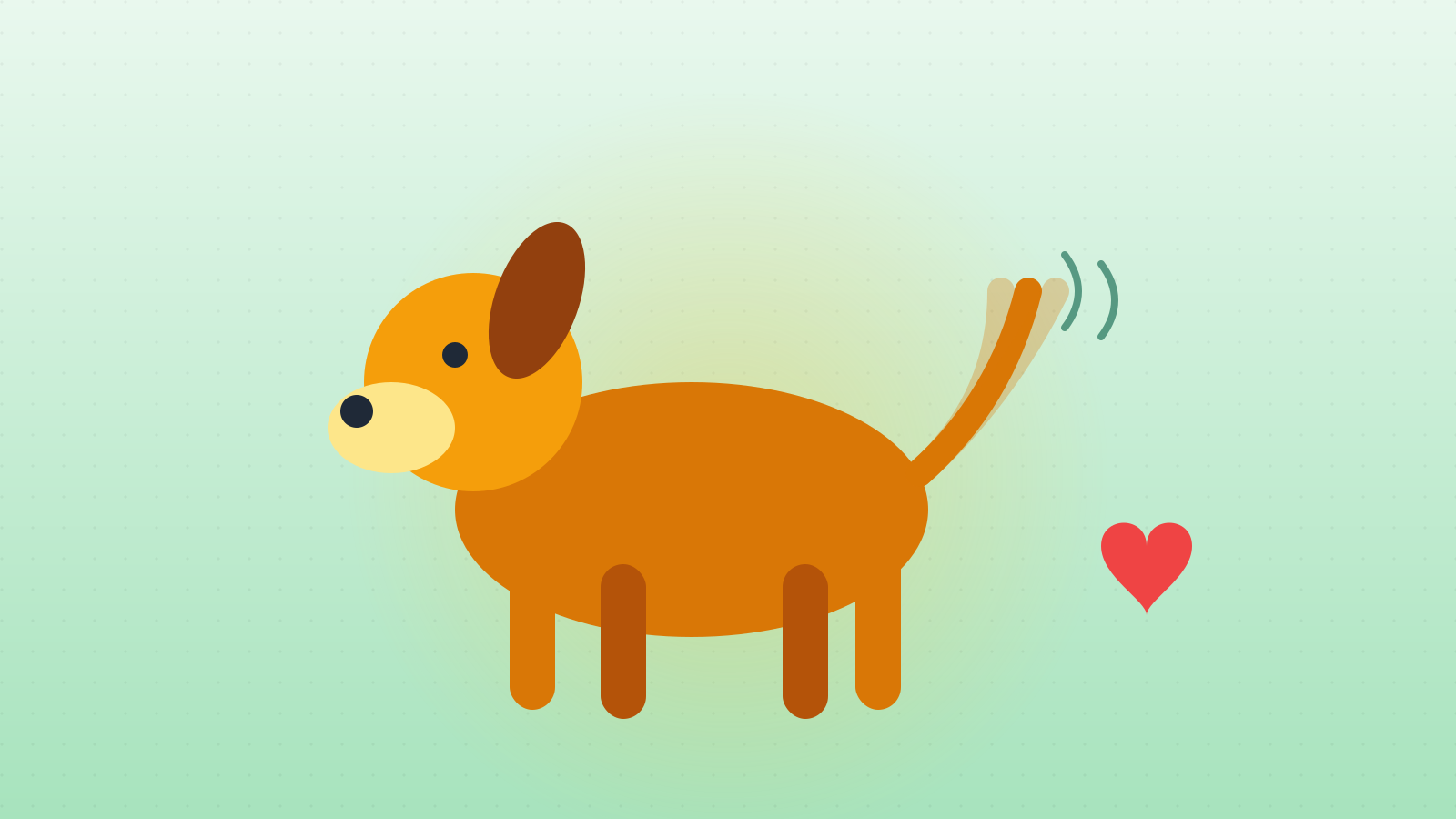
Dogs wag their tails mainly to communicate. A wag shows that a dog is emotionally aroused and ready to interact — but it does not always mean happiness. A loose, broad wag signals friendliness, a stiff, fast vibration with the tail held high signals tension, and a tail tucked between the legs signals fear. Research even suggests that whether a tail wags more to the right or the left is linked to different emotions.
In this article (7)
Open the door and your dog’s tail wags so fast that its whole body wiggles along. Most of us read it as “happy dog”, and usually we are right. But wagging is only one part of a complex body language. The height of the tail, its speed and even the direction it swings tell us a great deal about a dog’s feelings.
Tail wagging is communication
Dogs mostly wag their tails when others are around. Left alone, they rarely wag. That simple observation suggests the main function of wagging is communication.
Dogs are social animals, and their ancestors, wolves, live in packs. Within a group they rely heavily on body language to defuse tension, signal intentions and manage relationships, and the tail is one of its most visible parts.
In general, a wag shows that a dog is emotionally aroused and ready to interact. Whether that arousal is positive or negative depends on how the tail moves.
Tail height and movement
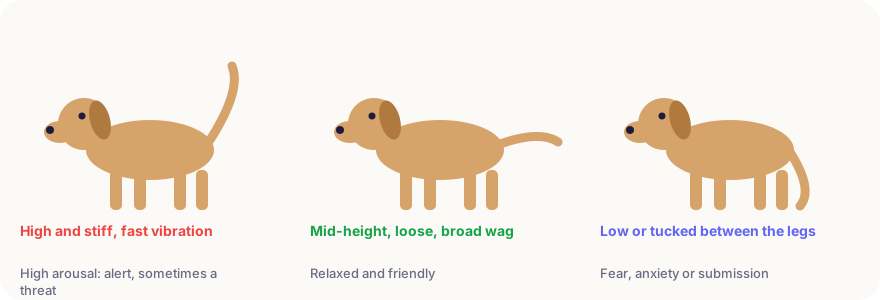
When reading tail language, look at two things: height and movement.
| Tail | Possible meaning |
|---|---|
| Mid-height, loose, broad wag, hips sometimes swinging too | Relaxed, happy and friendly |
| High, stiff, small rapid vibrations | High arousal, alertness or threat |
| Horizontal and still | Curiosity, careful assessment |
| Low, slow wag | Uncertainty, unease |
| Tucked between the legs | Fear, anxiety or submission |
Remember that a “normal” tail height varies by breed. A husky naturally carries its tail curled high, while a greyhound holds it low. Always judge the tail against that dog’s own natural carriage.
Right or left?
In 2007, Angelo Quaranta and colleagues at the University of Bari in Italy made a surprising discovery. They showed 30 dogs different stimuli and recorded their tail movements:
- When dogs saw their owner, their tails wagged more broadly to their own right.
- When faced with an unfamiliar dominant dog, their tails wagged more to their left.
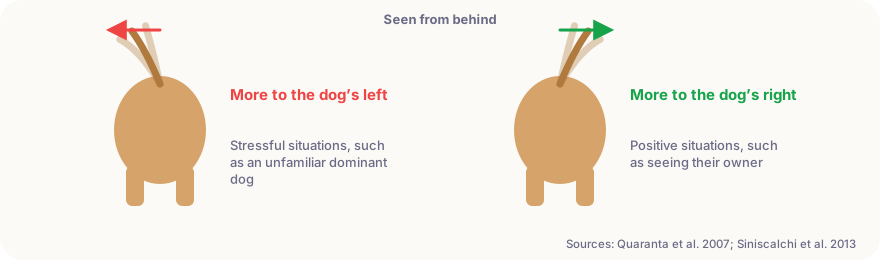
The researchers linked this to the two halves of the brain handling different emotions. In many animals, the left hemisphere is more active in positive, approach-related emotions and the right hemisphere in negative, withdrawal-related ones. Because the left half of the brain controls the right side of the body, positive emotions may make the tail swing more to the right.
Do dogs notice the difference?
In 2013 the same team went a step further, showing dogs videos of other dogs wagging more to the right or to the left. Dogs that watched a dog wagging to the left showed faster heart rates and more anxious behaviour, while those watching right-wagging dogs stayed calm.
So dogs appear to perceive this subtle difference — and respond to it.
How did tail wagging evolve?
In 2024, researchers from Italy, Austria and the Netherlands published a wide-ranging review of tail-wagging research. It concluded that surprisingly little is known about wagging, but highlighted some intriguing ideas:
- It starts in puppyhood: puppies begin wagging at about one month old, when they start playing with littermates and communicating with their mother.
- More than in wolves: dogs seem to wag more often and more conspicuously than wolves.
- The human factor: the researchers suggest that over thousands of years of domestication, people may have unconsciously favoured dogs that wagged more. Humans are naturally drawn to rhythmic movement and read wagging as a sign of friendliness.
These ideas are not yet proven and await testing, but they hint that tail wagging may be a product of the unique relationship between dogs and humans.
Other jobs of the tail
The tail is not only for communication:
- Balance: dogs use their tails like a balancing pole when running fast, turning or walking along narrow surfaces.
- Swimming: some breeds, such as Labradors, use their tails as a rudder.
- Scent: glands beneath the tail produce each dog’s individual scent, and wagging is thought to waft it around — which is why dogs sniff each other’s rear ends when they meet.
- Warmth: some dogs sleeping in the cold wrap their tails over their faces to keep their noses warm.
Reading tail language properly
The tail alone is not enough to know how a dog feels; read it together with the whole body:
- Ears: relaxed, pricked forward or pinned back?
- Eyes: soft, or fixed and hard? Can you see the whites of the eyes?
- Mouth: loosely open, tightly closed, teeth showing?
- Body: loose and wiggly, or stiff and leaning forward?
A dog wagging its tail but with a rigid body, fixed stare and tight lips is best left alone. It is especially important to teach children to ask an owner’s permission and read a dog’s body language before approaching an unfamiliar dog.
In short
Dogs wag their tails mainly to communicate. A wag shows emotional arousal, but not always happiness: a loose, broad wag means friendliness, a high, stiff vibration means tension and a tucked tail means fear. Even whether a tail wags more to the right or left is linked to different emotions — and dogs can tell the difference. Tail wagging may well be a by-product of thousands of years of friendship between dogs and people.
Frequently asked questions
Is a dog wagging its tail always friendly?
No. A dog holding its tail high, stiff and vibrating rapidly may be tense or aggressive. Tail movement should always be read together with the dog’s ears, eyes, mouth and posture.
Do dogs wag their tails when alone?
Very rarely. Tail wagging is largely social and usually happens in the presence of people or other animals, suggesting it is primarily a communication tool.
Does the tail have other functions?
Yes. It helps with balance when running and turning, works as a rudder when swimming, and wagging may help spread scent from glands beneath the tail.
Does tail docking harm dogs?
The tail is an important tool for communication and balance. Cosmetic tail docking is banned in many countries and criticised on animal-welfare grounds.
Sources
- Leonetti et al. (2024) – Why do dogs wag their tails?, Biology Letters
- Quaranta et al. (2007) – Asymmetric tail-wagging responses by dogs to different emotive stimuli, Current Biology
- Siniscalchi et al. (2013) – Seeing Left- or Right-Asymmetric Tail Wagging Produces Different Emotional Responses in Dogs, Current Biology
This article is based on peer-reviewed research and publications from trusted institutions, and it is reviewed regularly. How we work →
You might also wonder
All in Animals →
Why Do Octopuses Have Three Hearts? Blue Blood and Arms That Think
Why do octopuses have three hearts, why is their blood blue and how can their arms “think”? The science behind the body of the ocean’s strangest intelligence.
Why Do Cats Purr? How Purring Works and What It Means
Do cats only purr when they are happy? How purring is produced in the larynx, what new research revealed, and what your cat may actually be telling you.

How Do Migrating Birds Find Their Way? Sun, Stars and a Magnetic Compass
How do migrating birds cross thousands of kilometres without getting lost? Sun and star compasses, magnetic sensing in the eye and record-breaking journeys.
How Do Bees Make Honey? The Journey from Nectar to Honey
How do bees make honey, why doesn’t honey go off, and how do bees tell each other where the flowers are? The chemistry and communication inside a hive.

Why Do Zebras Have Stripes? Solving a 150-Year-Old Puzzle
Why are zebras striped? We weigh up camouflage, cooling and fly protection, and explain why horseflies struggle to land on a striped coat.
Why Do Cats Always Land on Their Feet? The Physics of the Righting Reflex
How do cats twist in mid-air to land on their feet? The righting reflex, the angular-momentum trick that puzzled physicists, and the real risks of high falls.