Why Do Zebras Have Stripes? Solving a 150-Year-Old Puzzle
Why are zebras striped? We weigh up camouflage, cooling and fly protection, and explain why horseflies struggle to land on a striped coat.

Short answer
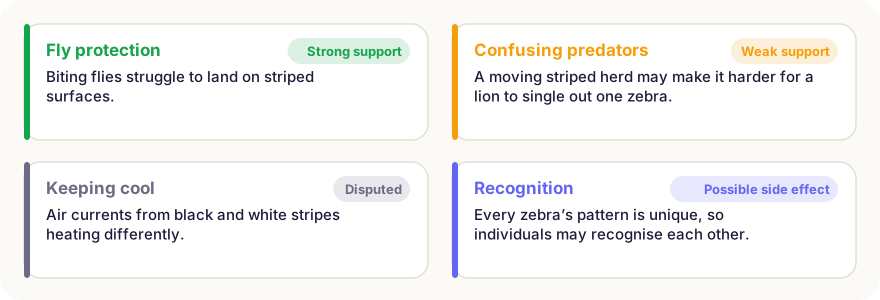
The explanation best supported by evidence is that stripes protect zebras from blood-sucking flies. In experiments, horseflies approached zebras as often as plain-coloured horses, but failed to slow down before landing on the striped coat, so most bumped off or flew past. Other explanations, such as confusing predators or keeping cool, rest on weaker or disputed evidence.
In this article (9)
The black-and-white stripes of the zebra, one of the best-known animals of the African savannah, are among nature’s most striking patterns. They have puzzled biologists since Charles Darwin and Alfred Russel Wallace. Over more than 150 years many ideas have been proposed — and recent experiments have shed light on the most likely answer.
Black on white, or white on black?
First, a common question. Shave a zebra and you will find black skin underneath. In the hairs, the pigment-producing cells — melanocytes — are active in some areas and switched off in others. Active areas form the black stripes; areas without pigment form the white ones. That is why it is more accurate to call a zebra “a black animal with white stripes”.
There are three species of zebra:
| Species | Stripe features | Where it lives |
|---|---|---|
| Plains zebra | Broad stripes, sometimes faint “shadow stripes” in between | Savannahs of eastern and southern Africa |
| Grévy’s zebra | Narrowest, most closely spaced stripes, white belly | Kenya and Ethiopia |
| Mountain zebra | Distinctive grid pattern on the rump | Mountainous south-western Africa |
Hypothesis 1: confusing predators
For many years the most popular idea was that stripes fool predators. In a running herd, so the theory goes, the stripes blur together and make it hard for a lion to pick out a single animal — a form of motion dazzle. Or the stripes break up a zebra’s outline in tall grass and at dusk.
But this hypothesis has weakened in recent years:
- Zebras are among the animals lions hunt most often. Stripes do not seem to deter them much.
- Calculations based on animal visual acuity suggest predators such as lions and hyenas can only clearly see zebra stripes from a few tens of metres away. Further off, a zebra looks like a grey-toned horse.
- Rather than hiding zebras in grass, the stripes make them more conspicuous on the open savannah.
Hypothesis 2: keeping cool
Another idea is that black stripes heat up more in the sun than white ones, and the temperature difference creates small air currents above the skin that help the animal cool down.
Studies testing this have produced conflicting results. Experiments comparing the temperature of striped and plain water barrels found no meaningful difference, while some field studies found that zebras in hotter areas have more pronounced stripes. The cooling hypothesis remains disputed.
Hypothesis 3: fending off flies
The explanation with the strongest support today is that stripes protect zebras from blood-sucking flies. In Africa, biting insects such as horseflies and tsetse flies are not just a nuisance — they carry deadly diseases such as trypanosomiasis and African horse sickness. Zebras have shorter hair than horses, making them more vulnerable.
In 2014, Tim Caro of the University of California and colleagues compared the distribution of zebra species and subspecies with environmental factors. The factor that best explained how strongly striped zebras were was where biting flies are most active. Predator density and temperature did not show nearly as strong a link.
The farm experiment: why can’t flies land on stripes?
In 2019, Caro’s team filmed horseflies on a farm in England that kept both zebras and horses. The results were revealing:
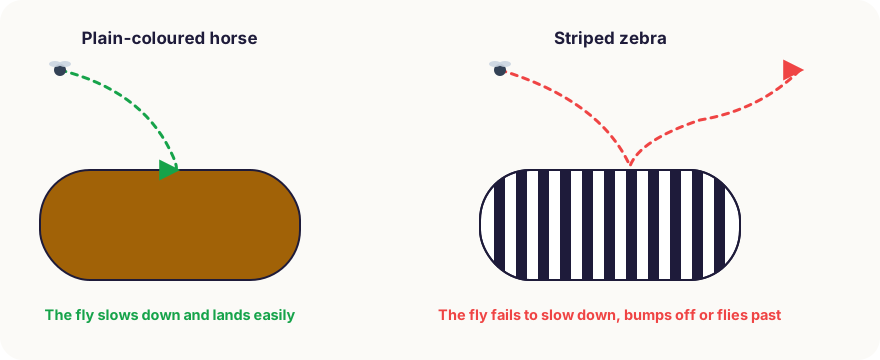
- Flies approached zebras and horses about equally often — the stripes did not deter them from a distance.
- When approaching horses, flies slowed down to land and touched down easily.
- Flies approaching zebras did not slow down. They bumped into the zebra, bounced off or flew past without landing.
- As a result, far fewer flies landed on zebras than on horses.
The researchers went one step further: they dressed horses in black, white and striped coats. Horses wearing striped coats had markedly fewer flies landing on their bodies — but there was no difference on their uncovered heads, showing that the effect came directly from the stripes.
How do stripes trick a fly’s eyes?
A fly’s compound eyes are excellent at detecting motion but poor at seeing detail. Scientists think stripes may confuse flies in two ways:
- A motion illusion: as the fly approaches, the stripes may send its motion-detection system misleading signals — as if things were moving the wrong way, or not at all. The fly cannot judge how fast it is closing in and misses the moment to brake.
- A vanishing target: from afar, the fly sees the zebra as a single mass. Up close, that mass breaks into black and white fragments and the fly “loses” its landing spot.
Some research also shows that horseflies use reflected polarised light to find water and hosts. Black and white stripes polarise light differently and may disrupt this navigation system too.
Is this knowledge useful?
Yes. The findings are already being applied to livestock:
- Some horse owners use striped fly rugs to protect their horses.
- In a study in Japan, painting black-and-white zebra stripes on cows significantly reduced the number of biting flies and fly-avoidance behaviours — a possible natural alternative to insecticides.
Every zebra is unique
Whatever their purpose, stripes have one certain side effect: every zebra’s pattern is unique. Like human fingerprints, no two zebras share the same stripes. Researchers can track individual zebras for years by comparing patterns in field photographs with computer software.
Whether zebras recognise each other by their stripes is less certain. Foals are thought to learn their mother’s pattern after birth, but scent and sound probably play important roles too.
In short
Zebra stripes have been a biological puzzle for 150 years. Popular explanations such as confusing predators or keeping cool now rest on weak or disputed evidence. The strongest evidence suggests stripes protect zebras from disease-carrying biting flies: the flies approach, but fail to slow down before reaching the striped coat and so often cannot land. The zebra’s stylish pattern turns out to be a highly practical fly repellent.
Frequently asked questions
Are zebras black with white stripes or white with black stripes?
Zebra skin is black. Some hairs produce pigment (black) and others do not (white). Looking at how they develop, zebras are best described as black animals with white stripes.
How many species of zebra are there?
Three: the plains zebra, Grévy’s zebra and the mountain zebra. Grévy’s zebra has the narrowest, most closely spaced stripes.
Do stripes protect zebras from lions?
The evidence is weak. Lions prey on zebras frequently, and research suggests lions can only make out stripes from fairly close range, so the effect on predators seems limited.
Does wearing stripes keep flies away?
In experiments, horses wearing striped coats had fewer flies landing on them. In Japan, painting zebra stripes on cows was also shown to reduce fly bites.
Sources
- Caro et al. (2019) – Benefits of zebra stripes: Behaviour of tabanid flies around zebras and horses, PLOS ONE
- Caro et al. (2014) – The function of zebra stripes, Nature Communications
This article is based on peer-reviewed research and publications from trusted institutions, and it is reviewed regularly. How we work →
You might also wonder
All in Animals →
How Do Bats See in the Dark? Echolocation Explained
Bats are not blind, but many hunt in total darkness by listening to echoes. How echolocation works, how fast bats call, and how moths fight back.
How Do Chameleons Change Colour? Nanocrystals, Not Pigments
Chameleons don’t change colour mainly to hide. They tune tiny crystals in their skin to signal mood, warn rivals and control temperature. How the trick works.
How Do Fireflies Glow? The Chemistry of Living Light
Fireflies make light without heat using a chemical reaction in their tails. How does bioluminescence work, how is it switched on and off, and why do they flash?
Why Are Flamingos Pink? Food, Pigments and Feather Make-Up
Flamingos are born grey, not pink. Their colour comes from pigments in algae and shrimp, and some even apply “make-up”. The science behind the pink bird.
How Can Owls Turn Their Heads So Far? The Secrets of a 270° Neck
Owls turn their heads about 270 degrees without cutting off blood to the brain. Why they need to, and the neck bones and vessels that make it possible.
How Do Dolphins Sleep? Half a Brain at a Time
Dolphins sleep with half the brain while the other half stays awake and one eye stays open. Why they can’t fully switch off, and who else does it.