How Do Chameleons Change Colour? Nanocrystals, Not Pigments
Chameleons don’t change colour mainly to hide. They tune tiny crystals in their skin to signal mood, warn rivals and control temperature. How the trick works.
Short answer
Chameleons change colour by adjusting a lattice of tiny guanine nanocrystals inside skin cells called iridophores. When the chameleon is relaxed the crystals sit close together and reflect blue light, which mixes with yellow pigment to look green. When it is excited the lattice spreads out, and longer wavelengths such as yellow, orange and red are reflected instead. The main reasons are communication and temperature control; camouflage is less important than most people think.
In this article (5)
Ask almost anyone how a chameleon changes colour and they will say it is to blend in. It is a lovely idea, and completely backwards. Chameleons mostly change colour to be seen, not to hide. And the way they do it is not by mixing paint, but by tuning tiny crystals in their skin like a living optical device.
Two kinds of colour
Animals make colour in two main ways.
- Pigments absorb some wavelengths of light and reflect others. The melanin that makes our hair dark and the carotenoids that make flamingos pink are pigments.
- Structural colours come from tiny structures that reflect certain wavelengths because of their size and spacing. The shimmering blue of a morpho butterfly or a peacock feather is structural.
Chameleons use both. Their skin contains pigment cells with yellow, red and dark brown pigments, but the dramatic changes come from a structural trick.
The secret: a lattice of nanocrystals
In 2015 a Swiss team led by Jérémie Teyssier and Michel Milinkovitch studied panther chameleons from Madagascar. Under the outer skin they found a thick layer of cells called iridophores. Each iridophore is packed with tiny crystals of guanine, a substance also found in DNA, arranged in a regular three-dimensional lattice.
The spacing between the crystals decides which colour is reflected, much as the spacing of grooves on a CD decides the rainbow you see.
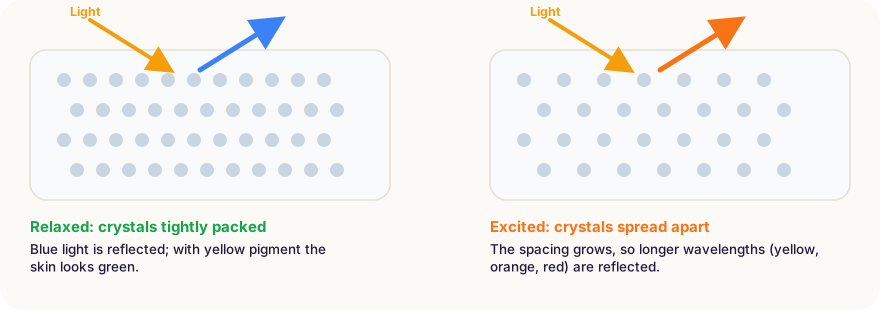
- When the chameleon is calm, the crystals are close together and reflect mainly blue light. Blue combined with yellow pigment above it makes the skin look green.
- When the chameleon is excited, the cells take up water and swell, pushing the crystals apart. The lattice spacing increases and longer wavelengths are reflected: yellow, orange and red.
The researchers confirmed this by bathing pieces of skin in salt solutions that made the cells swell or shrink. The colour changed just as it does in a living animal.
Beneath this layer lies a second layer of larger, less organised crystals. It reflects much of the near-infrared light from the sun, which may help protect the chameleon from overheating.
Why change colour at all?
If not for camouflage, then for what? Research points to several reasons.
Talking with colour
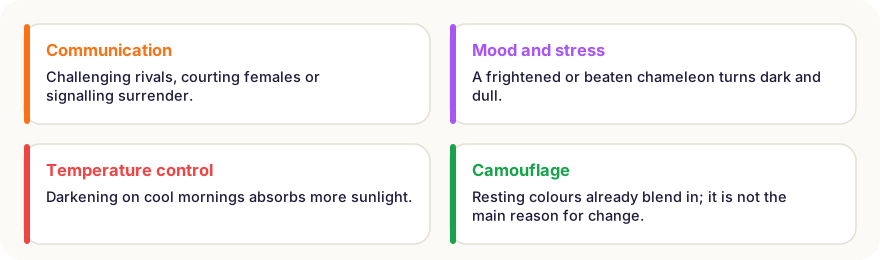
In 2008 Devi Stuart-Fox and Adnan Moussalli compared many species of South African dwarf chameleons. They found that the species with the greatest ability to change colour were those that used bold social displays, not those living in the most varied backgrounds. Colour change seems to have evolved mainly as a way to communicate.
A male confronting a rival flushes bright, contrasting colours. The winner stays bright; the loser quickly turns dark and drab, signalling surrender. Females can show whether they are receptive or not.
Mood and stress
Colour also reflects a chameleon’s state. Frightened, stressed or sick chameleons often turn dark brown or grey. Pet owners learn to read this as a warning sign.
Controlling temperature
Chameleons are cold-blooded and depend on their surroundings for heat. On cool mornings they can darken to absorb more sunlight and warm up faster, then lighten again in the heat of the day.
And camouflage?
Camouflage does play a part, but mostly through a chameleon’s resting colours, which already match leaves and bark. Some species also darken or pale to match the brightness of their surroundings, and they can adjust their colour depending on whether a predator is a bird or a snake. But the spectacular changes are about signalling.
Other remarkable features
Colour is not the only trick. A chameleon’s eyes sit in cone-shaped turrets that move independently, giving almost all-round vision. When it spots an insect, both eyes focus on it to judge distance. Then the tongue fires out at extreme acceleration, sticky tip first, and in some species reaches more than twice the length of the body.
There are more than 200 species of chameleon, most of them in Africa and Madagascar. The common chameleon also lives around the Mediterranean, including parts of southern Turkey.
In short
- Chameleons change colour mainly with structural colour, by tuning a lattice of guanine nanocrystals in skin cells called iridophores.
- Calm: crystals packed tightly reflect blue, which looks green with yellow pigment. Excited: crystals spread out and reflect yellow, orange and red.
- The main purposes are communication and temperature control, not hiding.
- Dark, dull colours often signal stress, cold or defeat.
- A deeper crystal layer reflects infrared light and may protect against overheating.
Frequently asked questions
Do chameleons change colour to match their background?
Not really. Their resting colours already blend in with leaves and branches. Studies show the biggest colour changes are used for social signals, such as challenging rivals or courting.
Can all chameleons change colour?
Most species can change colour to some degree, but the range differs a lot. Some, like the panther chameleon, are famous for dramatic changes, while others only shift between shades.
How fast can a chameleon change colour?
Panther chameleons can shift from green to yellow or orange in a minute or two, as the nanocrystal lattice in their skin is retuned.
What colour is a chameleon when it is sick or stressed?
Stressed, cold or defeated chameleons often turn dark brown or grey. Persistent dark colouring in a pet chameleon can be a sign of illness or poor conditions.
Sources
- Teyssier, J. et al. (2015). Photonic crystals cause active colour change in chameleons. Nature Communications
- Stuart-Fox, D. & Moussalli, A. (2008). Selection for social signalling drives the evolution of chameleon colour change. PLoS Biology
This article is based on peer-reviewed research and publications from trusted institutions, and it is reviewed regularly. How we work →
You might also wonder
All in Animals →
How Do Bats See in the Dark? Echolocation Explained
Bats are not blind, but many hunt in total darkness by listening to echoes. How echolocation works, how fast bats call, and how moths fight back.
How Do Fireflies Glow? The Chemistry of Living Light
Fireflies make light without heat using a chemical reaction in their tails. How does bioluminescence work, how is it switched on and off, and why do they flash?
Why Are Flamingos Pink? Food, Pigments and Feather Make-Up
Flamingos are born grey, not pink. Their colour comes from pigments in algae and shrimp, and some even apply “make-up”. The science behind the pink bird.
Why Do Octopuses Have Three Hearts? Blue Blood and Arms That Think
Why do octopuses have three hearts, why is their blood blue and how can their arms “think”? The science behind the body of the ocean’s strangest intelligence.

Why Do Cats Purr? How Purring Works and What It Means
Do cats only purr when they are happy? How purring is produced in the larynx, what new research revealed, and what your cat may actually be telling you.
Why Do Dogs Wag Their Tails? The Hidden Meanings of Tail Language
Does a wagging tail always mean a happy dog? What the height, speed and even the left–right direction of a dog’s wag reveal, according to research.