How Can Owls Turn Their Heads So Far? The Secrets of a 270° Neck
Owls turn their heads about 270 degrees without cutting off blood to the brain. Why they need to, and the neck bones and vessels that make it possible.
Short answer
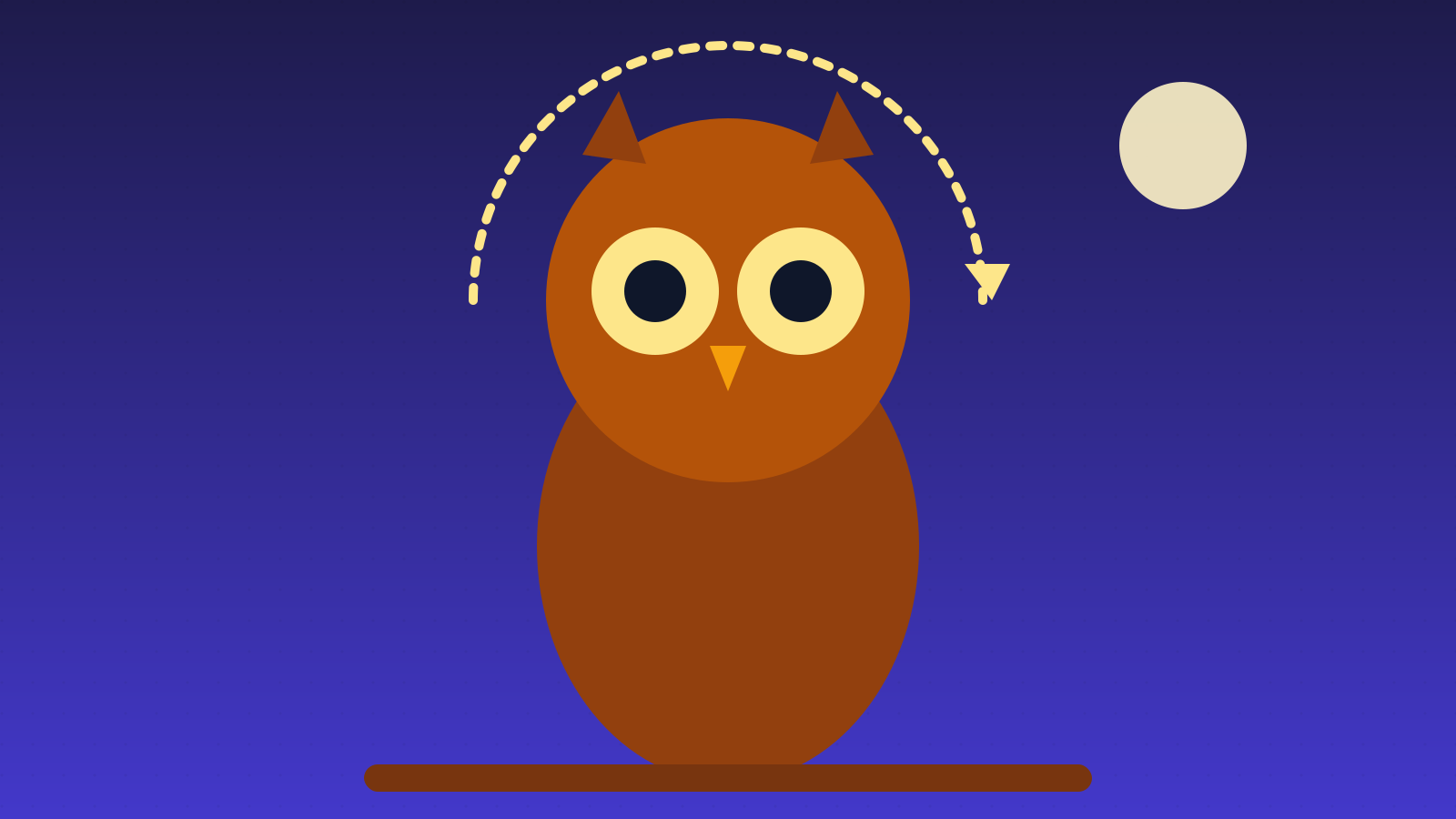
Owls can turn their heads up to about 270 degrees in total, roughly 135 degrees in each direction, because they cannot move their eyes. An owl’s eyes are long, tube-shaped and held rigidly in bony rings in the skull, so to look around it must turn its whole head. Its neck has 14 vertebrae, twice as many as ours, which makes it very flexible. Special adaptations protect the blood supply: the arteries pass through extra-wide channels in the neck bones, and expandable blood reservoirs at the base of the head keep blood flowing to the brain while the neck is twisted.
In this article (6)
Walk past an owl on a branch and it can follow you with its eyes as you go by, turning its head until its face seems to be looking straight over its back. It looks almost impossible, and it would injure us. How do owls do it?
Eyes that cannot move
The key is the owl’s eyes. Owls hunt mostly at night, and their eyes are enormous to gather as much light as possible. Instead of being round balls, they are long tubes, held in place by rings of bone in the skull called sclerotic rings. In some species the eyes take up more space in the skull than the brain.
The trade-off is that an owl cannot move its eyes in their sockets. We can glance sideways without moving our heads. An owl cannot: to look at anything, it has to point its whole head at it.

How far can an owl turn?
An owl can turn its head about 135 degrees in either direction, roughly 270 degrees in total. That means, starting with its head turned fully one way, it can sweep across to the other side and see almost everything around it. It cannot spin its head all the way round, as cartoons suggest. Humans, for comparison, manage about 70 to 90 degrees each way.
A neck built for twisting
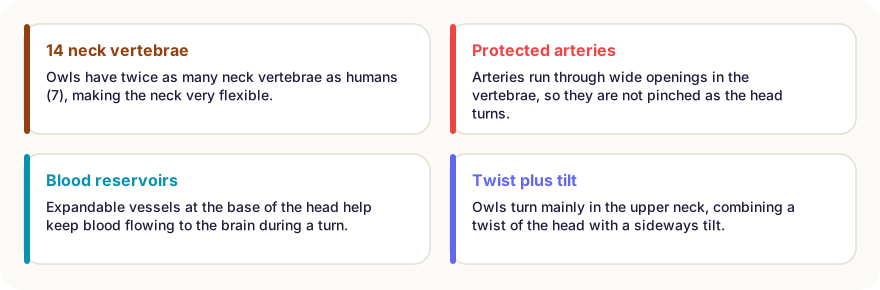
- Twice the vertebrae. Owls have 14 neck vertebrae, while humans and almost all mammals, even giraffes, have 7. More joints mean more flexibility.
- Twist plus tilt. X-ray and CT studies of barn owls, published in 2017 by a team led by Markus Krings, showed that owls achieve their extreme rotations mainly in the upper neck by combining a turning motion with a sideways roll of the head.
Protecting the blood supply
Twisting a neck that far could pinch the arteries that supply the brain. In people, sudden twists of the neck, for example in accidents or forceful manipulation, can tear arteries and cause strokes. Owls have several safeguards, described by researchers at Johns Hopkins University in 2013:
- The vertebral arteries run through holes in the neck bones that are about ten times wider than the arteries themselves, giving them room to move.
- The arteries enter the neck higher up than in other birds, leaving slack.
- At the base of the head, blood vessels can widen into small reservoirs, storing blood so the brain and eyes stay supplied while the neck is turned.
- Connections between blood vessels let blood take a different route if one is squeezed.
Other tricks of a night hunter
Owls are packed with hunting adaptations. Their flat facial disc acts like a satellite dish, funnelling sound to the ears. In many owls, such as the barn owl, the ears are placed asymmetrically, one higher than the other, which helps them pinpoint prey by sound in total darkness. Soft, fringed feathers let them fly almost silently. And they bob their heads to judge distance before striking.
In short
- Owls turn their heads about 135° each way, roughly 270° in total, not 360°.
- They must turn their heads because their tube-shaped eyes cannot move.
- Owls have 14 neck vertebrae, twice as many as humans.
- Arteries pass through extra-wide channels in the neck bones.
- Blood reservoirs at the base of the head keep the brain supplied while twisting.
- Facial discs, offset ears and silent flight complete the owl’s hunting toolkit.
Frequently asked questions
Can an owl turn its head all the way around?
No. A full 360-degree turn is a myth. Owls can turn about 135 degrees to each side, so by turning one way then the other they can look almost all the way round.
Why don’t owls hurt themselves turning their heads?
Their neck arteries run through extra-wide holes in the vertebrae, with room to move, and blood reservoirs at the base of the head keep the brain supplied. In humans, a sudden hard twist of the neck can damage arteries.
Why do owls bob their heads?
Bobbing and swaying the head lets an owl see an object from slightly different positions. This helps it judge distance accurately before it strikes.
Why are owls so quiet in flight?
Their wing feathers have soft, comb-like front edges and fringed back edges that break up the turbulence that normally makes flapping noisy, letting them approach prey almost silently.
Sources
- Krings, M. et al. (2017). Barn owls maximize head rotations by a combination of yawing and rolling in functionally diverse regions of the neck. Journal of Anatomy
- Encyclopaedia Britannica – Owl
This article is based on peer-reviewed research and publications from trusted institutions, and it is reviewed regularly. How we work →
You might also wonder
All in Animals →
How Do Bats See in the Dark? Echolocation Explained
Bats are not blind, but many hunt in total darkness by listening to echoes. How echolocation works, how fast bats call, and how moths fight back.
How Do Chameleons Change Colour? Nanocrystals, Not Pigments
Chameleons don’t change colour mainly to hide. They tune tiny crystals in their skin to signal mood, warn rivals and control temperature. How the trick works.
How Do Fireflies Glow? The Chemistry of Living Light
Fireflies make light without heat using a chemical reaction in their tails. How does bioluminescence work, how is it switched on and off, and why do they flash?
Why Are Flamingos Pink? Food, Pigments and Feather Make-Up
Flamingos are born grey, not pink. Their colour comes from pigments in algae and shrimp, and some even apply “make-up”. The science behind the pink bird.
How Do Dolphins Sleep? Half a Brain at a Time
Dolphins sleep with half the brain while the other half stays awake and one eye stays open. Why they can’t fully switch off, and who else does it.
How Good Is a Dog’s Sense of Smell? The Nose That Smells in Parts per Trillion
Dogs have hundreds of millions of smell receptors and a nose built for sniffing. How their noses work, what they can detect and why they sniff everything.