How Do Dolphins Sleep? Half a Brain at a Time
Dolphins sleep with half the brain while the other half stays awake and one eye stays open. Why they can’t fully switch off, and who else does it.
Short answer
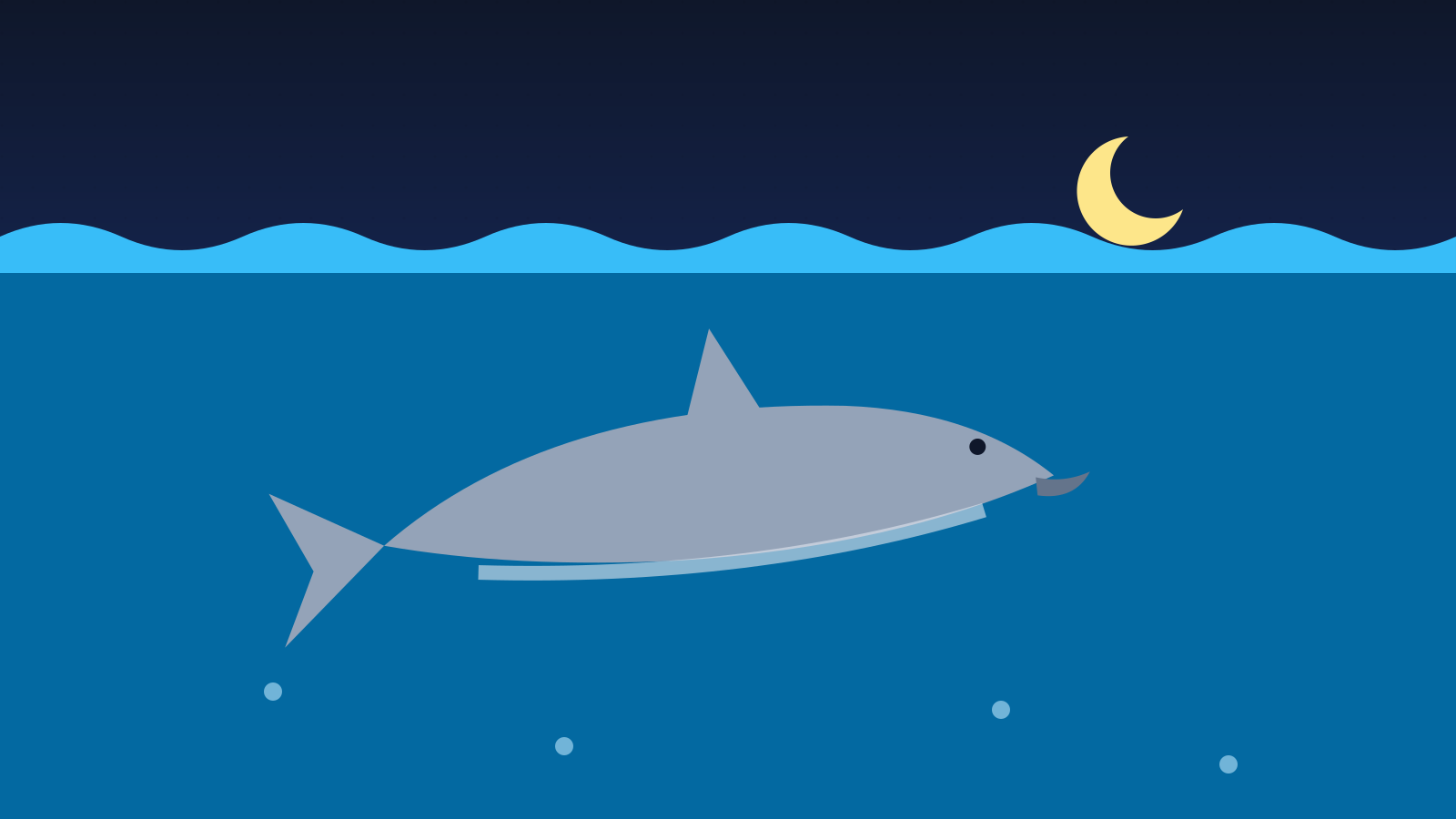
Dolphins sleep with only one half of their brain at a time, a state called unihemispheric slow-wave sleep. While one hemisphere is in deep sleep, the other stays awake, and the eye connected to the awake side often remains open. After a while the halves swap. Dolphins need this because they must breathe consciously: unlike us, they choose when to surface and take a breath, so if their whole brain fell asleep they could drown. Half-brain sleep also lets them keep watch for predators and stay in contact with their group. Seals, some whales and many birds can sleep this way too.
In this article (5)
We sleep by lying down, closing our eyes and switching off for hours. For a dolphin, that would be fatal. Dolphins are mammals that breathe air, living in water, and they have found a remarkable solution: they sleep with half a brain at a time.
One half sleeps, the other keeps watch
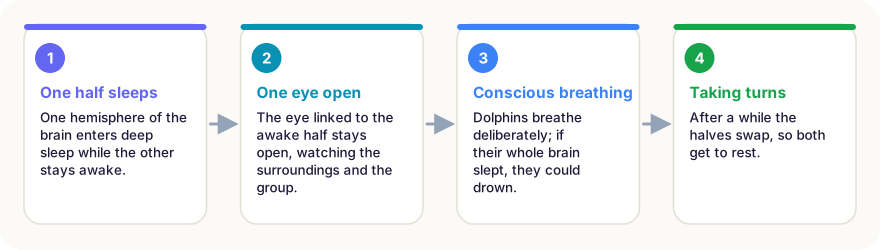
When scientists record the brain waves of sleeping dolphins, they see something unusual. One hemisphere shows the slow, large waves of deep sleep, while the other shows the fast activity of an awake brain. This is called unihemispheric slow-wave sleep.
The eye connected to the awake hemisphere usually stays open, while the other closes. After a period of rest, the two halves swap, so both get the sleep they need. Over a day, the sleep adds up to several hours.
Why dolphins can’t switch off completely
The main reason is breathing. In humans, breathing is automatic; we keep breathing while unconscious. Dolphins breathe voluntarily: each breath is a decision to surface and open the blowhole. If the whole brain fell into deep sleep, the dolphin might not surface and could drown.
Keeping half the brain awake also helps them:
- watch for predators such as sharks;
- stay in contact with their group and their calves;
- keep swimming and maintain body heat in cold water.
A study of bottlenose dolphins and killer whales reported that mothers and newborn calves showed almost no typical sleep behaviour for weeks after birth, staying constantly on the move, which may protect the calf and keep it warm.
Other half-brain sleepers
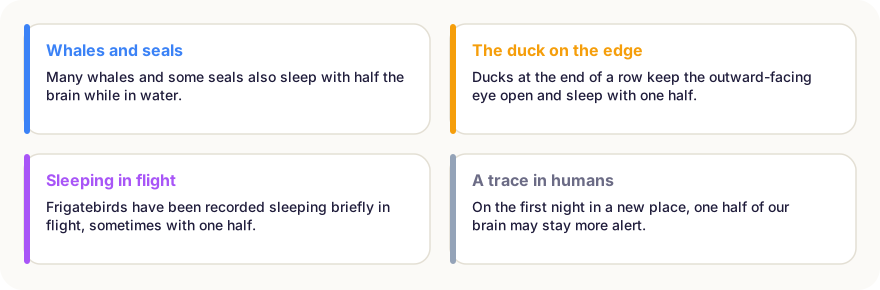
Dolphins are not alone. Fur seals sleep with half the brain when in water but switch to more normal sleep on land. Many birds do it too. In a classic experiment, ducks sleeping in a row kept the outward-facing eye open, with the matching half of the brain awake, watching for danger, while ducks in the safer middle slept with both halves more often.
In 2016, researchers fitted frigatebirds with tiny brain recorders and showed for the first time that birds really do sleep in flight, sometimes with one hemisphere and sometimes with both, but only for about 40 minutes a day, compared with over 12 hours on land.
Do humans do something similar?
People cannot sleep with only half the brain, but there may be an echo of it. A 2016 study found that on the first night in a new place, one hemisphere of the sleeper’s brain stays more alert, reacting more to unusual sounds and waking more quickly. This “first-night effect” may explain why many people sleep badly in hotels or unfamiliar beds.
In short
- Dolphins sleep with one half of the brain at a time: unihemispheric slow-wave sleep.
- The eye linked to the awake half often stays open.
- They must stay partly awake because they breathe consciously.
- Half-brain sleep also helps them watch for predators and stay with their group.
- Seals, some whales and many birds, including ducks and frigatebirds, sleep this way too.
- Humans show a hint of it on the first night in a new place.
Frequently asked questions
Do dolphins ever fully sleep?
Dolphins rarely show the kind of whole-brain deep sleep humans have. Their sleep is mostly one hemisphere at a time, adding up to several hours a day, often while slowly swimming or resting near the surface.
Do dolphins dream?
It is unclear. Dolphins show very little or no REM sleep, the stage most linked to vivid dreaming in humans, so if they dream at all it may be very different from our dreams.
Do humans sleep with half the brain?
Not fully, but a 2016 study found that on the first night in a new place, one hemisphere of the brain stays more alert and responds more to unusual sounds. This may be why people sleep poorly in unfamiliar beds.
Where do dolphins sleep?
They may rest motionless at the surface, a behaviour called logging, or swim slowly alongside a companion. Captive dolphins often swim in slow circles while sleeping.
Sources
- Rattenborg, N. C., Amlaner, C. J. & Lima, S. L. (2000). Behavioral, neurophysiological and evolutionary perspectives on unihemispheric sleep. Neuroscience & Biobehavioral Reviews
- Rattenborg, N. C. et al. (2016). Evidence that birds sleep in mid-flight. Nature Communications
- Tamaki, M. et al. (2016). Night watch in one brain hemisphere during sleep associated with the first-night effect in humans. Current Biology
This article is based on peer-reviewed research and publications from trusted institutions, and it is reviewed regularly. How we work →
You might also wonder
All in Animals →
How Do Bats See in the Dark? Echolocation Explained
Bats are not blind, but many hunt in total darkness by listening to echoes. How echolocation works, how fast bats call, and how moths fight back.
How Do Chameleons Change Colour? Nanocrystals, Not Pigments
Chameleons don’t change colour mainly to hide. They tune tiny crystals in their skin to signal mood, warn rivals and control temperature. How the trick works.
How Do Fireflies Glow? The Chemistry of Living Light
Fireflies make light without heat using a chemical reaction in their tails. How does bioluminescence work, how is it switched on and off, and why do they flash?
Why Are Flamingos Pink? Food, Pigments and Feather Make-Up
Flamingos are born grey, not pink. Their colour comes from pigments in algae and shrimp, and some even apply “make-up”. The science behind the pink bird.
How Can Owls Turn Their Heads So Far? The Secrets of a 270° Neck
Owls turn their heads about 270 degrees without cutting off blood to the brain. Why they need to, and the neck bones and vessels that make it possible.
How Good Is a Dog’s Sense of Smell? The Nose That Smells in Parts per Trillion
Dogs have hundreds of millions of smell receptors and a nose built for sniffing. How their noses work, what they can detect and why they sniff everything.