Why Do Cats Always Land on Their Feet? The Physics of the Righting Reflex
How do cats twist in mid-air to land on their feet? The righting reflex, the angular-momentum trick that puzzled physicists, and the real risks of high falls.
Short answer
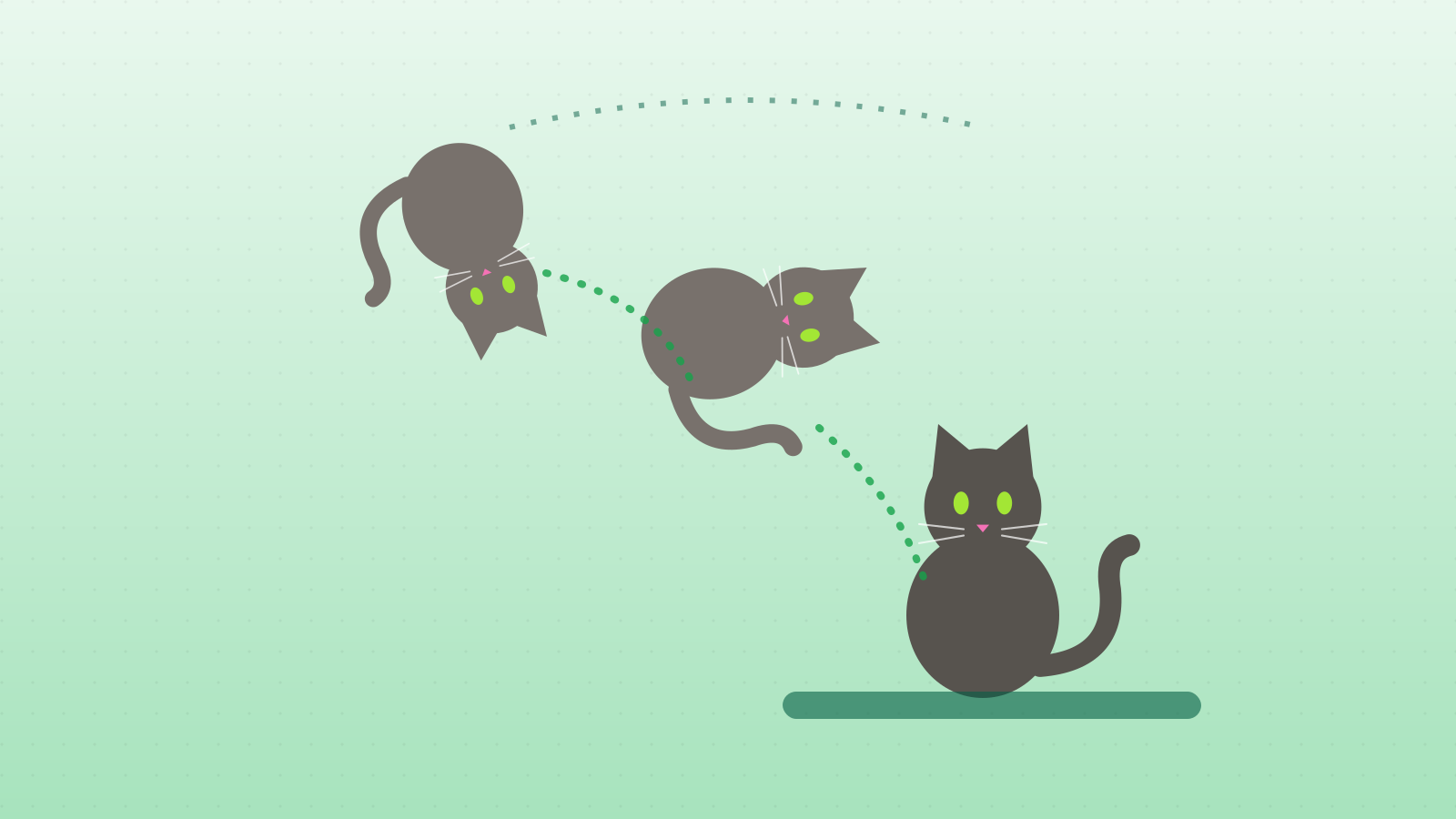
As a cat falls, the balance organ in its inner ear senses which way is down and triggers a righting reflex. The cat bends in the middle and rotates its front half and back half in turn, tucking and extending its legs to change how easily each half spins. This lets it turn over without pushing against anything — and without breaking the laws of physics. But the reflex does not protect cats from every fall.
In this article (8)
Imagine holding a cat upside down a short distance above a soft bed and letting go. In a fraction of a second it twists in mid-air and lands on all four feet. The move is so fast and flawless that in the 19th century it sparked a serious debate among physicists — because at first glance it seemed to break the laws of physics.
What is the righting reflex?
A cat’s ability to turn itself over in mid-air is called the righting reflex. It is innate, but it does not appear straight away:
- The first signs show up in kittens at around three to four weeks old.
- By around six to nine weeks, the reflex is fully developed.
The reflex starts in the vestibular system of the inner ear. This balance organ, made of fluid-filled canals, senses how the head is rotating and where “down” is. The eyes help too, but cats can right themselves even in the dark or with their eyes closed.
The problem that puzzled physicists
To see why this is so intriguing, you need one rule of physics: conservation of angular momentum.
An object falling freely through the air cannot grab or push against anything. If it is dropped without spinning, its total “amount of rotation” is zero — and it must stay zero. A figure skater can speed up or slow down a spin by pulling in or extending the arms. But a skater who starts without spinning cannot begin to spin just by waving the arms.
So how does a cat, dropped upside down without spinning, manage to turn 180 degrees?
In 1894 the French scientist Étienne-Jules Marey photographed a falling cat with a camera that could take 12 frames per second. The pictures set off a heated debate at the Paris Academy of Sciences: the cat really was turning over with nothing to push against.
The solution: bend and twist
The cat’s secret is that it uses its body not as one rigid object but as two separate parts. The front and back halves can rotate fairly independently by bending at the waist. The process has four stages:
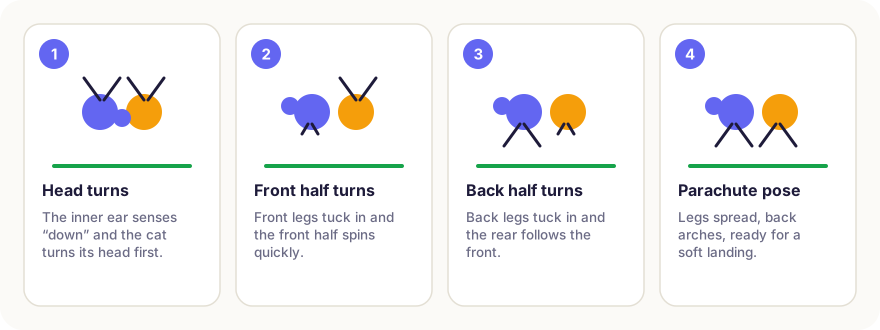
- The head turns: the inner ear senses “down” and the cat turns its head towards the ground.
- The front half turns: the cat tucks its front legs in and extends its back legs. The tucked front half resists rotation very little, while the back half with outstretched legs resists a lot. So the front half spins through a large angle while the back half turns only slightly the opposite way.
- The back half turns: now the cat does the reverse — it tucks its back legs and extends its front legs. This time the back half spins quickly and catches up with the front.
- Preparing to land: the legs reach towards the ground, the back arches slightly and the cat gets ready to absorb the impact.
At every stage the rotations of the two halves cancel each other out, so total angular momentum stays at zero — yet by the end, the whole cat is facing a new direction. In 1969 Thomas Kane and M. P. Scher of Stanford University described this bend-and-twist motion in a mathematical model that matched real photographs of falling cats remarkably well.
The tail plays a smaller part than you might think. Manx cats, a tailless breed, right themselves without any trouble.
Astronauts use the same trick
The method cats discovered works for humans too. Astronauts floating in weightlessness move their arms and legs in a similar sequence to change orientation without holding on to anything. Divers and trampolinists rely on the same principle when twisting in the air.
Why do cats get hurt so little?
Landing on their feet is only part of the story. Cats have other advantages.
A light, spread-out body
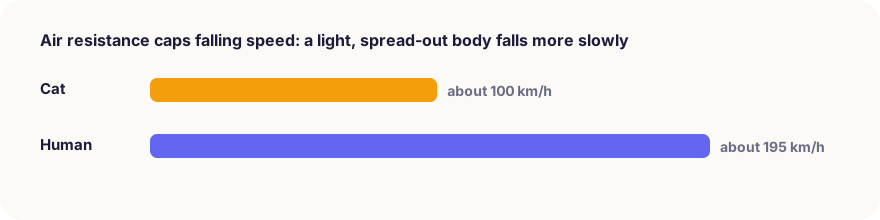
As an object falls faster, air resistance increases until it equals the object’s weight. From then on the object stops accelerating. This steady speed is called terminal velocity. A light body with a large surface area reaches terminal velocity at a lower speed.
A springy landing
As it touches down, a cat bends its legs and spreads the impact through its joints, muscles and flexible spine — rather like a car’s suspension.
High-rise syndrome: a legend and a warning
A famous 1987 veterinary study in New York looked at 132 cats that had fallen from tall buildings. The results were surprising:
- About 90% of the cats survived after treatment.
- Injuries increased with height up to about seven storeys but appeared to decrease above that.
The researchers’ explanation: after a fall of about five storeys a cat reaches terminal velocity and the sensation of acceleration disappears. At that point the cat relaxes, spreads its legs like a parachute and spreads the impact across its body.
That conclusion needs care, though. The study only included cats brought to the vet alive. Cats killed by very high falls were probably never recorded, which could make extreme falls look safer than they are.
What is certain is that cats are often seriously injured when they fall from height. The most common injuries are chest trauma, broken jaws and broken legs — a pattern vets call high-rise syndrome.
| Risk | Why? |
|---|---|
| Very low fall (1–2 storeys) | Too little time to complete the reflex |
| Medium height | The cat turns, but the legs cannot fully absorb the impact |
| Very high fall | Terminal velocity is high, so the impact is severe |
How to protect your cat
Cats usually lose their balance while chasing a bird or insect, or while dozing on a window ledge. Simple precautions save lives:
- Fit sturdy screens or cat netting to windows and balconies.
- Avoid placing furniture that lets the cat climb up to an open window.
- Never “test” the reflex by dropping a cat: the reflex is reliable, but falls are always risky.
In short
Cats sense they are falling through the balance system in their inner ear, then bend and twist their bodies in two parts to turn over in mid-air. By tucking and extending their legs in turn they change how easily each half rotates, landing on their feet without breaking any laws of physics. Their light bodies and springy landings protect them too. Even so, the skill does not make cats immune to the dangers of high falls — a good window net is a cat’s best insurance.
Frequently asked questions
How short a fall can a cat recover from?
A healthy adult cat can begin to right itself in a fall of about 30 centimetres, but it needs more height and time for a safe landing. In very short falls there may not be time to complete the reflex.
Do kittens land on their feet too?
The righting reflex appears at around three to four weeks of age and matures by about seven weeks. Younger kittens do not yet have the skill.
Do cats always survive high falls?
No. Cats that fall from windows and balconies often suffer chest trauma and broken jaws and legs — vets call it “high-rise syndrome”. Fitting screens or cat nets to windows is the best prevention.
Does the tail help a cat turn?
The tail may help a little, but the main rotation comes from bending and twisting the body. Tailless cats right themselves successfully.
Sources
- Kane & Scher (1969) – A dynamical explanation of the falling cat phenomenon, International Journal of Solids and Structures
- Whitney & Mehlhaff (1987) – High-rise syndrome in cats, Journal of the American Veterinary Medical Association
This article is based on peer-reviewed research and publications from trusted institutions, and it is reviewed regularly. How we work →
You might also wonder
All in Animals →
Why Do Octopuses Have Three Hearts? Blue Blood and Arms That Think
Why do octopuses have three hearts, why is their blood blue and how can their arms “think”? The science behind the body of the ocean’s strangest intelligence.
Why Do Cats Purr? How Purring Works and What It Means
Do cats only purr when they are happy? How purring is produced in the larynx, what new research revealed, and what your cat may actually be telling you.
Why Do Dogs Wag Their Tails? The Hidden Meanings of Tail Language
Does a wagging tail always mean a happy dog? What the height, speed and even the left–right direction of a dog’s wag reveal, according to research.

How Do Migrating Birds Find Their Way? Sun, Stars and a Magnetic Compass
How do migrating birds cross thousands of kilometres without getting lost? Sun and star compasses, magnetic sensing in the eye and record-breaking journeys.
How Do Bees Make Honey? The Journey from Nectar to Honey
How do bees make honey, why doesn’t honey go off, and how do bees tell each other where the flowers are? The chemistry and communication inside a hive.

Why Do Zebras Have Stripes? Solving a 150-Year-Old Puzzle
Why are zebras striped? We weigh up camouflage, cooling and fly protection, and explain why horseflies struggle to land on a striped coat.