Why Are Leaves Green? Chlorophyll, Photosynthesis and a Puzzle
Leaves are green because chlorophyll absorbs red and blue light. But why would plants waste the most abundant colour of sunlight? The surprising answer.
Short answer
Leaves are green because they are full of chlorophyll, the pigment plants use to capture sunlight for photosynthesis. Chlorophyll absorbs mainly blue and red light and absorbs green light less strongly, so more green light is reflected and transmitted to our eyes. That raises a puzzle, because green is among the most abundant colours in sunlight. One leading explanation, published in 2020, is that absorbing light at the edges of the green peak gives plants a steadier energy supply as light levels fluctuate, protecting their delicate photosynthetic machinery.
In this article (6)
Look out of almost any window and you will see green: lawns, trees, hedges, fields. Green is so normal for plants that we rarely ask why. Yet the answer leads into the heart of how life on Earth is powered, and it hides a puzzle that scientists have only recently started to solve.
The green pigment: chlorophyll
Inside the cells of a leaf are tiny structures called chloroplasts, packed with the pigment chlorophyll. Its job is to catch sunlight and use its energy to drive photosynthesis.
Sunlight looks white, but it is a mixture of all the colours of the rainbow. Chlorophyll does not absorb them all equally. It is very good at absorbing blue and red light and much weaker at absorbing green.
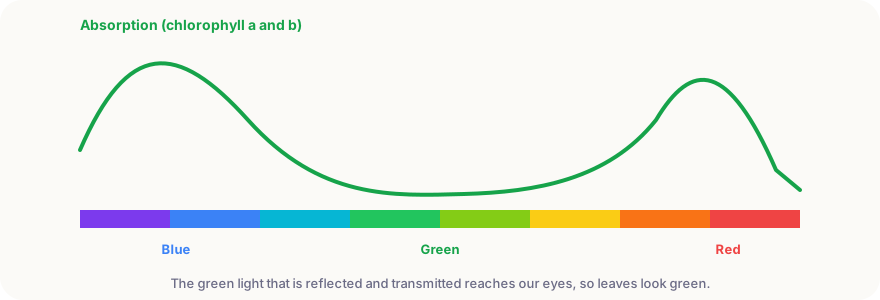
Light that is not absorbed is either reflected or passes through the leaf. Because a little more green escapes than other colours, the light that reaches our eyes from a leaf is rich in green. That is why leaves look green, both when light shines on them and when sunlight shines through them.
There are two main types: chlorophyll a and chlorophyll b, with slightly different absorption peaks. Leaves also contain yellow and orange carotenoids, which help collect light and protect the leaf, but in summer they are hidden by the abundant chlorophyll.
What the light is used for
Photosynthesis turns light energy into chemical energy. In simple terms, plants use the energy of absorbed light to combine carbon dioxide from the air with water from the soil, producing sugar and releasing oxygen.
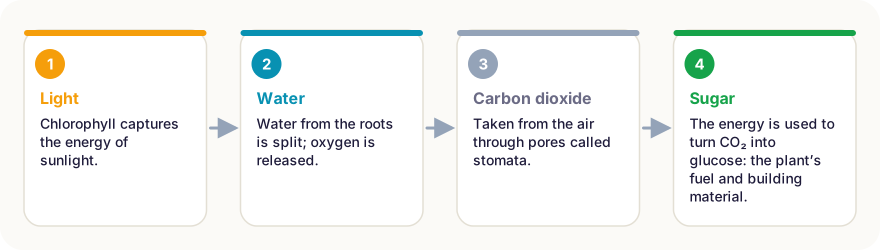
The sugar is the plant’s fuel and building material. It is turned into starch for storage, cellulose for cell walls and countless other molecules. Almost every food chain on land starts here.
The puzzle: why waste green?
Here is the strange part. Sunlight reaching Earth’s surface is most intense in the blue-green to green part of the spectrum. If you were designing a solar panel from scratch, you might expect it to absorb as much of that abundant light as possible, and to be dark, even black.
Plants do the opposite. They absorb less of the most plentiful colour. For a long time this was one of the open questions in plant biology.
A surprising answer: a quieter energy supply
In 2020 a team led by physicist Nathaniel Gabor and plant biologist Richard Cogdell proposed an answer based on physics. The light reaching a leaf is never constant; it changes as clouds pass, leaves move and shadows shift. Rapid swings in incoming energy are dangerous for photosynthesis, which needs a steady input. Too much energy at once can create harmful molecules and damage the machinery.
The researchers modelled light-harvesting systems as an antenna that tries to minimise this “noise”. Their calculations showed that the best strategy is to absorb light at two nearby wavelengths on the steep edges of the solar spectrum, rather than at its peak. When they used the real spectrum of light reaching plants, the model predicted absorption peaks remarkably close to those of chlorophyll a and b. Similar predictions matched the pigments of purple bacteria and green sulphur bacteria, which live under different light.
In other words, plants may be green not because they are inefficient, but because they are playing it safe, trading some extra energy for a more reliable supply.
Green is not wasted entirely
Leaves are not perfect green mirrors. A typical leaf still absorbs most of the green light that hits it, just less efficiently than red and blue. Green light also travels deeper into leaves and down through the canopy, where it can be used by cells and leaves that the red and blue light never reach.
In short
- Leaves are green because of chlorophyll, the pigment that captures light for photosynthesis.
- Chlorophyll absorbs blue and red light strongly and green light more weakly.
- Photosynthesis uses light to turn carbon dioxide and water into sugar, releasing oxygen.
- Plants absorb less of the most abundant colour of sunlight, which long puzzled scientists.
- A 2020 study suggests this gives a steadier, safer energy supply in fluctuating light.
- Green light is still partly used deeper in leaves and lower in the canopy.
Frequently asked questions
Why do leaves change colour in autumn?
As days shorten, many trees stop making chlorophyll and break it down. Yellow and orange carotenoids that were hidden all summer become visible, and some trees produce red anthocyanins.
Are there plants that are not green?
Yes. Some plants have red or purple leaves because extra pigments mask the chlorophyll, but they still photosynthesise. A few parasitic plants have lost chlorophyll entirely and take their food from other plants.
Why aren’t plants black, to absorb all the light?
Absorbing all wavelengths could overheat leaves and expose them to damaging swings in energy. Research suggests that a narrower, more stable energy input is safer for photosynthesis than maximum absorption.
Do plants use green light at all?
Yes. Green light penetrates deeper into leaves and canopies than red and blue, and some of it is absorbed and used for photosynthesis lower down, where red and blue light have already been taken up.
Sources
- Arp, T. B. et al. (2020). Quieting a noisy antenna reproduces photosynthetic light-harvesting spectra. Science
- Encyclopaedia Britannica – Photosynthesis
This article is based on peer-reviewed research and publications from trusted institutions, and it is reviewed regularly. How we work →
You might also wonder
All in Plants →
Do Sunflowers Follow the Sun? Yes, But Only When They Are Young
Young sunflowers turn east to west each day and swing back at night. Mature ones stop and face east. How the plant’s inner clock and bees explain it.
How Do Plants Drink Water? How Trees Lift Water 100 Metres Without a Pump
Plants have no heart, yet the tallest trees lift water over 100 metres. How roots, xylem and evaporation from leaves pull water up from the soil.
Can Plants Make Sounds? Stressed Tomatoes Click in Ultrasound
Thirsty or cut plants emit ultrasonic clicks that microphones can record. What a 2023 study found, how plants signal danger and why they still don’t “scream”.
How Does a Venus Flytrap Work? The Plant That Counts to Five
A Venus flytrap snaps shut in a tenth of a second, but only after counting two touches. How its trigger hairs, electrical signals and snap-buckling leaves work.
What Is the Oldest Tree in the World? Meet Methuselah, Nearly 5,000 Years Old
A bristlecone pine in California called Methuselah is about 4,850 years old. How scientists count tree rings, and how a gnarled pine outlives empires.

How Do Bats See in the Dark? Echolocation Explained
Bats are not blind, but many hunt in total darkness by listening to echoes. How echolocation works, how fast bats call, and how moths fight back.