Are Mushrooms Plants? Why Fungi Are Closer to Animals
Mushrooms grow in soil and don’t move, but they are not plants. Why fungi form their own kingdom, how they feed and why they are closer to animals.
Short answer
No. Mushrooms are not plants; they belong to the fungi, a separate kingdom of life. Unlike plants, fungi have no chlorophyll and cannot make their own food from sunlight. Instead, they release digestive enzymes into their surroundings and absorb the nutrients, feeding on dead material, living hosts or partnerships with plant roots. Their cell walls are made of chitin, the same tough substance found in insect shells, rather than the cellulose of plants. Genetic studies since the 1990s have shown that fungi are actually more closely related to animals than to plants. The mushroom we see is only the fruiting body of a much larger network of threads in the soil.
In this article (5)
They grow out of the soil, sit still and are sold next to the vegetables. Many of us learned at school that mushrooms are a kind of plant. But biologists put them in a completely different group, and the surprising truth is that a mushroom is more closely related to you than to the grass it grows in.
A kingdom of their own
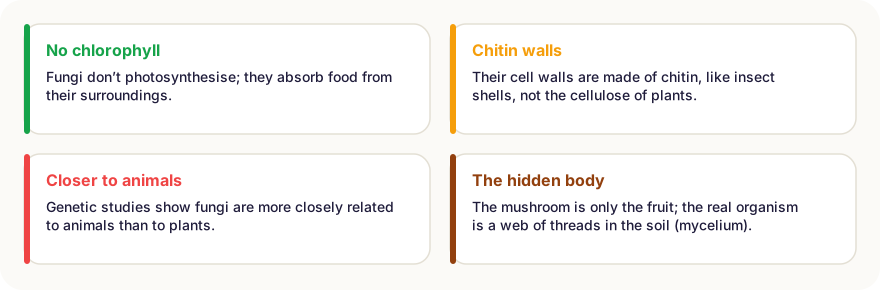
For centuries, living things were simply divided into animals and plants, and fungi ended up with the plants. Only in the 20th century did scientists recognise fungi as a separate kingdom. The differences are fundamental:
- No photosynthesis. Plants are green because of chlorophyll, which lets them make sugar from sunlight. Fungi have no chlorophyll. They must get their food from other sources.
- Digesting outside the body. Fungi feed by releasing digestive enzymes into their surroundings, breaking down food outside their cells, and then absorbing the nutrients. Some recycle dead leaves and wood, some infect living hosts, and many form partnerships with plant roots.
- Chitin walls. Plant cell walls are made of cellulose. Fungal cell walls are made of chitin, the same tough material that forms the shells of insects and crabs.
- Different food stores. Plants store energy as starch. Fungi, like animals, store it as glycogen.
Closer to animals than to plants
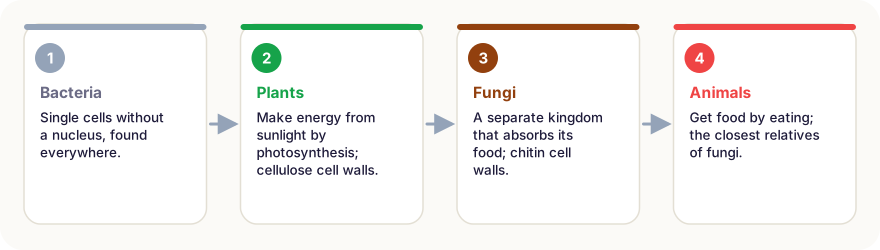
The most surprising discovery came from genetics. In 1993, biologists Sandra Baldauf and Jeffrey Palmer compared the sequences of several proteins found in plants, animals and fungi. The evidence pointed clearly to one conclusion: animals and fungi are each other’s closest relatives. Later studies confirmed this. Fungi and animals belong to a larger group sometimes called the opisthokonts, which split from the ancestors of plants long ago.
So, in evolutionary terms, the button mushroom on your plate is a closer cousin of yours than the lettuce next to it.
The mushroom is just the fruit
What we call a mushroom is only a small part of the organism. The real body of the fungus is a vast, hidden web of thin threads called hyphae, which together form the mycelium. It spreads through soil, wood or leaf litter, feeding as it grows. When conditions are right, the mycelium produces a mushroom, a fruiting body whose job is to release spores, the fungal equivalent of seeds.
Mycelium networks can become enormous. A honey fungus in Oregon’s Blue Mountains forms a single network covering about 9 square kilometres, making it one of the largest organisms on Earth, perhaps thousands of years old.
Why fungi matter
Fungi are essential to life on land. They are the main recyclers of dead wood and leaves, returning nutrients to the soil. Most land plants form partnerships with fungi in their roots, called mycorrhizae, trading sugars for water and minerals. Fungi give us bread, beer, cheese and medicines such as penicillin. But some also cause diseases in crops, animals and people, and a few mushrooms, like the death cap, are deadly poisonous.
In short
- Mushrooms are not plants; they belong to the separate kingdom of fungi.
- Fungi have no chlorophyll and feed by absorbing nutrients after digesting food outside their cells.
- Their cell walls are made of chitin, like insect shells, not cellulose.
- Genetic studies show fungi are more closely related to animals than to plants.
- A mushroom is only the fruiting body of a hidden network called the mycelium.
- Fungi recycle nutrients, partner with plant roots and give us foods and medicines.
Frequently asked questions
Why were mushrooms once classed as plants?
For centuries, living things were divided simply into animals and plants. Fungi grow in place, have rigid cell walls and seem plant-like, so they were grouped with plants until scientists recognised them as a separate kingdom in the 20th century.
Do mushrooms need sunlight?
They don’t need sunlight for food, because they don’t photosynthesise. Some species use light as a signal to time the growth of their fruiting bodies, but many grow perfectly well in the dark.
Are all fungi mushrooms?
No. Mushrooms are produced by only some fungi. The fungus kingdom also includes yeasts, moulds and many microscopic species that never form mushrooms.
Is it safe to eat wild mushrooms?
Only if identified by an expert. Some deadly species, such as the death cap, look similar to edible ones, and even small amounts can cause fatal liver damage.
Sources
- Baldauf, S. L. & Palmer, J. D. (1993). Animals and fungi are each other’s closest relatives: congruent evidence from multiple proteins. PNAS
- Encyclopaedia Britannica – Fungus
This article is based on peer-reviewed research and publications from trusted institutions, and it is reviewed regularly. How we work →
You might also wonder
All in Plants →
Do Sunflowers Follow the Sun? Yes, But Only When They Are Young
Young sunflowers turn east to west each day and swing back at night. Mature ones stop and face east. How the plant’s inner clock and bees explain it.
How Do Plants Drink Water? How Trees Lift Water 100 Metres Without a Pump
Plants have no heart, yet the tallest trees lift water over 100 metres. How roots, xylem and evaporation from leaves pull water up from the soil.
Why Are Leaves Green? Chlorophyll, Photosynthesis and a Puzzle
Leaves are green because chlorophyll absorbs red and blue light. But why would plants waste the most abundant colour of sunlight? The surprising answer.
How Do Cacti Survive Without Water? The Desert Survival Toolkit
Cacti store water in swollen stems, use spines instead of leaves, breathe at night and grow roots within hours of rain. How they survive in deserts.
Why Does the Sensitive Plant Close When You Touch It? Mimosa pudica Explained
Touch a Mimosa pudica leaf and it folds up in seconds. How electrical signals and water pressure move it, why it does it, and can it learn?
Can Plants Make Sounds? Stressed Tomatoes Click in Ultrasound
Thirsty or cut plants emit ultrasonic clicks that microphones can record. What a 2023 study found, how plants signal danger and why they still don’t “scream”.