How Do Cacti Survive Without Water? The Desert Survival Toolkit
Cacti store water in swollen stems, use spines instead of leaves, breathe at night and grow roots within hours of rain. How they survive in deserts.

Short answer
Cacti survive long dry periods by storing water and losing very little of it. Their thick, fleshy stems act as water tanks, and pleated ribs let them swell after rain and shrink during drought. Their leaves have been reduced to spines, which lose almost no water, shade the stem and protect it from thirsty animals. A waxy skin seals in moisture. Most cacti use a special kind of photosynthesis called CAM: they open their pores only in the cool night to take in carbon dioxide, and keep them closed during the hot day. Their shallow, wide roots quickly soak up rain, and new roots can sprout within hours of a shower.
In this article (5)
In the desert, months can pass without a drop of rain, and summer temperatures soar above 45 °C. Most plants would shrivel and die. Yet cacti stand tall, green and full of water. Some live for 150 years or more. They manage it with a remarkable set of survival tricks, built into every part of their bodies.
A body built for storage
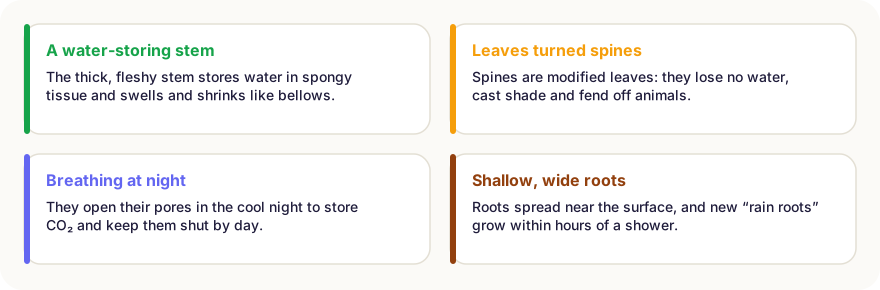
Swollen stems. In most plants, the stem is a support and the leaves do the work. In cacti, the thick green stem does almost everything: it photosynthesises and stores water in spongy tissue. Many cacti have pleated ribs that work like an accordion, letting the stem expand quickly after rain and shrink during drought without splitting. A large saguaro can soak up hundreds of litres after a single storm.
Spines instead of leaves. Broad, thin leaves lose a lot of water. In cacti, leaves have been transformed into spines. They lose almost no water, and they do several jobs: they protect the juicy stem from thirsty animals, cast a little shade, trap a layer of still air that reduces drying, and in some species collect dew.
A waterproof skin. A thick, waxy coating seals the stem’s surface, and cacti have relatively few pores, often sunk into the surface to reduce water loss.
Round shapes. Many cacti are round or column-shaped. These shapes hold a lot of volume for a small surface area, which means less surface through which water can escape.
Breathing at night
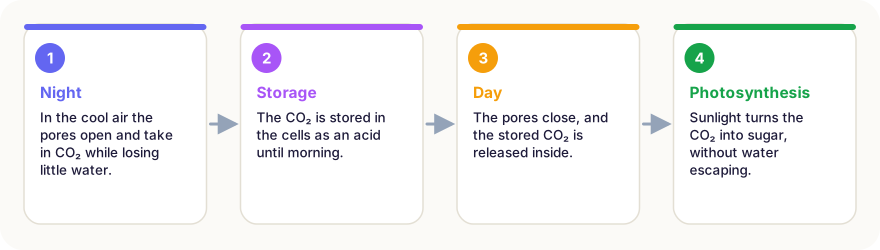
Plants need carbon dioxide for photosynthesis, which they take in through pores called stomata. But every time the pores open, water escapes. In the desert sun, opening them during the day would be disastrous.
Most cacti solve this with CAM photosynthesis, short for crassulacean acid metabolism. They open their stomata at night, when it is cool and humid and much less water is lost. They capture carbon dioxide and store it overnight as an acid inside their cells. During the day, with pores firmly closed, they release the stored carbon dioxide inside and use sunlight to turn it into sugar.
The trade-off is slow growth: CAM plants cannot take in carbon dioxide as fast as ordinary plants. That is one reason many cacti grow very slowly.
Roots that grab every drop
Desert rain is rare and often brief, and water quickly drains or evaporates. Cacti usually have shallow roots that spread out widely just under the surface, sometimes several metres from the plant, to catch rain before it disappears. After a shower, many cacti grow new fine “rain roots” within hours, which absorb water and then die back when the soil dries again.
Studies of the barrel cactus in the Colorado Desert by plant physiologist Park Nobel showed how these features work together: the cactus can keep its tissue hydrated and continue photosynthesising for long periods after rain by drawing on its internal water store.
Not only deserts
Almost all cacti are native to the Americas. Not all live in deserts: some, like the Christmas cactus, grow on trees in tropical forests. But their talent for storing water has made them the iconic plants of dry lands.
In short
- Cacti store water in thick stems with pleated ribs that expand and shrink.
- Their leaves have become spines, which save water, give shade and deter animals.
- A waxy skin and few pores reduce water loss.
- Most use CAM photosynthesis, opening pores only in the cool night.
- Shallow, wide roots and fast-growing rain roots capture brief rainfall.
- At home, more cacti die from overwatering than from drought.
Frequently asked questions
How long can a cactus live without water?
It depends on the species and its size. Large barrel cacti and saguaros can survive many months, even a year or more, on stored water, slowly shrinking as they use it.
Can you drink water from a cactus?
Not safely. The moisture inside most cacti is a bitter, slimy fluid, and in some species it contains acids or alkaloids that can make you ill. Survival experts advise against relying on it.
Do all cacti live in deserts?
No. Many cacti grow in dry places, but some live in tropical forests, growing on trees. Almost all cacti are native to the Americas.
How often should I water a cactus at home?
Water thoroughly, then let the soil dry out completely before watering again. More cacti die from overwatering and root rot than from drought.
Sources
- Nobel, P. S. (1977). Water relations and photosynthesis of a barrel cactus, Ferocactus acanthodes, in the Colorado Desert. Oecologia
- Encyclopaedia Britannica – Cactus
This article is based on peer-reviewed research and publications from trusted institutions, and it is reviewed regularly. How we work →
You might also wonder
All in Plants →
Do Sunflowers Follow the Sun? Yes, But Only When They Are Young
Young sunflowers turn east to west each day and swing back at night. Mature ones stop and face east. How the plant’s inner clock and bees explain it.
How Do Plants Drink Water? How Trees Lift Water 100 Metres Without a Pump
Plants have no heart, yet the tallest trees lift water over 100 metres. How roots, xylem and evaporation from leaves pull water up from the soil.
Why Are Leaves Green? Chlorophyll, Photosynthesis and a Puzzle
Leaves are green because chlorophyll absorbs red and blue light. But why would plants waste the most abundant colour of sunlight? The surprising answer.
Are Mushrooms Plants? Why Fungi Are Closer to Animals
Mushrooms grow in soil and don’t move, but they are not plants. Why fungi form their own kingdom, how they feed and why they are closer to animals.

Why Does the Sensitive Plant Close When You Touch It? Mimosa pudica Explained
Touch a Mimosa pudica leaf and it folds up in seconds. How electrical signals and water pressure move it, why it does it, and can it learn?
Can Plants Make Sounds? Stressed Tomatoes Click in Ultrasound
Thirsty or cut plants emit ultrasonic clicks that microphones can record. What a 2023 study found, how plants signal danger and why they still don’t “scream”.