Why Do We Have Phobias? How Intense Fears Form and How They Are Treated
Why are so many people terrified of spiders, heights or needles? How phobias form, which types are most common and why exposure therapy works so well.

Short answer
A phobia is an intense, lasting fear of a specific thing or situation that is out of proportion to the real danger. Phobias form through a mix of evolution and learning. Evolution seems to have ‘prepared’ humans to learn fears of ancient dangers such as snakes, spiders and heights quickly. A frightening experience, watching someone else panic or hearing scary stories can then trigger the fear. What keeps a phobia alive is avoidance: every time we escape the feared thing, we feel relief, and the brain concludes that the danger was real. Phobias are very common, but they respond well to treatment, especially gradual exposure therapy.
In this article (7)
A tiny spider appears in the corner of the bathroom, and a grown adult, who knows perfectly well it is harmless, cannot go in. Someone else plans long detours to avoid a bridge, or refuses a vaccine because of the needle. Phobias can seem irrational to others, but they are among the most common mental health conditions in the world, and science understands rather well how they arise.
Fear is useful, phobia is too much
Fear is one of our most important survival tools. When we sense danger, the brain’s alarm system, centred on a region called the amygdala, triggers the fight-or-flight response: the heart races, breathing speeds up, muscles tense.
A phobia is when this alarm goes off too strongly, too often and for the wrong reasons. Psychiatrists speak of a specific phobia when the fear:
- is out of proportion to the actual danger,
- appears almost every time the person meets the feared thing,
- lasts for months,
- leads to avoidance or distress that affects daily life.
According to a 2018 review in The Lancet Psychiatry, specific phobias are among the most common mental disorders: a substantial share of people, roughly one in ten in many surveys, will have one at some point in their lives. They are more common in women and usually begin in childhood.
The most common types
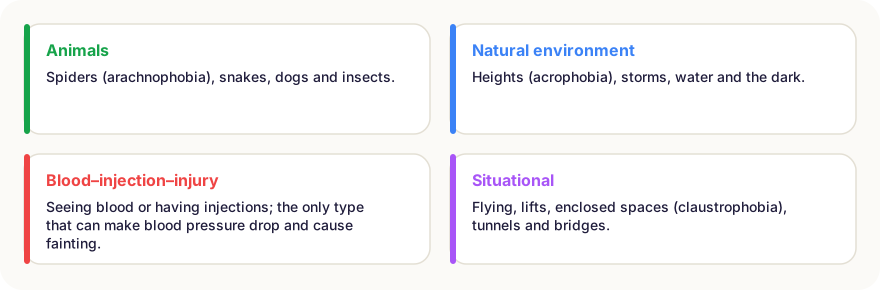
| Type | Examples | Name |
|---|---|---|
| Animals | Spiders, snakes, dogs, insects | Arachnophobia (spiders), ophidiophobia (snakes) |
| Natural environment | Heights, storms, water, darkness | Acrophobia (heights) |
| Blood–injection–injury | Blood, needles, medical procedures | Hemophobia, trypanophobia |
| Situational | Flying, lifts, tunnels, enclosed spaces | Claustrophobia (enclosed spaces), aviophobia (flying) |
Fear of public places and crowds (agoraphobia) and fear of being judged by others (social anxiety disorder) are related but are classified separately, because they are broader and work somewhat differently.
Why spiders and not cars?
Here is a puzzle. Cars, electrical sockets and cigarettes kill far more people today than spiders or snakes. Yet phobias of spiders, snakes, heights and the dark are common, while phobias of cars are rare. Why?
In 2001, psychologists Arne Öhman and Susan Mineka brought together a large body of evidence for preparedness: evolution has prepared the human brain to learn fears of threats that endangered our ancestors for millions of years. In experiments, people and monkeys learn to fear pictures of snakes and spiders faster than pictures of flowers or mushrooms, and those fears are harder to unlearn. Laboratory-raised monkeys that had never seen a snake quickly developed a fear of snakes after watching other monkeys react with fear, but not of flowers shown in the same way.
In other words, we are not born with phobias, but we are born ready to learn certain fears easily.
How a phobia forms and persists
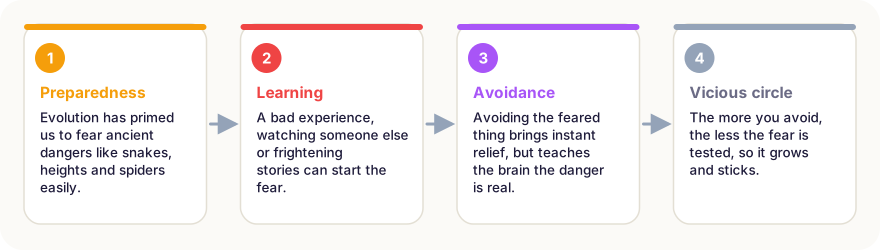
Psychologists describe several routes into a phobia:
- A direct bad experience, such as being bitten by a dog or stuck in a lift.
- Observation: watching a parent scream at a spider can teach a child that spiders are dangerous.
- Information: frightening stories, warnings or films.
Not everyone who has these experiences develops a phobia. Genes, temperament and stress all play a role.
The key to why a phobia lasts is avoidance. Every time a person avoids the feared thing, they feel instant relief. The brain treats that relief as a reward and concludes: “Good thing we escaped, it really was dangerous.” Because the fear is never tested, the person never learns that nothing bad would have happened. The fear grows, and the circle of avoided places and situations widens.
Exposure therapy: facing the fear step by step
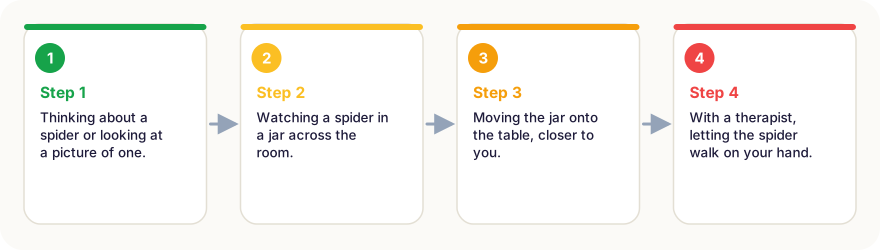
The good news is that specific phobias are among the most treatable mental health problems. A 2008 meta-analysis by Kate Wolitzky-Taylor and colleagues found that exposure-based treatments worked better than other psychological approaches.
In exposure therapy, the person, guided by a therapist, approaches the feared thing gradually, starting with something mildly scary, such as a picture of a spider, and moving up a “fear ladder”. At each step they stay until the anxiety naturally fades. The brain learns something new: “I was close to it and nothing terrible happened.” This new learning gradually overrides the old fear.
Exposure can also be done with virtual reality, which is useful for fears of flying or heights. Some treatments squeeze the whole process into one long session of a few hours, with good results for many people.
When to seek help
Many people live with mild fears without problems. It is worth seeing a professional if a fear makes you avoid important things, such as medical care, travel, work or time with family, or if it causes panic attacks. Treatment is usually short and effective; avoidance, by contrast, tends to make phobias worse over time.
In short
- A phobia is an intense, lasting fear out of proportion to the real danger.
- Specific phobias are very common and usually start in childhood.
- Evolution has prepared us to learn fears of snakes, spiders and heights quickly.
- Phobias can start with a bad experience, observing others or frightening information.
- Avoidance brings relief but keeps the phobia alive.
- Exposure therapy, facing the fear step by step, is the most effective treatment.
Frequently asked questions
What is the difference between a fear and a phobia?
Fear is a normal, useful reaction to danger. A phobia is a fear that is excessive, lasts for months, and leads to avoidance or distress that interferes with everyday life.
What is the most common phobia?
Specific phobias of animals, such as spiders, snakes or dogs, and of heights are among the most common. Fear of public speaking is also very widespread but is usually classed under social anxiety.
Can phobias go away on their own?
Some childhood fears fade naturally, but phobias in adults often persist for years because avoidance keeps them going. Treatment, especially exposure therapy, is usually much faster.
How long does phobia treatment take?
Often surprisingly short. Many specific phobias improve markedly within a few sessions of exposure therapy, and some studies have used a single session of about three hours.
Sources
- Öhman & Mineka (2001) – Fears, phobias, and preparedness: toward an evolved module of fear and fear learning, Psychological Review
- Eaton, Bienvenu & Miloyan (2018) – Specific phobias, The Lancet Psychiatry
- Wolitzky-Taylor et al. (2008) – Psychological approaches in the treatment of specific phobias: a meta-analysis, Clinical Psychology Review
This article is based on peer-reviewed research and publications from trusted institutions, and it is reviewed regularly. How we work →
You might also wonder
All in Brain & Mind →
Why Does Music Give You Chills? The Brain Science of Goosebumps from a Song
That shiver during a great song is frisson. How surprise, dopamine and the brain’s reward system turn music into goosebumps, and why not everyone feels it.

Why Do We Laugh? The Surprising Science of Laughter
Most laughter has nothing to do with jokes. Why we laugh far more with others, why laughter is contagious, how it relieves pain, and why apes laugh too.

Why Do We Procrastinate? It’s About Feelings, Not Laziness
Procrastination isn’t a time-management problem: it’s a way of escaping bad feelings. What science says about why we delay and the tricks that help.

Why Does Time Fly When You’re Having Fun? The Psychology of Time
An hour with friends vanishes while a boring meeting drags on. Why our sense of time stretches and shrinks, and why holidays seem long afterwards.

Can You Remember Things That Never Happened? How False Memories Form
Memory is not a video recording. Classic experiments show how a single word can change what people remember, and how vivid false memories can be created.

Why Do We Cry? The Science of Emotional Tears
Humans are the only animals known to cry emotional tears. The three kinds of tears, why we cry when sad or happy, and whether crying really helps.