Why Do We Laugh? The Surprising Science of Laughter
Most laughter has nothing to do with jokes. Why we laugh far more with others, why laughter is contagious, how it relieves pain, and why apes laugh too.
Short answer
We laugh mainly to connect with other people. Laughter is about 30 times more likely when we are with others than when we are alone, and most of it follows ordinary remarks rather than jokes. It signals friendliness, playfulness and that a situation is not serious, which helps groups bond and defuses tension. Laughing together also seems to release endorphins, the brain’s natural painkillers. Laughter is far older than language: great apes laugh when tickled or playing, and the sound probably evolved from the panting breaths of rough-and-tumble play.
In this article (7)
Think about the last time you laughed. Chances are it was not at a brilliant joke. It was probably at something a friend said, a small mishap or a shared look. Laughter is one of the most common things we do, yet for a long time science largely ignored it. Researchers now see it not mainly as a reaction to humour, but as one of our oldest social tools.
Most laughter is not about jokes
In the 1990s the psychologist Robert Provine and his students did something simple: they listened in on people laughing in everyday places such as cafés and shopping centres and noted what happened just before.
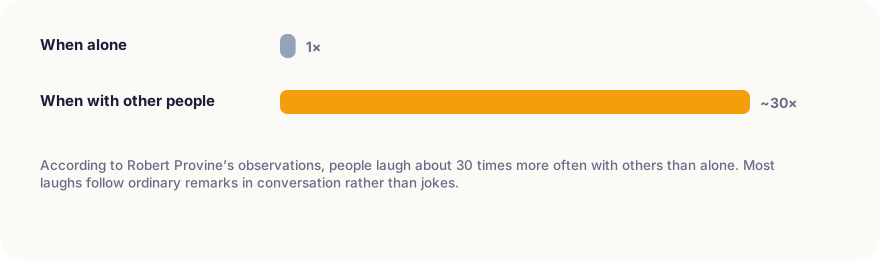
The results were surprising. Only a small fraction of laughs followed anything resembling a joke. Most came after ordinary remarks such as “I’ll see you later” or “Are you sure?” Speakers also laughed more than their listeners. Laughter, Provine concluded, is mainly a way of managing conversations and relationships, not a response to comedy.
A signal that says “we are friends”
Laughter carries several messages at once:
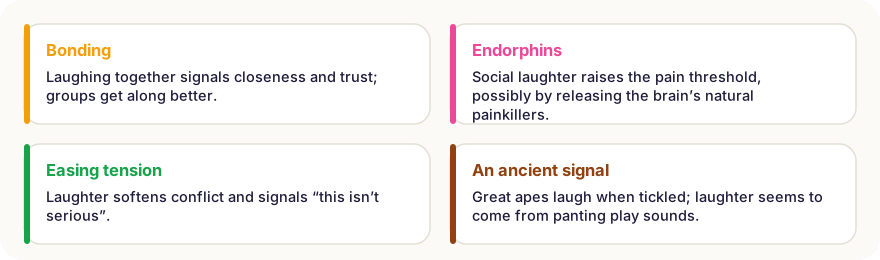
- I like you, and I am not a threat. Laughing with someone signals friendliness and openness.
- This is play, not a fight. Laughter can turn a tense moment or a teasing remark into something harmless.
- We see the world the same way. Sharing a laugh shows shared understanding, which strengthens bonds.
In a 2014 review, neuroscientist Sophie Scott and colleagues described laughter as a social emotion that people use to show affection, agreement and group membership. Couples who laugh together, for example, tend to report being closer.
Laughter and the brain’s painkillers
Laughing hard is physically demanding. It involves repeated, forceful exhalations that work the diaphragm and chest muscles. Psychologist Robin Dunbar suspected that this might trigger the release of endorphins, the body’s own opioid painkillers, which also play a role in social bonding.
In 2011 his team showed people comedy videos in groups and then tested how long they could tolerate an uncomfortable cold or tight sleeve. After laughing together, participants could withstand more discomfort than after watching neutral videos. The effect suggests that laughter helps release feel-good chemicals that make us feel closer to the people we laugh with.
Why laughter is contagious
Hearing someone laugh makes us more likely to laugh ourselves. Brain-imaging studies show that the sound of laughter activates regions involved in preparing facial movements, priming us to join in. That is why a room full of laughing people is so infectious, and why television comedies use laugh tracks.
The effect is strongest with people we know. Laughter from a friend spreads more easily than laughter from a stranger.
Apes and rats laugh too
Laughter is much older than language. Chimpanzees, bonobos, gorillas and orangutans make breathy, panting sounds when they are tickled or playing rough-and-tumble games.
In 2009 Marina Davila Ross and colleagues recorded tickle-induced vocalisations from young apes and human infants and compared them. The pattern of similarities matched the family tree of the great apes, suggesting that laughter evolved from a shared ancestor more than ten million years ago. Human laughter differs mainly in that we laugh while breathing out, in a series of short “ha-ha” bursts, while apes often pant in and out.
Even rats seem to have a version. Neuroscientist Jaak Panksepp found that young rats make high-pitched chirps when tickled and actively seek out more tickling.
Real laughter and polite laughter
Not all laughter is the same. Spontaneous laughter, which bursts out when something is genuinely funny or joyful, is controlled by older, emotional brain systems. Polite or social laughter, the chuckle we give to show we are listening, is more deliberate and relies on brain areas involved in voluntary movement.
People are surprisingly good at telling the two apart. Genuine laughter tends to be higher-pitched, more irregular and breathier.
In short
- Most laughter follows ordinary remarks, not jokes.
- We laugh about 30 times more with other people than alone.
- Laughter signals friendliness, play and shared understanding, strengthening bonds.
- Laughing together may release endorphins, raising the pain threshold.
- Laughter is contagious, especially among friends.
- It is ancient: great apes laugh when tickled, and even rats chirp with pleasure.
Frequently asked questions
Why is laughter contagious?
Hearing laughter activates brain areas that prepare our own face muscles to smile and laugh. This priming makes it easy to join in, which is why laugh tracks and laughing friends make things seem funnier.
Why can’t I stop laughing at the wrong moment?
Laughter is partly an involuntary response, controlled by older brain systems. Trying to suppress it in tense or formal settings can make the urge stronger, especially if someone else starts laughing too.
Is laughter really good for your health?
Laughter can relax muscles, raise the pain threshold and strengthen social bonds, which are linked to better health. But claims that laughter cures illness are exaggerated; it is a helpful extra, not a treatment.
What is the difference between real and fake laughter?
Spontaneous laughter is controlled by different brain pathways from deliberate, polite laughter. Listeners can usually tell the difference; real laughter tends to be higher-pitched, more breathy and less controlled.
Sources
- Scott, S. K. et al. (2014). The social life of laughter. Trends in Cognitive Sciences
- Dunbar, R. I. M. et al. (2011). Social laughter is correlated with an elevated pain threshold. Proceedings of the Royal Society B
- Davila Ross, M., Owren, M. J. & Zimmermann, E. (2009). Reconstructing the evolution of laughter in great apes and humans. Current Biology
This article is based on peer-reviewed research and publications from trusted institutions, and it is reviewed regularly. How we work →
You might also wonder
All in Brain & Mind →
Why Do We Procrastinate? It’s About Feelings, Not Laziness
Procrastination isn’t a time-management problem: it’s a way of escaping bad feelings. What science says about why we delay and the tricks that help.

Why Does Time Fly When You’re Having Fun? The Psychology of Time
An hour with friends vanishes while a boring meeting drags on. Why our sense of time stretches and shrinks, and why holidays seem long afterwards.
What Is Déjà Vu? The Science Behind “I’ve Been Here Before”
Why does déjà vu happen? The brain processes and memory theories behind the feeling of having lived a moment before — and when déjà vu can be a warning sign.
Why Do We Dream? What Science Knows About Dreams
What are dreams for, and why do we forget most of them? What the brain does during sleep and the strongest scientific theories about the purpose of dreaming.
Why Do Songs Get Stuck in Your Head? The Science of Earworms
Why does a song loop in your mind for days? How earworms form, which songs stick the most, and the research-backed ways to get rid of them.
Why Do We Forget? The Forgetting Curve and Science-Backed Ways to Remember
Why do we forget what we learn so quickly? Ebbinghaus’s forgetting curve, the main reasons for forgetting, and the study methods that make memories last.