What Is Déjà Vu? The Science Behind “I’ve Been Here Before”
Why does déjà vu happen? The brain processes and memory theories behind the feeling of having lived a moment before — and when déjà vu can be a warning sign.
Short answer
Déjà vu is the feeling that a new moment is familiar. The leading explanation is that the situation resembles an earlier experience you cannot consciously recall: the brain registers a signal of familiarity but cannot find its source, producing a brief, strange sensation. About two-thirds of healthy people experience it at least once.
In this article (7)
You walk into a café for the first time, and suddenly everything feels familiar — the layout of the tables, the light, even the sentence the person next to you just said. The feeling that “I’ve lived this before” lasts a few seconds and vanishes as quickly as it came. It is called déjà vu, French for “already seen”.
How common is déjà vu?
Déjà vu is far more common than many people think. According to psychologist Alan Brown’s comprehensive review of decades of research:
- About two-thirds of people experience déjà vu at least once in their lives.
- It is most frequent between the ages of 15 and 25 and declines with age.
- It occurs more often when people are tired or stressed.
- People who travel a lot, see more new places and often remember their dreams report it more often.
The strangest thing about déjà vu is that people know the feeling is wrong. The sense of familiarity is strong, yet logic insists “I have never been here”. That conflict is what separates déjà vu from an ordinary memory error.
Two different routes to recognition
To understand déjà vu, it helps to know that the brain recognises things in two different ways:

- Recollection: retrieving a memory with details. “I met this person at Sarah’s wedding last summer.”
- Familiarity: a sense of knowing without details. “I know this face from somewhere — but where?”
Normally the two work together. When something feels familiar, the brain looks for the source and usually finds it. Déjà vu is thought to be what happens when a familiarity signal arrives but its source cannot be found.
The leading theory: a forgotten resemblance
Psychologist Anne Cleary at Colorado State University is one of the researchers who have managed to produce déjà vu in the lab. Her team showed volunteers a series of scenes in virtual reality, then later presented new scenes with the same layout but completely different content — the arrangement of a junkyard, for instance, repeated in a garden scene.
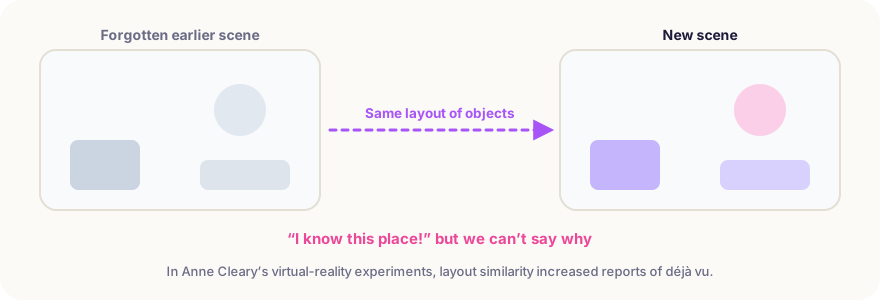
The results were striking:
- Even when participants did not consciously recall that a new scene resembled an old one, they reported déjà vu more often in those scenes.
- What triggered the feeling was not the objects but the spatial layout — how things were arranged relative to each other.
This suggests déjà vu is a “hidden resemblance” effect. The café may resemble a place you visited years ago and forgot. Your brain picks up the similarity, cannot locate its source, and declares: “I know this place.”
“I knew what would happen next”
During déjà vu, many people feel they could predict what comes next. In a 2018 study, Cleary and Claxton tested this too: participants experiencing déjà vu in a virtual scene were asked which way the path would turn next.
They felt highly confident about their predictions — but were no better than chance. The “premonitions” of déjà vu are not real foresight but an illusion created by the feeling of familiarity. That illusion helps explain why déjà vu is so often linked to the paranormal.
Other explanations
Scientists have proposed other models as well:
- Delayed processing: Information about a scene might reach two brain pathways a fraction of a second apart, so the brain treats the second arrival as a “repeat”. The idea is appealing but has limited experimental support.
- A memory-checking system: Some brain-imaging studies suggest that frontal regions involved in decision-making and monitoring become active during déjà vu. That hints déjà vu may be a moment when the brain catches and corrects a false familiarity signal — which could also explain why it becomes rarer with age.
When can déjà vu be a warning sign?
In healthy people, déjà vu is harmless. In some cases, however, it can point to a medical issue. In people with temporal lobe epilepsy, déjà vu can appear as an “aura” at the start of a seizure.
It is worth seeing a neurologist if:
- déjà vu happens very often, for example every day;
- it comes with brief lapses of awareness or staring spells;
- it is accompanied by strange smells or tastes, nausea or involuntary movements.
In short
Déjà vu is a harmless memory illusion that occurs when the brain’s familiarity system produces a signal whose source it cannot find — most likely because the moment resembles an earlier experience you do not remember. That “I’ve been here before” feeling is not a glimpse of the future, but a fascinating side effect of the brain checking its own memory.
Frequently asked questions
Does déjà vu mean you can predict the future?
No. During déjà vu people often feel they know what will happen next, but experiments show their predictions are no better than chance.
Who experiences déjà vu most often?
It is most common between the ages of 15 and 25 and becomes rarer with age. Tiredness, stress and frequent travel can make it more likely.
Is déjà vu a symptom of illness?
Usually it is completely harmless. If it happens very often and comes with confusion, strange smells or involuntary movements, it can be a sign of temporal lobe epilepsy — in that case, see a neurologist.
Sources
- Brown (2003) – A review of the déjà vu experience, Psychological Bulletin
- Cleary (2008) – Recognition Memory, Familiarity, and Déjà vu Experiences, Current Directions in Psychological Science
- Cleary & Claxton (2018) – Déjà Vu: An Illusion of Prediction, Psychological Science
This article is based on peer-reviewed research and publications from trusted institutions, and it is reviewed regularly. How we work →
You might also wonder
All in Brain & Mind →
Why Do We Laugh? The Surprising Science of Laughter
Most laughter has nothing to do with jokes. Why we laugh far more with others, why laughter is contagious, how it relieves pain, and why apes laugh too.

Why Do We Procrastinate? It’s About Feelings, Not Laziness
Procrastination isn’t a time-management problem: it’s a way of escaping bad feelings. What science says about why we delay and the tricks that help.

Why Does Time Fly When You’re Having Fun? The Psychology of Time
An hour with friends vanishes while a boring meeting drags on. Why our sense of time stretches and shrinks, and why holidays seem long afterwards.

Can You Remember Things That Never Happened? How False Memories Form
Memory is not a video recording. Classic experiments show how a single word can change what people remember, and how vivid false memories can be created.
Why Do We Cry? The Science of Emotional Tears
Humans are the only animals known to cry emotional tears. The three kinds of tears, why we cry when sad or happy, and whether crying really helps.
Why Does My Voice Sound Different on Recordings? Blame Your Skull
Your recorded voice sounds higher and thinner because you normally hear yourself partly through bone. Why recordings feel strange and how to adapt.