Why Do We Cry? The Science of Emotional Tears
Humans are the only animals known to cry emotional tears. The three kinds of tears, why we cry when sad or happy, and whether crying really helps.

Short answer
We cry for several reasons. Basal tears keep the eyes moist, and reflex tears wash away irritants like smoke or onion fumes. Emotional tears, shed in sadness, joy, anger or relief, appear to be uniquely human. Scientists think they serve mainly social purposes: tears are a powerful signal that we are in distress, which can draw comfort and help from others and soften conflict. Crying may also help us calm down by activating the parasympathetic nervous system. A 2011 study even found that women’s emotional tears contain a chemical signal that lowered testosterone in men who sniffed them. Crying does not always bring relief, however.
In this article (6)
A sad film, a goodbye at the airport, a wedding speech, a piece of music: sometimes tears come before we can stop them. Babies cry from their first breath, and adults still cry in every culture on Earth. Yet humans seem to be the only animals that cry because of their feelings. Why did we evolve to do this?
Three kinds of tears
Tears are made by the lacrimal glands above each eye, and not all tears are the same:
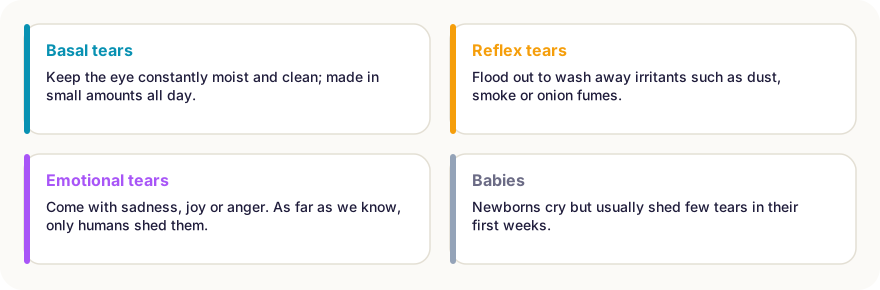
- Basal tears keep the surface of the eye moist, clean and nourished all day long. Every blink spreads a thin film.
- Reflex tears pour out when something irritates the eye: dust, smoke, wind, or the sulphur compounds released by chopping onions. They wash the irritant away.
- Emotional tears come with sadness, grief, joy, anger, frustration or relief. As far as we know, only humans shed them.
Many animals make tears to protect their eyes, and many make distress calls, but there is no good evidence that any other species weeps from emotion.
Why cry? A signal to others
Charles Darwin thought emotional tears had no purpose, merely a side effect of tightening the muscles around the eyes. Modern researchers disagree. The leading idea is that tears are a social signal.
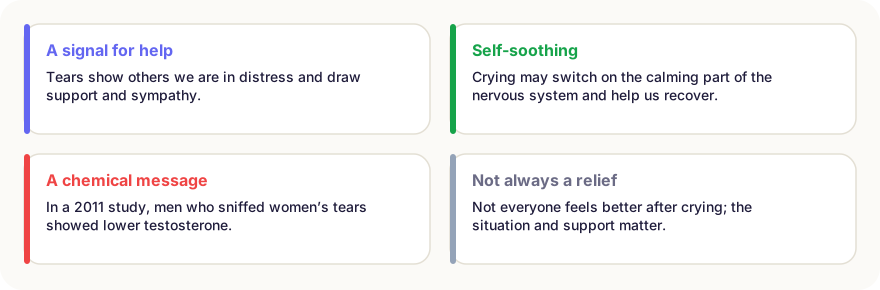
Tears are a very visible, hard-to-fake sign that someone is in distress or overwhelmed. In studies, faces with tears are judged as sadder and more in need of help than the same faces without tears, and people feel more willing to comfort them. Tears may also calm conflict: it is hard to stay angry at someone who is crying.
This makes sense from the start of life. A baby cannot survive without adults, and crying is its most powerful way to call for care. Interestingly, newborns usually cry with few tears in their first weeks; emotional tears develop as babies grow.
Does crying make you feel better?
Many people say that a “good cry” brings relief. In a 2014 review, psychologists Asmir Gračanin, Lauren Bylsma and Ad Vingerhoets looked at the evidence. They found signs that crying can be self-soothing: after an initial rise in arousal, it may activate the parasympathetic nervous system, the body’s calming system, slowing breathing and heart rate.
But the effect is not guaranteed. People tend to feel better after crying when they receive comfort and support, or when the situation that made them cry is resolved. Crying alone, or in front of people who react badly, can leave people feeling worse.
A chemical message?
Tears may carry a hidden message too. In a 2011 study, Noam Sobel’s team at the Weizmann Institute collected emotional tears from women watching sad films. Men who sniffed these tears, without knowing what they were, showed lower testosterone and reduced sexual arousal compared with men who sniffed salt water. The tears were odourless, so the effect seemed to be a chemical signal. The finding is intriguing, and researchers are still exploring what it means.
Who cries more?
Crying varies a lot between people. On average, women in many countries report crying more often than men. That difference probably reflects both biology and social expectations about when it is acceptable to cry. Crying very often, or being unable to cry at all, can sometimes be linked to depression or other conditions.
In short
- There are three kinds of tears: basal, reflex and emotional.
- Emotional tears appear to be unique to humans.
- Their main role is probably as a social signal that draws comfort and help.
- Crying may be self-soothing, activating the body’s calming system.
- Relief is more likely with support; crying does not always help.
- A 2011 study found emotional tears may carry a chemical signal.
Frequently asked questions
Do animals cry?
Many animals produce tears to protect their eyes and make distress calls, but there is no good evidence that any other animal sheds tears in response to emotions as humans do.
Why do we cry when we are happy?
Strong emotions of any kind activate the same brain and nerve systems. Tears of joy often come at moments of overwhelming feeling, such as reunions or weddings, and may help us regain emotional balance.
Is crying good for you?
Many people feel better after crying, especially when they receive comfort. But studies show the effect depends on the situation: crying alone or in an unsupportive setting does not always bring relief.
Why do some people cry more than others?
Crying frequency varies with personality, mood, culture and sex. On average, women report crying more often than men in many countries, which may reflect both biology and social norms.
Sources
- Gračanin, A., Bylsma, L. M. & Vingerhoets, A. J. J. M. (2014). Is crying a self-soothing behavior? Frontiers in Psychology
- Gelstein, S. et al. (2011). Human tears contain a chemosignal. Science
This article is based on peer-reviewed research and publications from trusted institutions, and it is reviewed regularly. How we work →
You might also wonder
All in Brain & Mind →
Why Do We Laugh? The Surprising Science of Laughter
Most laughter has nothing to do with jokes. Why we laugh far more with others, why laughter is contagious, how it relieves pain, and why apes laugh too.

Why Do We Procrastinate? It’s About Feelings, Not Laziness
Procrastination isn’t a time-management problem: it’s a way of escaping bad feelings. What science says about why we delay and the tricks that help.

Why Does Time Fly When You’re Having Fun? The Psychology of Time
An hour with friends vanishes while a boring meeting drags on. Why our sense of time stretches and shrinks, and why holidays seem long afterwards.

Can You Remember Things That Never Happened? How False Memories Form
Memory is not a video recording. Classic experiments show how a single word can change what people remember, and how vivid false memories can be created.

Why Does My Voice Sound Different on Recordings? Blame Your Skull
Your recorded voice sounds higher and thinner because you normally hear yourself partly through bone. Why recordings feel strange and how to adapt.
What Is Déjà Vu? The Science Behind “I’ve Been Here Before”
Why does déjà vu happen? The brain processes and memory theories behind the feeling of having lived a moment before — and when déjà vu can be a warning sign.