Can You Remember Things That Never Happened? How False Memories Form
Memory is not a video recording. Classic experiments show how a single word can change what people remember, and how vivid false memories can be created.

Short answer
Yes. Memory does not work like a video recording; each time we remember something, the brain rebuilds it from pieces and fills gaps with expectations and later information. That makes it possible to remember details, or even whole events, that never happened. In a famous 1974 experiment, Elizabeth Loftus and John Palmer showed people a film of a car crash: those asked how fast the cars were going when they “smashed” into each other gave higher speeds and were later more than twice as likely to recall broken glass that was not there. Feeling confident about a memory does not prove it is accurate.
In this article (6)
You may be certain that you remember exactly where you were during an important event, what someone said at a family dinner, or how a childhood holiday went. Yet psychology has shown again and again that confident, vivid memories can be wrong, and that it is surprisingly easy to remember things that never happened.
Memory is rebuilt, not replayed
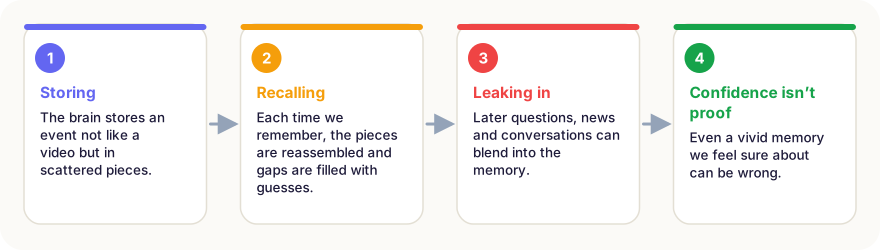
It is tempting to think of memory as a video recorder: an event is filmed and stored, and later we press play. The brain does not work that way. An experience is broken into pieces, sights, sounds, feelings, meanings, stored in different networks. When we remember, the brain reassembles these pieces, filling in gaps with what it expects or knows about similar situations.
Each time a memory is recalled, it can be updated. Information we learn later, from questions, conversations, photos or news, can blend in. Usually this works well enough for everyday life. But it means memory is reconstructive, and reconstruction can go wrong.
One word changes the memory
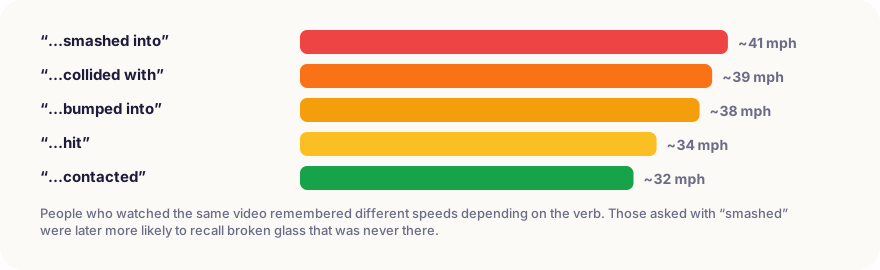
In 1974, psychologists Elizabeth Loftus and John Palmer showed students films of car accidents and then asked: “About how fast were the cars going when they ___ each other?” The blank was filled with different verbs: smashed, collided, bumped, hit or contacted.
The word mattered. People asked about cars that “smashed” estimated an average of about 41 mph, while those asked about cars that “contacted” estimated about 32 mph, after watching exactly the same film.
A week later, the researchers asked another question: “Did you see any broken glass?” There was no broken glass in the film. But 32% of those who had heard “smashed” said yes, compared with 14% of those who had heard “hit”. A single word had changed not just their judgement, but what they remembered seeing.
Remembering words that weren’t there
In 1995, Henry Roediger and Kathleen McDermott revived a simple test. People heard lists of related words, such as bed, rest, awake, tired, dream, snooze, blanket. The word sleep was never on the list. Yet when asked to recall or recognise the words, many people confidently “remembered” hearing sleep, often as frequently as they remembered words that were actually presented.
Implanting whole events
Later studies went further. In the “lost in the mall” study of the 1990s, Loftus and colleagues gave adults short descriptions of childhood events supplied by their relatives, plus one invented story about getting lost in a shopping centre. After repeated interviews, about a quarter of participants came to remember the false event, some with vivid details.
Why it matters
False memories are not lies; people genuinely believe them. That has serious consequences:
- Eyewitness testimony can be shaped by leading questions, line-ups and media reports. Mistaken identifications have contributed to many wrongful convictions.
- Shared false memories, sometimes called the Mandela effect, show how expectations and repetition can lead many people to remember the same wrong detail.
- Confidence is not proof: a vivid, emotional memory can still be inaccurate.
The good news is that knowing how memory works helps. Police and courts in many countries now use interview techniques designed to avoid leading questions, and keeping notes, photos and records protects our own memories from slowly drifting.
In short
- Memory is reconstructed each time we recall it, not replayed like a video.
- Later information can blend into and change a memory.
- In 1974, the word “smashed” raised speed estimates and false reports of broken glass.
- People often “remember” words never presented in related word lists.
- Researchers have implanted memories of whole events that never happened.
- Confident memories can still be wrong, which matters for eyewitnesses.
Frequently asked questions
Are false memories the same as lying?
No. A person with a false memory genuinely believes it happened. False memories form through normal memory processes, not deliberate deception.
What is the Mandela effect?
It is a popular name for shared false memories, where many people remember something the same wrong way, such as a famous logo or film quote. It is usually explained by ordinary memory errors and expectations.
Why does this matter for courts?
Eyewitness testimony can be influenced by leading questions, news reports and conversations. Mistaken eyewitness identifications have contributed to many wrongful convictions, which is why researchers recommend careful interview methods.
Can I trust my own memories?
Most everyday memories are broadly accurate, especially their gist. But details can shift over time, and vivid, confident memories can still be wrong, especially for events long ago or that we have discussed many times.
Sources
- Loftus, E. F. & Palmer, J. C. (1974). Reconstruction of automobile destruction: an example of the interaction between language and memory. Journal of Verbal Learning and Verbal Behavior
- Roediger, H. L. & McDermott, K. B. (1995). Creating false memories: remembering words not presented in lists. Journal of Experimental Psychology: Learning, Memory, and Cognition
This article is based on peer-reviewed research and publications from trusted institutions, and it is reviewed regularly. How we work →
You might also wonder
All in Brain & Mind →
Why Do We Laugh? The Surprising Science of Laughter
Most laughter has nothing to do with jokes. Why we laugh far more with others, why laughter is contagious, how it relieves pain, and why apes laugh too.

Why Do We Procrastinate? It’s About Feelings, Not Laziness
Procrastination isn’t a time-management problem: it’s a way of escaping bad feelings. What science says about why we delay and the tricks that help.

Why Does Time Fly When You’re Having Fun? The Psychology of Time
An hour with friends vanishes while a boring meeting drags on. Why our sense of time stretches and shrinks, and why holidays seem long afterwards.

Why Do We Cry? The Science of Emotional Tears
Humans are the only animals known to cry emotional tears. The three kinds of tears, why we cry when sad or happy, and whether crying really helps.
Why Does My Voice Sound Different on Recordings? Blame Your Skull
Your recorded voice sounds higher and thinner because you normally hear yourself partly through bone. Why recordings feel strange and how to adapt.
What Is Déjà Vu? The Science Behind “I’ve Been Here Before”
Why does déjà vu happen? The brain processes and memory theories behind the feeling of having lived a moment before — and when déjà vu can be a warning sign.