Why Do We Procrastinate? It’s About Feelings, Not Laziness
Procrastination isn’t a time-management problem: it’s a way of escaping bad feelings. What science says about why we delay and the tricks that help.
Short answer
We procrastinate mainly to avoid unpleasant feelings, not because we are lazy. When a task feels boring, difficult, vague or threatening, thinking about it triggers anxiety, frustration or self-doubt. Putting it off gives instant relief, so the brain learns to repeat the escape, even though it creates more stress later. Researchers describe procrastination as a failure of short-term mood regulation: the immediate wish to feel better wins over our long-term goals. Breaking tasks into small steps, planning exactly when to start and forgiving yourself for past delays all help.
In this article (6)
You sit down to write the report. First you check your email, then make tea, then tidy the desk, then just look at your phone for a minute. Suddenly an hour has gone. Almost everyone knows this pattern. For a long time it was blamed on laziness or poor time management, but research tells a different story.
Almost everyone does it
Procrastination means voluntarily delaying an intended task even though you expect to be worse off for the delay. That last part is crucial: we procrastinate on things we actually want to do.
In 2007 the psychologist Piers Steel reviewed hundreds of studies. He estimated that 80 to 95% of university students procrastinate, and that around 15 to 20% of adults are chronic procrastinators. The problem affects every age group and every culture studied.
The real cause: escaping bad feelings
If procrastinators want to do the task, why don’t they? According to psychologists Fuschia Sirois and Tim Pychyl, the answer is emotion.
Some tasks make us feel bad just thinking about them. They might be boring, difficult, unclear, or carry the risk of failure and judgement. That creates anxiety, frustration, insecurity or plain boredom. Avoiding the task makes those feelings disappear instantly. In Sirois and Pychyl’s words, procrastination gives priority to short-term mood repair over long-term goals.
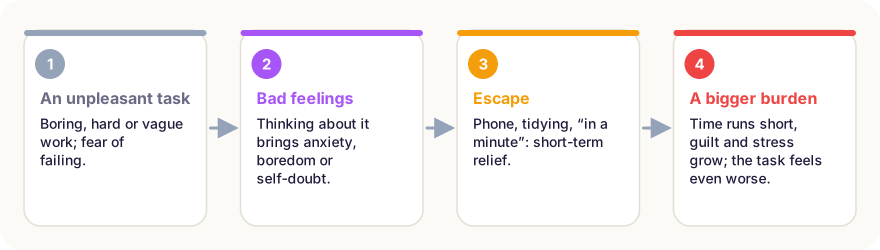
The relief is real, but it does not last. As the deadline approaches, stress and guilt grow, and the task becomes even more unpleasant to face. This makes the next escape even more tempting. Over time the cycle can become a habit.
Why our brain prefers “later”
There is also a deeper reason. Our brains value rewards that come now much more than rewards that come later, a tendency called present bias or temporal discounting. Watching a funny video gives instant pleasure; the benefit of finishing a project lies weeks away and feels abstract.
Steel combined these ideas into what he calls temporal motivation theory. In simple terms, we are most likely to act when:
- we expect to succeed;
- the task feels valuable or rewarding;
- the reward is close in time;
- and we are not too impulsive or easily distracted.
Tasks that feel uncertain, boring and far-off score badly on every count, which is exactly why they get pushed aside.
The cost of putting things off
Procrastination is not harmless. Studies link chronic procrastination with lower grades and work performance, more stress, poorer sleep and even poorer health, partly because people also delay things like seeing a doctor. It also tends to feed negative feelings about oneself, which, ironically, makes further procrastination more likely.
What actually helps
Because procrastination is driven by emotions, the most effective strategies make tasks feel less threatening or make starting easier.
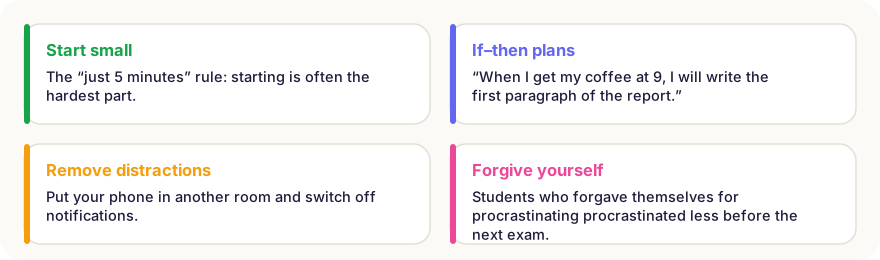
- Make the first step tiny. “Write the report” feels heavy; “open the file and write one sentence” does not. Many people find that once they start, continuing is much easier.
- Plan exactly when and where. “If–then” plans, known as implementation intentions, such as “when I sit down at my desk after lunch, I will read the first page”, make it more likely you will follow through.
- Reduce temptation. Put the phone in another room, block distracting websites or work somewhere with fewer distractions.
- Notice the feeling. Ask yourself what emotion the task triggers. Naming it, for example “this makes me anxious because I might fail”, can make it easier to tolerate.
- Forgive yourself. In 2010 Michael Wohl, Tim Pychyl and Shannon Bennett found that students who forgave themselves for procrastinating before a first exam procrastinated less before the second. Self-criticism adds bad feelings; self-compassion takes some away.
In short
- Procrastination is delaying a task you intend to do, despite knowing it will cost you.
- It is extremely common: up to 95% of students do it.
- The main driver is escaping unpleasant feelings, not laziness.
- Our brains favour immediate rewards, which makes distant goals easy to postpone.
- Tiny first steps, if–then plans, fewer distractions and self-forgiveness help break the cycle.
Frequently asked questions
How common is procrastination?
Very common. A large review estimated that 80 to 95% of university students procrastinate at least sometimes, and around a fifth of adults describe themselves as chronic procrastinators.
Is procrastination the same as laziness?
No. A lazy person does not want to do the task and does not care. A procrastinator usually wants and intends to do it and feels bad about delaying, but avoids it because of the emotions it triggers.
Can procrastination be a sign of ADHD or depression?
It can be one feature among many, but most procrastination is not a disorder. If delays seriously harm your work, studies or health and come with other symptoms, it is worth talking to a professional.
Does working under pressure really make you more productive?
Some people feel energised by deadlines, but studies generally find that chronic procrastination is linked to lower performance, more stress and poorer health, not better results.
Sources
- Steel, P. (2007). The nature of procrastination: a meta-analytic and theoretical review of quintessential self-regulatory failure. Psychological Bulletin
- Sirois, F. & Pychyl, T. (2013). Procrastination and the priority of short-term mood regulation. Social and Personality Psychology Compass
- Wohl, M. J. A., Pychyl, T. A. & Bennett, S. H. (2010). I forgive myself, now I can study. Personality and Individual Differences
This article is based on peer-reviewed research and publications from trusted institutions, and it is reviewed regularly. How we work →
You might also wonder
All in Brain & Mind →
Why Do We Laugh? The Surprising Science of Laughter
Most laughter has nothing to do with jokes. Why we laugh far more with others, why laughter is contagious, how it relieves pain, and why apes laugh too.
Why Does Time Fly When You’re Having Fun? The Psychology of Time
An hour with friends vanishes while a boring meeting drags on. Why our sense of time stretches and shrinks, and why holidays seem long afterwards.
What Is Déjà Vu? The Science Behind “I’ve Been Here Before”
Why does déjà vu happen? The brain processes and memory theories behind the feeling of having lived a moment before — and when déjà vu can be a warning sign.
Why Do We Dream? What Science Knows About Dreams
What are dreams for, and why do we forget most of them? What the brain does during sleep and the strongest scientific theories about the purpose of dreaming.
Why Do Songs Get Stuck in Your Head? The Science of Earworms
Why does a song loop in your mind for days? How earworms form, which songs stick the most, and the research-backed ways to get rid of them.
Why Do We Forget? The Forgetting Curve and Science-Backed Ways to Remember
Why do we forget what we learn so quickly? Ebbinghaus’s forgetting curve, the main reasons for forgetting, and the study methods that make memories last.