Why Do We Forget? The Forgetting Curve and Science-Backed Ways to Remember
Why do we forget what we learn so quickly? Ebbinghaus’s forgetting curve, the main reasons for forgetting, and the study methods that make memories last.
Short answer
There is no single cause of forgetting. Some information is never properly stored in the first place, some fades over time, and some gets mixed up with older or newer memories. Often the information is not lost — we just struggle to retrieve it. Ebbinghaus’s famous experiments showed that much of what we learn is forgotten within the first few hours. Spaced repetition and testing yourself are the most effective ways to slow forgetting down.
In this article (5)
The name of someone you met yesterday, exam material a week after the test, why you walked into the kitchen — forgetting is something we all do every day. We usually see it as a flaw. But to scientists, forgetting is not a malfunction of memory; it is a natural part of how memory works. Understanding why we forget also teaches us how to remember better.
Ebbinghaus’s experiment on himself
The first person to measure forgetting scientifically was the 19th-century German psychologist Hermann Ebbinghaus. To stop meaningful words mixing with what he already knew, he invented nonsense syllables such as “DAX”, “BUP” and “ZOL”. He made lists of them and studied each until he could recite it perfectly.
Then he waited for different lengths of time and relearned the lists, measuring how much quicker relearning was than the original learning — the “savings”. His results, published in 1885, became the basis of what we now call the forgetting curve.
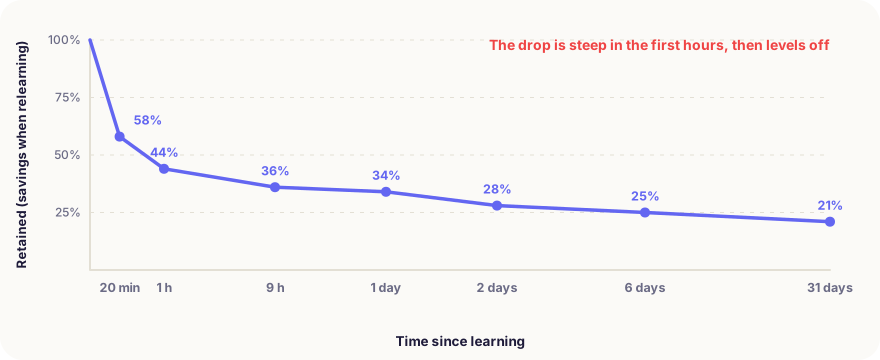
The most striking thing is the shape: forgetting is very fast in the first hours, then slows. In Ebbinghaus’s data, savings fell to 58% after just 20 minutes and to 34% after a day. After a month, they were down to about 21%.
In 2015, researchers at the University of Amsterdam repeated Ebbinghaus’s experiment using the same method and obtained a very similar curve. A 140-year-old finding still holds.
Of course, nonsense syllables are forgotten far more easily than real-world information. We remember meaningful, interesting things linked to what we already know for much longer. But the general shape of the curve shows up in almost every kind of learning.
Why do we forget? Five main reasons
Psychologists do not explain forgetting with a single process. Several mechanisms work together.
1. It was never stored
Sometimes what we “forget” we never learned in the first place. A name heard while our attention was elsewhere never makes it into memory. Try this: draw both sides of a coin you use every day in detail. Most people cannot, because we never pay attention to those details.
2. The trace fades
Unused memories can fade over time — the oldest explanation for forgetting. It is not enough on its own, though, because an ordinary memory from years ago can suddenly come flooding back with a smell or a song.
3. Memories interfere
Research shows that one of the biggest causes of forgetting is interference:
- Old information disrupts new: while learning your new phone number, the old one keeps popping up.
- New information disrupts old: as you learn a new language, you may struggle to recall words from one you learned earlier.
Similar information interferes most. Two similar subjects studied back to back on the same day disrupt each other the most.
4. The information is there but unreachable
Much of what we think we have forgotten is actually still in memory; the problem is retrieval. The tip-of-the-tongue feeling is the best-known example: you know the first letter, the length, even words it sounds like — but not the word itself.
Remembering depends on finding the right cue. That is why recall gets easier when you return to the place where you learned something or are in the same mood.
5. The doorway effect
Walking into a room and forgetting why is a very common experience. Gabriel Radvansky and colleagues at the University of Notre Dame studied it experimentally. Participants carried objects in virtual or real environments; after walking through a doorway, they found it harder to remember what they were carrying than people who walked the same distance within one room.
The researchers suggest the brain treats doorways as event boundaries. When a new scene begins, information from the previous one is “archived” and becomes harder to access.
Forgetting is actually useful
You might think it would be great to remember everything. But forgetting has real benefits:
- It filters out trivia: your brain prefers to keep who you talked to at lunch, not how many forks were on the table.
- It prioritises current information: forgetting where you parked last week makes it easier to remember where you parked today.
- It enables generalisation: letting go of details helps us draw common lessons from experiences.
The very rare people who forget almost nothing describe it as sometimes exhausting and overwhelming.
Science-backed ways to slow forgetting
The good news: the forgetting curve can be bent. Psychology research shows several methods are especially effective.
Spaced repetition
Instead of studying something once for a long time, reviewing it several times with gaps in between produces far more durable learning. A large 2006 analysis combining hundreds of studies confirmed that this effect is extremely robust.
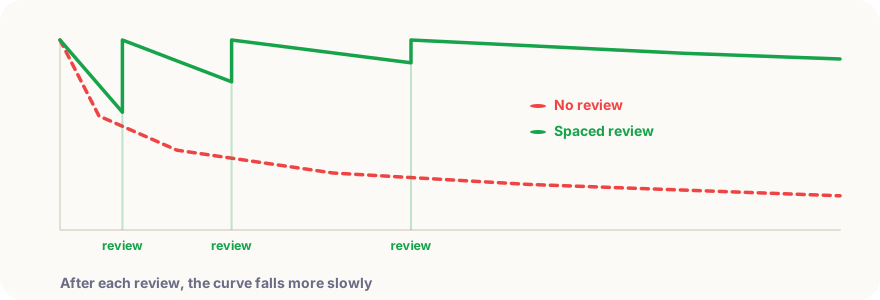
After each review the memory becomes sturdier, and you can wait longer before the next one. Reviewing something the day after learning it, then three days later, then a week later is a good start. Many language-learning apps work on this principle.
Testing yourself
In 2006, Henry Roediger and Jeffrey Karpicke at Washington University in St. Louis split students into two groups. One group reread a text several times; the other read it once and then tried to write down everything they remembered.
In the short term, the rereaders did slightly better. But a week later, the self-testing group remembered far more. This is called the testing effect: the act of trying to recall strengthens the path to the memory.
| Method | Short term | Long term |
|---|---|---|
| Rereading | Feels familiar; we think we have learned it | Quickly forgotten |
| Highlighting | Not very effective | Not very effective |
| Testing yourself (flashcards, practice questions) | Feels harder | Much more durable |
| Spaced repetition | Needs planning | Much more durable |
Making meaning and connections
Linking new information to what you already know gives you more than one route to it. Explaining a concept in your own words, finding examples or teaching it to someone else all strengthen memory.
Sleeping well
During sleep the brain replays what it learned during the day and transfers it into long-term memory. People who sleep after learning remember more than those who stay awake for the same time — which is why pulling an all-nighter before an exam often backfires. We cover this in our article Why do we dream?.
In short
We forget for different reasons: information is never stored, fades over time, gets mixed up with other memories or becomes hard to retrieve. Ebbinghaus’s forgetting curve shows that we lose much of what we learn in the first hours. But spaced repetition, self-testing, making connections and good sleep can slow the curve dramatically. Forgetting is not the enemy of memory — it is part of how memory selects what matters.
Frequently asked questions
Is forgetting a bad thing?
No. Forgetting is part of how a healthy brain works. By discarding unimportant details, the brain makes room for important information and makes it easier to generalise.
Why is a word on the tip of my tongue but I can’t recall it?
This is the tip-of-the-tongue phenomenon. The information is in memory but the route to it is temporarily blocked. We often remember the first letter or number of syllables, and the word tends to pop up a little later.
Does sleep strengthen memory?
Yes. During sleep the brain replays what was learned during the day and transfers it into long-term memory. Sleeping well after learning improves recall markedly compared with staying awake.
When should I see a doctor about forgetfulness?
If forgetfulness disrupts daily life, or you get lost or fail to recognise familiar places or people, see a professional. Occasionally forgetting where you left your keys is normal.
Sources
- Murre & Dros (2015) – Replication and Analysis of Ebbinghaus’ Forgetting Curve, PLOS ONE
- Roediger & Karpicke (2006) – Test-Enhanced Learning, Psychological Science
- Cepeda et al. (2006) – Distributed practice in verbal recall tasks, Psychological Bulletin
- Radvansky et al. (2011) – Walking through doorways causes forgetting, Quarterly Journal of Experimental Psychology
This article is based on peer-reviewed research and publications from trusted institutions, and it is reviewed regularly. How we work →
You might also wonder
All in Brain & Mind →
What Is Déjà Vu? The Science Behind “I’ve Been Here Before”
Why does déjà vu happen? The brain processes and memory theories behind the feeling of having lived a moment before — and when déjà vu can be a warning sign.

Why Do We Dream? What Science Knows About Dreams
What are dreams for, and why do we forget most of them? What the brain does during sleep and the strongest scientific theories about the purpose of dreaming.
Why Do Songs Get Stuck in Your Head? The Science of Earworms
Why does a song loop in your mind for days? How earworms form, which songs stick the most, and the research-backed ways to get rid of them.

Why Can’t You Tickle Yourself? Your Brain’s Prediction Machine
Someone else’s fingers leave you helpless with laughter, but your own do nothing. The reason is your brain predicting the result of your own movements.

Why Is the Night Sky Dark? Olbers’ Paradox and the Age of the Universe
With billions of stars out there, why isn’t the night sky ablaze with light? Olbers’ paradox, the finite age of the universe and cosmic expansion, explained.
Why Do Leaves Change Colour in Autumn? The Science of Yellow, Orange and Red
Why do leaves turn yellow or red in autumn, and why do trees drop them? The pigments in leaves, colourful autumns and why America is redder than Europe.