Why Can’t You Tickle Yourself? Your Brain’s Prediction Machine
Someone else’s fingers leave you helpless with laughter, but your own do nothing. The reason is your brain predicting the result of your own movements.

Short answer
When you move, your brain — especially the cerebellum — predicts the sensation the movement will produce. When the predicted sensation arrives, the brain treats it as unimportant and dampens it. Touching yourself is completely predictable, so it feels weak and does not tickle. When someone else touches you, the sensation is unexpected and is felt at full strength.
In this article (9)
The moment a friend’s fingers head for your ribs, you start to squirm — you may even laugh before they touch you. Yet make exactly the same movement with your own hand and nothing happens. That small mystery opens a door onto one of the cleverest systems in the brain.
What exactly is tickling?
Scientists divide tickling into two types:

- Knismesis: the light, itchy feeling of a feather or an insect walking across the skin. It is found in many animals and is probably an ancient warning system that helps us notice parasites and bugs.
- Gargalesis: the laughter-inducing tickle caused by firmer, repeated pressure on the armpits, ribs or soles. It is seen in humans and some other mammals, notably apes and rats.
It is the second type we cannot do to ourselves. Brush a feather across your own lip and you may feel a slight itch, but however much you poke your own ribs, you will not burst out laughing.
The brain predicts the future
The answer lies in a prediction mechanism in the brain’s movement system. When you decide to move your arm, the brain sends a command to your muscles. A copy of that command also goes elsewhere — mostly to the cerebellum, at the lower back of the brain.
The cerebellum uses the copy to work out: “What will this movement feel like?” Then, when the real sensation arrives from the skin, it compares the two:
- If the sensation matches the prediction, the brain treats it as unimportant and turns it down.
- If it differs, the brain directs attention there and feels it strongly.
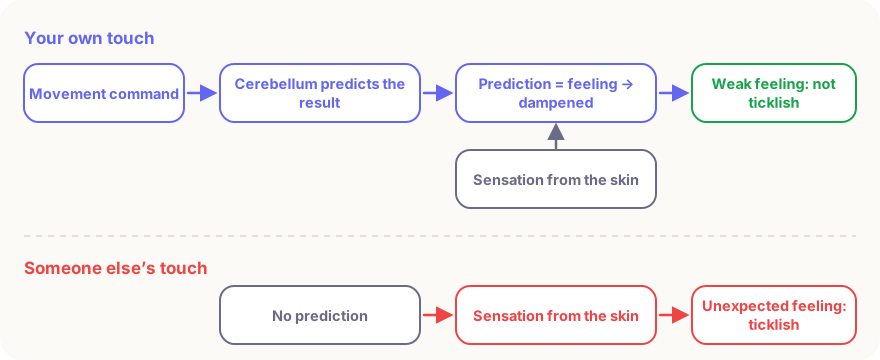
When you try to tickle yourself, your brain knows exactly where, when and how hard your fingers will touch. There is no surprise. The sensation is suppressed and the tickle never happens.
The famous experiment: a tickling robot
To test the idea, in 1998 Sarah-Jayne Blakemore, Daniel Wolpert and Chris Frith at University College London built an ingenious set-up. Volunteers used their own hand to guide a robot arm that stroked their palm with soft foam.
The researchers introduced small mismatches between the movement and the touch:
- When the robot transmitted the movement instantly and in the same direction, people found the touch least ticklish.
- Adding a delay of just a couple of hundred milliseconds, or slightly changing the direction of the stroke, made it noticeably more ticklish.
- The bigger the mismatch, the more the touch felt like someone else’s.
Brain-imaging studies have also shown that the cerebellum and touch-processing regions are less active when we touch ourselves. The brain turns the volume down before the sensation fully registers.
Why does this system exist?
Not being able to tickle yourself might seem trivial. But the system behind it does something vital: it separates sensations we create ourselves from those coming from the outside world.
Without it:
- Every brush of our clothes as we walk would distract us.
- We would struggle to tell whether a touch was our own hand or an outside threat.
- Our own voice would constantly pull our attention while we talk.
By predicting and dampening the consequences of our own actions, the brain saves its attention for stimuli that are unexpected — and therefore potentially important. It is why you instantly notice an insect crawling up your leg.
The same system makes fights escalate
This prediction mechanism has a surprising side effect. In a 2003 experiment, pairs of volunteers took turns pressing on each other’s finger with a device. Each was asked to return exactly the same force they had just felt.
The result: with every round, the force increased. Because the brain dampens the force we produce ourselves, it feels weaker than it really is. Each person believed they were matching the force — but was actually pressing harder.
The researchers noted that this could explain why children’s squabbles of the “He hit me harder!” kind tend to escalate.
People who can tickle themselves
Some people can tickle themselves more easily. Research suggests that some people with schizophrenia — particularly those who feel their thoughts or actions are controlled from outside — dampen their own touch less.
The finding supports an important idea: in these people, the brain system that stamps a movement “made by me” may work differently. That could contribute to experiencing their own actions or inner voice as if they belonged to someone else.
Rats laugh too
Tickling is not unique to humans. In 2016 Shimpei Ishiyama and Michael Brecht at Humboldt University in Berlin showed that rats produce ultrasonic calls of around 50 kilohertz when tickled — far above what human ears can hear.
Tickled rats:
- chased the tickling hand, wanting the game to continue;
- “laughed” most when turned on their backs and tickled on the belly;
- responded far less to tickling when they were in a stressful or frightening setting.
That last finding will sound familiar. Being tickled when you are tense or uncomfortable is rarely fun. For tickling to be enjoyable, the setting needs to feel safe and playful.
Is tickling really fun?
Laughter during tickling does not always mean pleasure. Many people say they want to escape even while laughing. Tickling is therefore seen as a kind of mixed emotion: the laughter is a reflex, but the feeling itself can be unpleasant.
That is why, especially when playing with children, it matters to stop the moment someone says “stop”.
In short
You cannot tickle yourself because your brain predicts the sensations your own movements will cause and dampens them. This prediction system separates self-made sensations from those coming from outside, keeping our attention on stimuli that really matter. Someone else’s fingers, though, are always a bit of a surprise — and the brain’s answer to that surprise is often laughter.
Frequently asked questions
Can anyone tickle themselves?
Some research suggests that in certain conditions, such as schizophrenia, people dampen their own touch less and can tickle themselves more easily. This is linked to differences in the brain’s system for telling who made a movement.
Why are the armpits and ribs most ticklish?
These areas are packed with nerve endings and are vulnerable parts of the body. Some scientists think the tickle response may be linked to learning to protect these spots from childhood.
Does laughing when tickled mean we are enjoying it?
Not always. Laughter during tickling is largely a reflex, and many people say they feel discomfort at the same time. That is why it matters to respect people’s limits.
Is the strange sound of our recorded voice related?
Not directly. Our recorded voice sounds odd mainly because when we speak we also hear our voice through the bones of the skull. But the brain is known to dampen self-produced sounds to some degree, too.
Sources
- Blakemore, Wolpert & Frith (1998) – Central cancellation of self-produced tickle sensation, Nature Neuroscience
- Shergill et al. (2003) – Two Eyes for an Eye: The Neuroscience of Force Escalation, Science
- Ishiyama & Brecht (2016) – Neural correlates of ticklishness in the rat somatosensory cortex, Science
This article is based on peer-reviewed research and publications from trusted institutions, and it is reviewed regularly. How we work →
You might also wonder
All in Brain & Mind →
What Is Déjà Vu? The Science Behind “I’ve Been Here Before”
Why does déjà vu happen? The brain processes and memory theories behind the feeling of having lived a moment before — and when déjà vu can be a warning sign.
Why Do We Dream? What Science Knows About Dreams
What are dreams for, and why do we forget most of them? What the brain does during sleep and the strongest scientific theories about the purpose of dreaming.
Why Do Songs Get Stuck in Your Head? The Science of Earworms
Why does a song loop in your mind for days? How earworms form, which songs stick the most, and the research-backed ways to get rid of them.
Why Do We Forget? The Forgetting Curve and Science-Backed Ways to Remember
Why do we forget what we learn so quickly? Ebbinghaus’s forgetting curve, the main reasons for forgetting, and the study methods that make memories last.

Why Is the Night Sky Dark? Olbers’ Paradox and the Age of the Universe
With billions of stars out there, why isn’t the night sky ablaze with light? Olbers’ paradox, the finite age of the universe and cosmic expansion, explained.

Why Do Leaves Change Colour in Autumn? The Science of Yellow, Orange and Red
Why do leaves turn yellow or red in autumn, and why do trees drop them? The pigments in leaves, colourful autumns and why America is redder than Europe.