Why Does Time Fly When You’re Having Fun? The Psychology of Time
An hour with friends vanishes while a boring meeting drags on. Why our sense of time stretches and shrinks, and why holidays seem long afterwards.
Short answer
Time seems to fly when we are having fun because our attention is absorbed by what we are doing instead of by the passing of time. Many researchers think the brain estimates duration partly by how much attention it gives to time itself, so when we are busy and engaged, fewer “ticks” are noticed and the time feels short. When we are bored, we keep checking the clock and time drags. Looking back, the opposite can happen: a fun holiday full of new experiences leaves many memories and feels long, while monotonous weeks blur together and seem short.
In this article (7)
An evening with good friends ends and you look at your watch in disbelief: where did four hours go? Yet ten minutes in a dentist’s waiting room can feel like an hour. Clocks tick at the same rate, but our experience of time stretches and shrinks dramatically. Psychologists have learnt a lot about why.
Our brain has no single clock
We have no organ that senses time the way our eyes sense light. Instead, the brain estimates duration using several mechanisms spread across different regions, including the basal ganglia, the cerebellum and parts of the cortex. These systems are easily influenced by attention, emotion and memory.
Psychologists also distinguish two very different ways of judging time:
- Prospective timing: judging time as it passes, when you know you will need to keep track, for example while waiting for a bus.
- Retrospective timing: judging afterwards how long something lasted, based on your memories of it.
These two can give opposite answers for the same experience.
While it happens: attention eats the minutes
A popular explanation is the attentional gate idea. Imagine an internal pacemaker that produces “ticks”. A gate controlled by attention decides how many of those ticks are counted. When you pay attention to time, many ticks get through and time seems long. When your attention is absorbed by something else, such as a great conversation, a film or a game, fewer ticks are counted and time seems to fly.
That is why waiting is so painful: there is nothing to do except watch the time. Watching a pot does seem to make it take longer to boil.
Emotions also matter. In a 2007 review, Sylvie Droit-Volet and Warren Meck described how high-arousal emotions such as fear can make the internal clock run faster, so threatening moments feel longer, while pleasant absorption tends to make time feel shorter.
Looking back: memories stretch time
When we look back on a period, we judge its length partly by how many distinct memories it left.
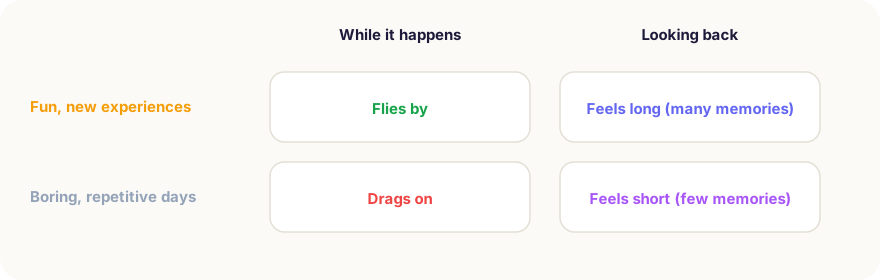
A week of holiday packed with new places, people and surprises flies by at the time, but afterwards it feels long because it produced many vivid memories. The psychologist and writer Claudia Hammond called this the holiday paradox. A month of repetitive routine, on the other hand, can drag while you live it and then seem to have vanished, because the days blur into one memory.
Does time slow down when we are scared?
Many people who have been in accidents say everything seemed to happen in slow motion. Neuroscientist David Eagleman and colleagues tested this in an unusual way.
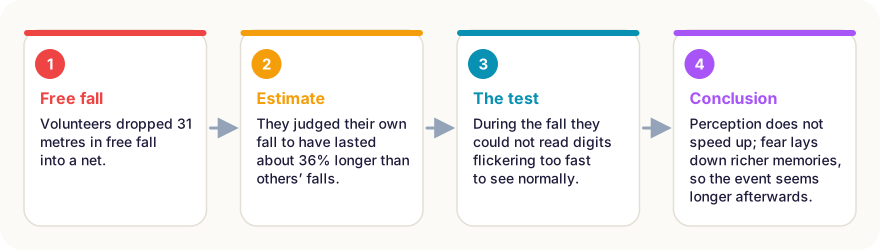
Volunteers dropped backwards from a 31-metre tower into a net. Afterwards they estimated their own fall as lasting about 36% longer than falls they watched others take. To test whether they really perceived more during the fall, they wore a wrist display that flashed numbers slightly too fast to read normally. If time had really slowed down for them, they should have been able to read the numbers. They could not.
The conclusion: in frightening moments, the brain does not speed up its perception. Instead, the amygdala helps lay down unusually rich, detailed memories. When we recall the event, the density of those memories makes it seem to have lasted longer.
Why the years speed up
Many adults feel that years pass much faster than they did in childhood. There are a few explanations, and they may all play a part:
- Fewer new experiences. Children face constant novelty, so their memories are packed with distinct events. Adult routines produce fewer standout memories, so a year seems shorter in hindsight.
- Proportion. For a five-year-old, one year is a fifth of their life. For a fifty-year-old, it is a fiftieth.
- Busy lives. Adults often juggle many tasks, so attention is rarely on the passing of time.
How to make time feel richer
You cannot change the speed of the clock, but you can change how time feels in memory. Novelty is the key: travelling, learning a skill, meeting new people and varying everyday routines all create distinct memories. When you look back, those memories make a period feel fuller and longer.
In short
- The brain has no single clock; its sense of time depends on attention, emotion and memory.
- While it happens, absorbing activities steal attention from time, so it seems to fly; boredom makes it drag.
- Looking back, periods with many new memories feel long, routine periods feel short.
- In frightening moments, the brain records richer memories, not faster perception.
- Years seem to speed up partly because adult life brings fewer novel experiences.
Frequently asked questions
Why do years seem to pass faster as we get older?
One idea is that adults have fewer new experiences than children, so fewer distinct memories are laid down and a year seems shorter in hindsight. Another is that each year is a smaller fraction of a longer life.
Does time really slow down in emergencies?
It feels that way afterwards, but experiments suggest perception does not speed up. Fear makes the brain record memories more densely, so the event seems to have lasted longer when we recall it.
Why does waiting feel so long?
While waiting, we focus on time itself, so we notice its passing in detail. Uncertainty makes it worse: waits feel longer when we do not know how long they will last.
Can I make time feel longer?
To make life feel fuller in hindsight, seek new experiences, travel, learn new things and vary your routine. Novelty creates distinct memories, and those memories make a period seem longer when you look back.
Sources
- Droit-Volet, S. & Meck, W. H. (2007). How emotions colour our perception of time. Trends in Cognitive Sciences
- Stetson, C., Fiesta, M. P. & Eagleman, D. M. (2007). Does time really slow down during a frightening event? PLoS ONE
This article is based on peer-reviewed research and publications from trusted institutions, and it is reviewed regularly. How we work →
You might also wonder
All in Brain & Mind →
Why Do We Laugh? The Surprising Science of Laughter
Most laughter has nothing to do with jokes. Why we laugh far more with others, why laughter is contagious, how it relieves pain, and why apes laugh too.

Why Do We Procrastinate? It’s About Feelings, Not Laziness
Procrastination isn’t a time-management problem: it’s a way of escaping bad feelings. What science says about why we delay and the tricks that help.
What Is Déjà Vu? The Science Behind “I’ve Been Here Before”
Why does déjà vu happen? The brain processes and memory theories behind the feeling of having lived a moment before — and when déjà vu can be a warning sign.

Why Do We Dream? What Science Knows About Dreams
What are dreams for, and why do we forget most of them? What the brain does during sleep and the strongest scientific theories about the purpose of dreaming.
Why Do Songs Get Stuck in Your Head? The Science of Earworms
Why does a song loop in your mind for days? How earworms form, which songs stick the most, and the research-backed ways to get rid of them.
Why Do We Forget? The Forgetting Curve and Science-Backed Ways to Remember
Why do we forget what we learn so quickly? Ebbinghaus’s forgetting curve, the main reasons for forgetting, and the study methods that make memories last.